


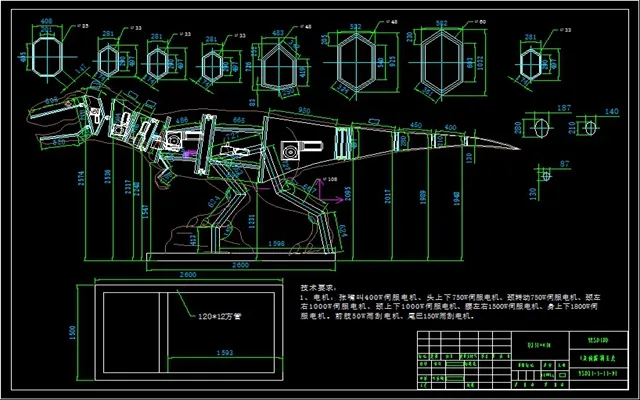
Brief and drawing
Species or character, size, movement list, surface and site conditions are drawn to scale. You approve the drawing before material is cut.
Explore our full range of animatronic products for theme parks, museums, exhibitions, shopping malls and commercial events. We manufacture animatronic dinosaurs, animatronic animals, dinosaur costumes, fiberglass sculptures and custom themed models with support for customization, shipping and installation guidance. Whether you need a single display piece or a complete themed attraction solution, our team can help you choose suitable products based on your project type, space, budget and target audience.
Everything on this page is built in the same factory in Zigong, Sichuan: steel frames welded to a drawing, bodies carved in foam, skins in silicone, fur or fibreglass, painted by hand and programmed before they are crated. The ten lines below are not ten suppliers — they are ten ways of using the same four processes.
| Product line | What it is | Typical buyer | Moves? |
|---|---|---|---|
| Animatronic dinosaurs | Life-size mechanical dinosaurs, any species, 1–20 m+ | Theme parks, museums, touring shows | Yes |
| Animatronic animals | Realistic mammals, birds, reptiles and extinct megafauna | Zoos, museums, malls, hotels | Yes |
| Custom animatronics | Character and film-driven builds — creatures, props, themed figures | Studios, IP holders, attractions | Usually |
| Dinosaur rides | Ride-on animatronic mounts and tracked ride units | Zoos, parks, family entertainment centres | Yes |
| Animatronic insects | Giant beetles, centipedes, butterflies, spiders at 10–20× life size | Science centres, exhibitions, malls | Yes |
| Animatronic dragons | Invented creatures with opening or flapping wings and effects | Theme parks, festivals, stage shows | Yes |
| Fiberglass sculptures | Static realistic figures in FRP, no mechanism | Entrances, gardens, rooftops, trails | No |
| Dinosaur costumes | Wearable realistic suits driven by a performer | Events, festivals, film, brand activations | Wearer |
| Dinosaur puppets | Handheld and shoulder-mounted puppets for close-up work | Museums, educators, performers, resellers | Hand |
| Dinosaur electric cars | Battery ride-on cars in dinosaur shells for operators | Malls, parks, family entertainment centres | Drives |
Swipe the table sideways on a phone.
The same animal is specified differently in five different places. These are the five we are asked about most, and what usually changes between them.
Large, moving, and built to be seen from a distance. The money goes into scale, movement range and a show loop that runs unattended. Skin detail matters less than silhouette and colour contrast against planting.
Smaller, closer, quieter. Visitors stand a metre away, so anatomy, eye detail and paint accuracy carry the exhibit. Movement is slower and more restrained — a museum animal that lunges reads as a toy.
Indoor, temporary, and usually part of a campaign. Weight, floor protection, ceiling height and noise limits decide the build more than the species does. Most of these are demountable.
Outdoors all year, so the surface is silicone or FRP and the control cabinet is sealed and reachable. Interpretation signage usually sits with the animal, which changes the mounting height.
The build has to survive being crated and rebuilt every few weeks. Every section is designed to travel from the start, joints are keyed and numbered, and the crate is part of the design brief.
Short duty cycles, high detail on camera, and controls that a operator can drive live rather than run on a loop. Often a one-off build that never repeats.
Most first orders are a species we already build — a T-Rex, a Triceratops, a panda, a mammoth — because the sculpt, the movement set and the drawing already exist and the only decisions left are size, surface and colour. That is faster and cheaper than starting from a blank page, and it is what we recommend when the animal is one the audience will recognise anyway.
Custom work starts to make sense in three situations: the creature is invented and has no reference sculpt to borrow from; the client is matching a film, game or brand design; or the site needs a figure that does something no animal does — carrying a sign, holding a pose, sitting at a table.
Either way the first deliverable is a drawing. Nothing is carved, welded or moulded until that drawing is signed, which is the point where changes are still cheap.
| Size range | 0.5 m to 20 m+ |
|---|---|
| Frame | Anti-rust treated welded square steel tube |
| Body | Hand-sculpted high-density foam |
| Surfaces | Silicone skin, synthetic fur, shaped feathers, FRP shell |
| Drive | Brushed DC gear motors with relay board; servo for slow or positioned motion |
| Control | Programmable controller, show loop, visitor sensor, staff trigger |
| Power | 110 V or 220 V mains; battery where the unit has to move |
| Operating range | −25 °C to 45 °C |
| Warranty | 2 years on core electronics |
| Minimum order | One unit |
The same six stages apply whether the unit is a 2 m puppet or a 15 m dinosaur. What changes is how long each one takes.
Species or character, size, movement list, surface and site conditions are drawn to scale. You approve the drawing before material is cut.
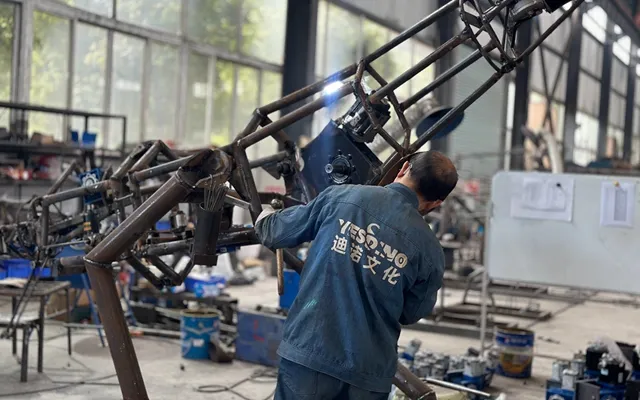
Square steel tube is cut and welded to the drawing, treated against rust, and built with fixing points for the foundation or the crate.
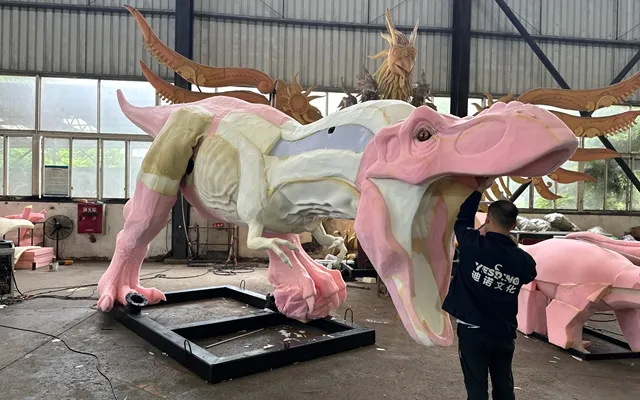
Foam is carved over the frame to the anatomy or the character. Muscle, folds and facial structure are all decided here.
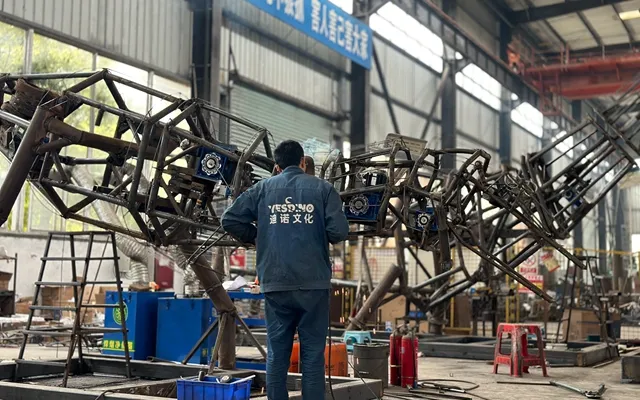
Motors and servos go in at each moving joint, wiring runs inside the frame, and the control cabinet goes where a technician can reach it.
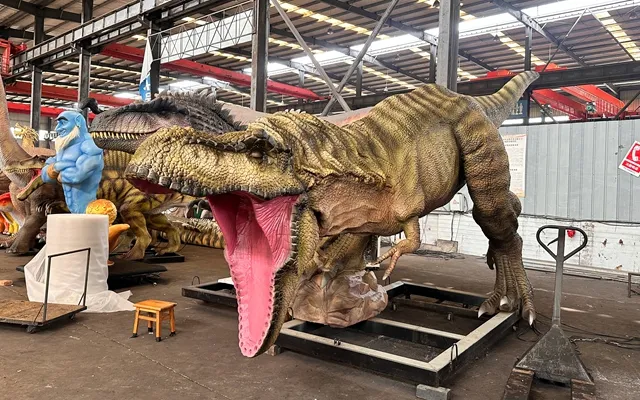
Silicone, fur, feathers or FRP, then translucently painted colour and a topcoat chosen for the climate the unit will live in.
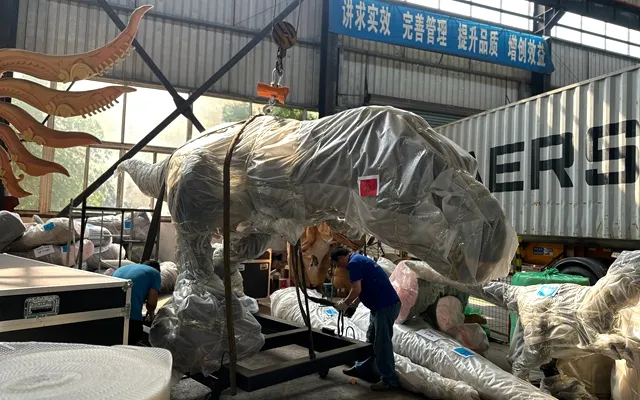
Full movement and sound test, then foam-lined crates with numbered assembly drawings, or our installers on site.
Freight, import duty, destination certificates and installation labour depend on the port, the site and who does the groundwork, so they sit outside the unit price. We list them at quotation stage so the total budget is visible in one document rather than arriving in pieces.
For outdoor units the concrete pad or foundation is usually the largest site cost and belongs to your contractor. Send a photograph of the position with the quotation request and the drawing comes back sized to it.
Describe the venue and what should happen there — where it stands, who walks past it, and what they should do when they see it. We will say which line fits and which does not, including when the cheaper option is the right one.
No. One unit is a normal order across all ten lines. Most first orders are a single piece used to test a trail, a campaign or a season before a larger phase.
Yes, and it is common — a park often orders animals, a sculpture and a costume together so the paint and the finish match. Because the surfaces come from the same material system, a mixed order looks like one production rather than three.
Yes. Rentals, event companies and integrators buy from us and either keep the units or re-let them. Tell us at the quotation stage so the crate and the operating notes suit a unit that travels.
The schedule starts when the drawing is signed, not when the enquiry arrives, because the build follows the approved shape. Schedule is agreed with the quotation and depends on size, surface and the number of moving axes. Changes after the frame is welded move the date.
Packing list, commercial invoice, export documents, wiring diagram, controller notes, spare-parts list and maintenance schedule. Larger builds add numbered assembly drawings and, where the order includes installation, an on-site handover with staff training.
Send the venue type, the space available, the species or character you have in mind and whether it has to move. We will come back with the product line that fits, a written quotation and a drawing.