Production Process
This animal has two things most dinosaurs on a trail don't: a crest that runs across the top of its head like a swept-back fan, and a location story that stops people mid-step. Cryolophosaurus was found in Antarctica — and it lived there when Antarctica was forested, not frozen.
SKU YKL-076: eight metres long, 0.8 m across the body, 2.3 m at the top of the crest.
The crest, and why it's a build problem
The crest sits across the skull, above the eyes, rising vertically and sweeping forward — nothing like the horns or domes of other theropods, which is why the animal picked up the Elvis nickname. It is thin at the top and wide at the base, which makes it the first thing to fail if it is built as a raised ridge in the skin.
We build it as a separate moulded part on a bracket tied into the skull frame, with the skin closing against the base. That keeps the edge crisp, stops the crest flexing when the head turns, and means a knock damages a replaceable part rather than the face of the animal.
Antarctica, 190 million years ago
The animal lived in the Early Jurassic, on a landmass at high southern latitude that carried forests and rivers rather than ice. The site it came from has produced plant material and the remains of other animals, which is what makes the story work in an exhibit: not a dinosaur that survived the cold, but a dinosaur that lived somewhere which later became the coldest place on Earth.
If your display carries interpretive panels, that is the line to build around. It also gives a designer a reason to use a cooler palette — greys and slate blues with a pale underside — which is truthful to the animal's environment and stands out against the usual olive-green trail.
Six movement groups
Head left and right, neck up and down, jaw open and close with a roar, blinking eyes, tail sweep, forearm scratch. The neck group matters more on this animal than usual: the crest is best seen when the head lifts, so the rise-and-hold is the pose to tune. A head that stays level hides the one feature visitors came to see.
Independent drives with end-of-travel protection, triggered from a loop, a sensor or a mat, with speeds set and documented at commissioning.
Where it works
Park trails with a story. Eight metres is a strong mid-trail animal — big enough to be a destination, not so big that it competes with the hero predator at the entrance.
Museums and science centres. The Antarctic connection gives a curator something to say beyond size, and the model carries a "dinosaur discovery" narrative that most species can't.
Winter and ice-themed events. A dinosaur in a cold-weather installation is a pairing that works better than it sounds, and this is the one species where it isn't a design compromise.
Finish and delivery
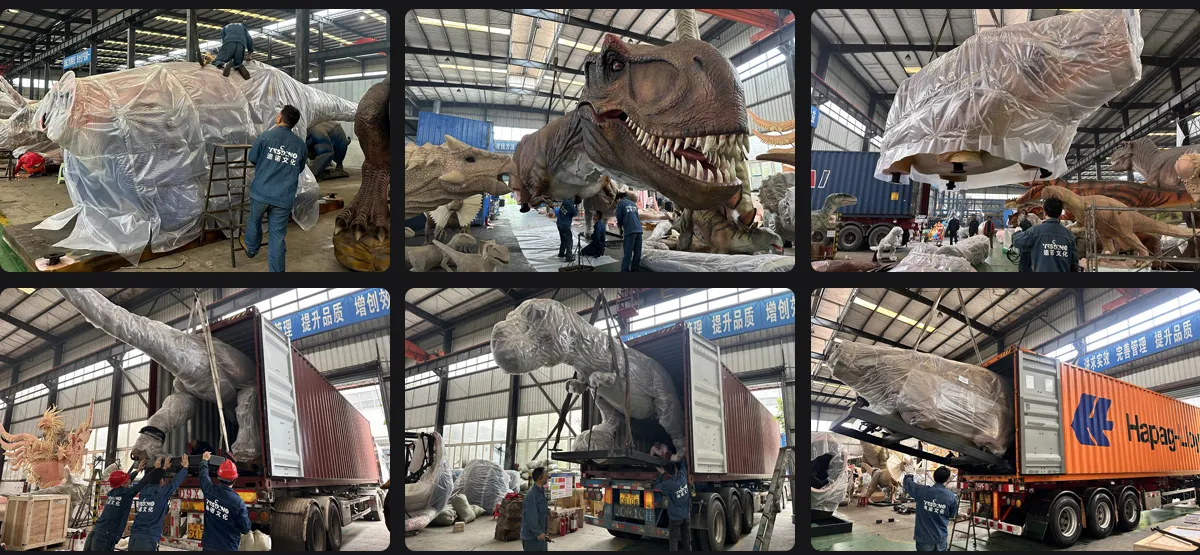
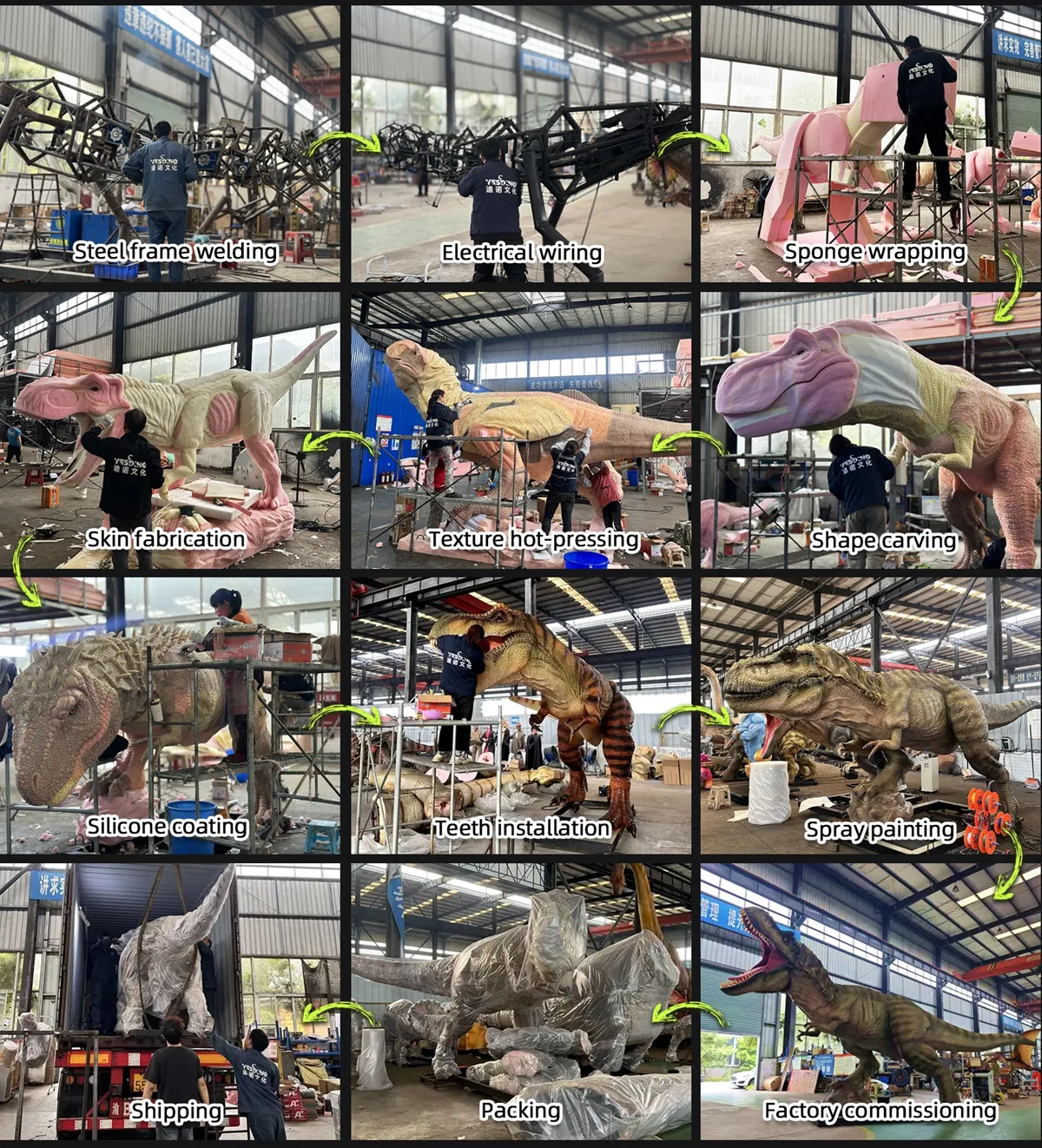
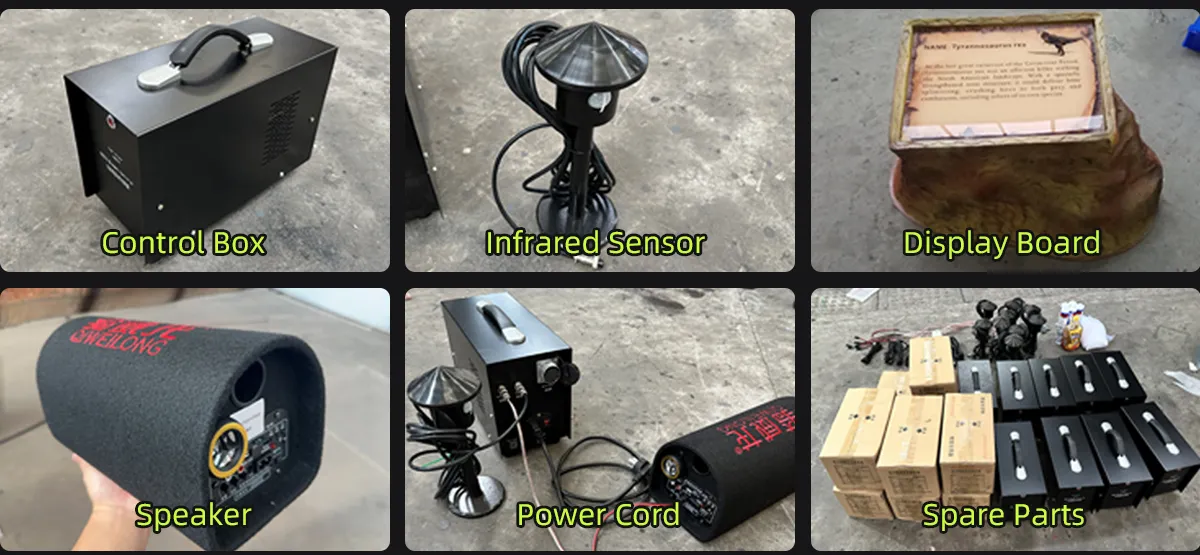
Welded Q235 steel frame with anti-rust treatment, foam volume, silicone five to seven millimetres, translucent layered colour. Rated −25 °C to 45 °C, 110 V or 220 V configured at build. Ships in sections with base frame, control cabinet, sound system, wiring diagram and calibration sheet.
Freight, duties, certificates and installation are quoted separately and are not part of the product price. For a cold-climate site, tell us the winter minimum at enquiry — the standard build covers −25 °C, and sites below that need a different drive specification.
How it was found
The first specimens came out of the Transantarctic Mountains in the early 1990s, from a formation that also produced plant fossils and the remains of other animals. That combination is what makes the site remarkable: it is not a dinosaur that got washed into polar deposits, it is an ecosystem that existed at high latitude.
For a model, the practical consequence is a colour palette. Animals in seasonal, forested environments tend to be countershaded and relatively subdued, and that reads better than the high-contrast scheme a designer might choose for a predator. It also makes the animal distinct on a trail where every other build is olive and ochre.
Enquiry
Send the site photo, the viewing distance and whether the exhibit has a theme beyond dinosaurs. This animal rewards a theme; it looks like a generic predator when it stands in a row of them.
Where to go next
Worth reading before you commit: the spare parts and repair kit list for how the sizes compare, the size guide covering 3 m to 12 m builds for what the ground has to carry, and the rental cost breakdown for where the money actually goes.
For ideas on placing it, see exhibit planning walkthrough. The rest of the range is on animatronic dinosaurs, and if this one is the wrong size for the slot, animatronic carcharodontosaurus for sale is the closest alternative.
Product Accessories
Packaging and Container Loading