


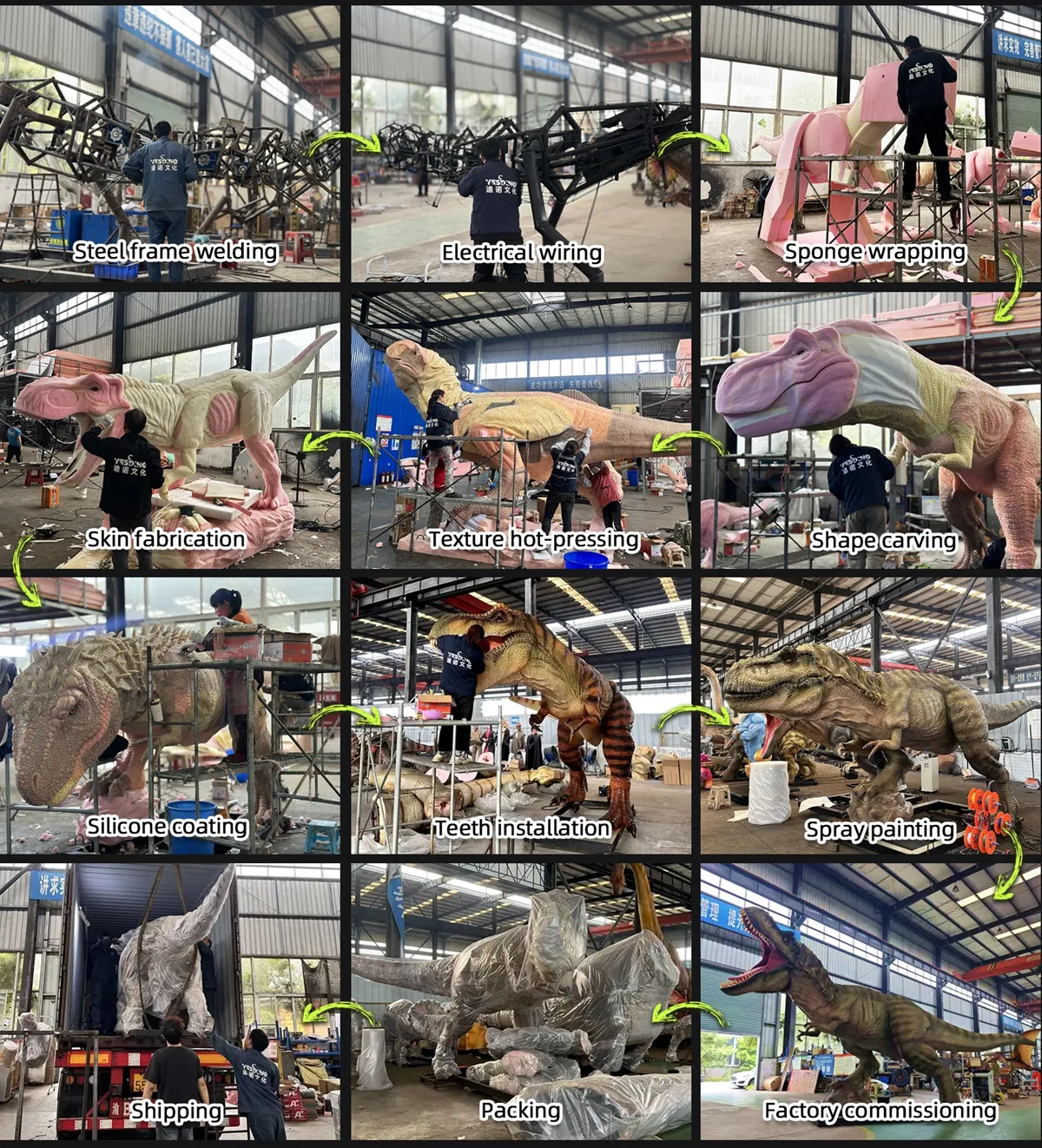
Production Process
Eight metres is the size where Carnotaurus stops being an interesting smaller predator and becomes the animal it actually was: a heavy-headed hunter with horns over its eyes and arms that barely functioned.
SKU YKL-078: eight metres long, 0.9 m across the body, 2.1 m at the head.
The proportions only work at this size
Carnotaurus has a short, deep skull and a thick neck, and both read better on a larger animal. Scale it down to five metres and the head starts to look oversized; at eight metres the mass sits where it should, and the animal reads as something built for impact rather than for speed.
The horns are the identifying feature. They project outward above the eyes, broad at the base and tapering, and in life were probably covered in keratin — which means the fossil gives the core, not the final shape. We build them slightly heavier than the bone profile, which is how they would have looked.
The arms question
Abelisaur forelimbs are reduced almost to nothing — the arm bones are shorter than the skull is deep, and the hand is barely functional. Our default set includes a forearm movement because most buyers want the gesture, and we build it small so it doesn't contradict the anatomy.
If the exhibit is interpretive, specify it off. The arms are then sculpted in a fixed position and the drive is left out, which also removes a service point. Both answers are defensible; long grasping arms on a Carnotaurus are not.
Six movement groups
Head left and right, neck up and down, jaw open and close with a roar, blinking eyes, tail sweep, forearm movement. The jaw travel is short and heavy — a wide gape on a deep skull looks like a puppet — and the neck moves with weight, slower than a raptor of similar height.
Independent drives with end-of-travel protection; loop, proximity sensor or button. On an eight-metre animal the tail covers more ground than visitors expect, so the end stops are set against the barrier line rather than to the full travel.
Skin
Carnotaurus skin impressions show a mosaic of small bumps and ridges rather than smooth scales, which suits a model: texture hides seams and holds pigment unevenly in a way that reads as hide. We build that pebbled surface deeper along the back and finer on the flanks and face.
The usual finish is a muted rust-brown body with darker dorsal banding and a pale underside, horns picked out slightly darker. Pattern, posture and colour are made to order.
Placement and delivery
An eight-metre animal needs a viewing distance of five metres or more to read properly; closer than that and visitors are looking at a joint rather than an animal. Put it at a bend or in a clearing, angled three-quarters to the path.
Welded Q235 steel frame with anti-rust treatment, foam volume, silicone five to seven millimetres, translucent layered colour. Rated −25 °C to 45 °C, 110 V or 220 V configured at build. Ships in sections with base frame, control cabinet, sound system, wiring diagram and calibration sheet. Freight, duties, certificates and installation are quoted separately from the product price.
What it was built to do
Carnotaurus is known from a single well-preserved skeleton from Argentina, and what it shows is an animal built around its head: a deep skull with heavy jaw muscles, a stiffened tail for balance, and hind limbs proportioned for running. The horns and the reduced arms are the parts everyone remembers, but the engineering is in the skull and the tail.
For an exhibit, that gives you a line that isn't about size. This was a hunter that ran, and the model should be posed accordingly — body level, head forward, tail straight. A Carnotaurus in a rearing pose contradicts the one thing the skeleton makes clear.
Enquiry
Tell us the viewing distance and whether the arms should move. Those two answers settle most of the build.
Where to go next
Two things come up in almost every enquiry on this build: how the size compares with the alternatives, and what it takes to get it on site. The rental cost breakdown sets out the length options side by side, and the pneumatic versus hydraulic comparison covers pads, access and assembly. Budget planning sits in the installation guide for pads and access.
For ideas on placing it, see layout strategies for themed trails. The rest of the range is on animatronic dinosaurs, and if this one is the wrong size for the slot, animatronic stegosaurus for sale is the closest alternative.
Product Accessories

Packaging and Container Loading



