
Animatronic dinosaurs · manufacturer
Animatronic Dinosaurs
Welded Q235 steel frame, carved foam, 5–7 mm silicone skin, brushed DC drive. Built in our own workshop in Zigong for theme parks, museums, malls and events — with installation handled by our crew.
3–16 m
Length range built
4–7 joints
Typical movement set
110 / 220 V
Rated −25 °C to 45 °C
2 years
Warranty on electronics
What an animatronic dinosaur actually is
Not a statue with a motor bolted on. A welded steel frame carries the load, carved foam gives it volume, and a silicone skin 5–7 mm thick covers the result. The colour is built up in translucent coats rather than sprayed on as a single finish, which is why the surface reads as skin under direct light instead of painted plastic.
Movement comes from DC motors through a relay control board, programmed to a fixed cycle or triggered by a sensor. That is the whole machine. Everything that varies between one quote and another — and between one supplier and another — sits in how those four parts are executed.
On this page
Types and sizes: what the range covers
Length is the number most buyers start with, and the one that decides the least. A 4 m Velociraptor and a 4 m Triceratops share a length and almost nothing else: one is a biped on two legs with a counterweighted tail, the other a quadruped carrying a heavy skull and frill. Joint count, frame layout and skin area all follow the species, so two animals of identical length can sit far apart in price.
Orders cluster into four bands. The table describes what each band is usually built for and what changes technically — not a catalogue limit.
| Length band | Where it usually goes | What changes technically |
|---|---|---|
| Under 5 m | Indoor exhibits, mall atriums, photo zones, stage shows | Lighter frame, 3–5 joints, single-phase power, often movable on castors by two people |
| 6–8 m | Theme parks, dinosaur parks, museum halls | The most common band. Base plate or ground anchor required; skin area roughly doubles against the 4 m class |
| 10–12 m | Outdoor set pieces, entrance landmarks, roadside attractions | Frame splits into transport sections; crane or forklift on site; wind loading becomes a design input |
| 12 m and above | Signature centrepieces, long-neck species, drive-through routes | Engineering review before quoting; multiple transport units; crew on site for several days |
Band by band detail is in the 3 m to 12 m size guide. Every model in production is listed in the animatronic dinosaur range.
Which species suits which brief
Species is not a free choice — it is a shape, and the shape dictates what the animal can do convincingly. These eight come up most often, and this is where they usually end up.
| Species | Lengths usually ordered | Where it works best | Movement worth paying for |
|---|---|---|---|
| Tyrannosaurus | 5 m to 12 m | Entrance landmark, outdoor park, any photo zone | Jaw, head, tail — the whole silhouette reads from far away |
| Triceratops | 4 m to 8 m | Family-facing exhibits, museums, mixed herds | Head turn; the frill is the read, movement is secondary |
| Velociraptor | 3 m to 5 m | Photo zones, indoor corridors, close visitor contact | Eyes, forelimbs, tail — it is seen at two metres, not twenty |
| Spinosaurus | 8 m to 16 m | Water features, lakeside routes, ride-through sections | Neck and jaw; the sail needs no movement to read |
| Brachiosaurus | 10 m to 16 m | Open landscapes, drive-through routes, tall atriums | Neck. Without neck movement it is a very large statue |
| Stegosaurus | 4 m to 8 m | Children's areas, mixed exhibits, walkway edges | Head and tail; the plates do the work |
| Ankylosaurus | 4 m to 7 m | Low sightlines, museum floors, herd groupings | Head and tail club; body is close to the ground already |
| Carnotaurus | 5 m to 8 m | Themed walkways, event stages, close-up horror beats | Jaw and head; the horns need a low angle to read |
Two things worth saying plainly. A species with a long neck costs more at the same length, because the neck has to be engineered to travel and the transport sections get longer. And a small predator is not a cheap large one — at 4 m the joint count and surface detail start to matter more than the frame, so the price gap between a good 4 m piece and a poor one is proportionally wider than it is at 12 m.
Movement options, and what each one costs you
"How many movements" is the second question after size, and the answer is not "as many as possible". Every joint adds a motor, a linkage and a control channel, and every one of those is a part that can wear. Most builds take four to seven of these.
| Movement | What it does | When it is worth paying for |
|---|---|---|
| Head turn | Left-right sweep, sometimes with a slow pause | Almost always. The cheapest way to make a still figure read as alive at distance |
| Jaw | Open and close, synced with a roar in most builds | Predators and anything photographed head-on. Adds a motor and a linkage in the skull |
| Eyes | Blink, plus optional LED | Close-viewing venues only. Invisible from 15 m, so it earns nothing in a drive-through park |
| Neck | Up-down or side motion at the base of the neck | Sauropods and anything tall. Without it a long-neck piece reads as a statue |
| Tail | Side sweep, one or two segments | Bipeds. Balances the silhouette and hides a static body |
| Forelimbs | Raise, lower, grip | Photo zones where visitors want a pose to react to |
| Body rise | Breathing motion through the torso | Indoor and close range. The most expensive add-on per unit of visible effect |
| Sound | Roar, breath, footstep | Cheap relative to mechanical joints and the effect is large. Watch local noise limits |
Standard drive is a STC89C52 board switching relays; on most builds the joints run on 450 W brushed DC motors. Where a joint has to hold position or travel slowly and evenly, servo drive with its own controller is specified — a different cost class, not a small upgrade. The mechanism breakdown covers the hardware.
Watch them run: four builds, two drive types
Photos show the skin. These clips show what the joints actually do under load — including the servo-driven builds, where a movement has to travel slowly and stop without overshoot. Pick a clip on the right.
7 m Tyrannosaurus · servo drive
Head, jaw, neck, tail, forelimbs and sound. Servo joints travel slowly and hold position — the reason the head does not snap between poses.
The two longer builds run on servo drive with matched controllers rather than brushed DC through relays. It is a different cost class, and it is why those movements look slow and deliberate instead of jerky — a servo can be told to hold a position, which a relay-driven motor cannot. The other two are specified differently, and the clips show how the motion reads either way.
Venue by venue: the same animal, four different specs
Where the piece stands decides more of the spec than the species does. Each of these briefs shifts money to a different part of the build.
OUTDOOR · YEAR ROUND
Theme and dinosaur parks
Seen from a walkway, not touched. Sealing at the cable entry and control cabinet matters more than fine skin detail, because nobody studies texture from 20 m away. Movement range has to read at distance, so head sweep and jaw beat blink every time. Base and anchoring are design inputs, not accessories.
INDOOR · CLOSE VIEWING
Museums and science centres
Detail pays off here and movement often comes down rather than up — head, neck and tail only, so the piece reads as a specimen instead of a ride. Drive noise carries in a closed hall, which is worth planning for on a large animal. Ceiling height limits how far a neck can travel.
TEMPORARY · FIXED DATES
Malls, events and campaigns
Short install window, atrium sightlines from several floors, and a removal date already in the calendar. Sectional frames and castors save more money here than any material upgrade. Layout planning matters more than the animal itself — see the park layout guide.
LANDSCAPE · MIXED WITH LIVE ANIMALS
Zoos and scenic areas
The brief changes when the piece sits beside real animals: it has to belong to an existing landscape and read as an installation rather than a fairground prop. Quieter drive, matte finish and restrained movement usually win over extra joints.
How it is built: eight stages on our own floor
Sculpting, framing, skinning, wiring and testing all happen in the same workshop. Nothing is subcontracted to a second party, which is why a specification change mid-build can be absorbed instead of turning into a re-quote.


Packing follows testing: sections are braced, wrapped and crated for export, with the control cabinet and loose parts boxed separately. Large animals travel as several units and are assembled on site, which is why the access route gets checked before production rather than after.
What drives the price, in the order it moves
Four variables account for most of the difference between one quote and another.
Size, and with it skin area
Skin is surface, and surface grows faster than length. Doubling the length of an animal roughly quadruples the area that has to be carved, coated and painted.
Joint count
Every joint is a motor, a linkage, a control channel and a future maintenance point. Going from four movements to seven is a structural step, not a trim option.
Surface detail
Scale pattern, teeth, tongue, jaw interior, the translucent colour coats. This is hand work, and it is where cheap builds look cheap up close.
Indoor or outdoor service
Sealing, base design, wind load and UV-stable coating. None of it is visible in a photo, which is why it is the first thing cut when a specification is copied from a cheaper quote.
Inside the workshop, cost divides into material, labour and overhead, and the proportions tell you where the money sits. Material is roughly 45%, labour roughly 40%, overhead the remaining 15% — of cost, not of selling price. On a large animal the skin is the biggest single material line, and within the skin the silicone is the expensive part, not the foam: on an 8 m T-Rex the carved foam is a small item, while the silicone with its tinted translucent coats is the line that runs into the thousands of yuan. A supplier who tells you "special foam" is the expensive part has the structure backwards.
The cost breakdown walks through the full structure. What we do not do is fold freight, duty, certification and installation into the product price and present one rounded figure — those are real costs, but they are not the product, and hiding them makes comparison between suppliers impossible.
What the quote covers, and what it does not
Almost every misunderstanding in this trade comes from this table, so here it is in two columns.
IN THE PRODUCT PRICE
Framed and skinned animal, wired and tested
Specified movement set and control system
Remote or sensor control as specified
Export packing for the transport units
Two-year warranty on core electronics
OUTSIDE THE PRODUCT PRICE
Freight and insurance
Import duty and taxes at both ends
Certificates required by your market
Installation: crew travel, crane or forklift, local labour, power and water on site
Site works: foundations, footings, access preparation
Delay costs from permits, weather or site conditions
This is not a way of inflating the product figure. It is the opposite: the animal is priced as an animal, and the project costs stay visible so you can compare them against your own contractors. Budget the right column before you commit — on a long-haul project it is a real part of the total.
Site preparation: what we need before the truck arrives
Six items decide whether installation takes a day or a week. All of them are cheaper to settle before production than after the crate lands.
| Item | What to send us | Why it matters |
|---|---|---|
| Access route | Door width, lift size, gate width, turning space for a truck | A section that will not pass a doorway stops the install on day one |
| Ground | Photos of the surface, and what is under it | Concrete slab, paving, grass and decking take different bases; soft ground outdoors needs load and wind design |
| Sightlines | Closest and furthest viewing distance | Sets how much skin detail is worth paying for and how much movement range is needed |
| Power | Voltage, distance to the nearest supply, whether it stays live after hours | A controller on a switched circuit resets every night and loses its programme |
| Weather | Rainfall, salt air, frost, direct sun hours | Each one changes the sealing spec. See waterproofing an animatronic dinosaur |
| Who services it | Whether you have on-site technical staff | Decides how much of the maintenance routine we document for you, and what spares ship with the unit |
Maintenance: a routine that costs a morning a month
The failures we see are boring and predictable: a seam that opened, a joint that seized from standing still, a cabinet that took water. None of them need a technician to prevent.
| Interval | What to do |
|---|---|
| Daily, in season | Run the full movement cycle once before opening; listen for a change in sound |
| Monthly | Check seams and the base seal; wipe the skin; confirm the cabinet is dry and the door gasket seats |
| Before winter | Re-seal the jaw hinge and base seams; check for water tracks inside the cabinet; confirm drainage around the base |
| Off season | Exercise the mechanism monthly rather than leaving it still — idle joints are the ones that seize |
| Spares | Keep a relay, a motor of the same rating and a set of linkages. See the spares list |
Models currently in production
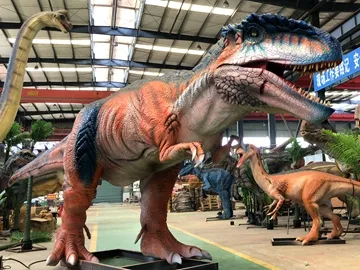
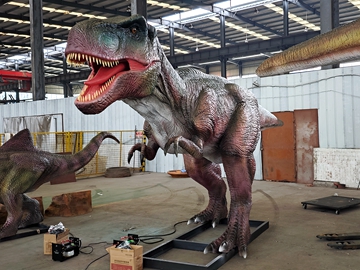
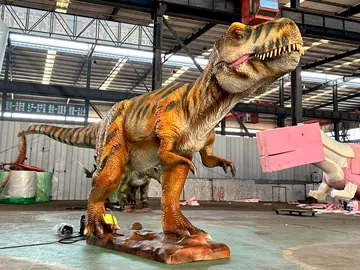
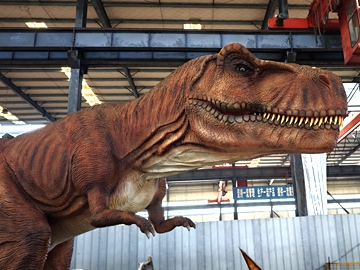
A selection from the range. Any species can be sculpted from reference if what you need is not shown.
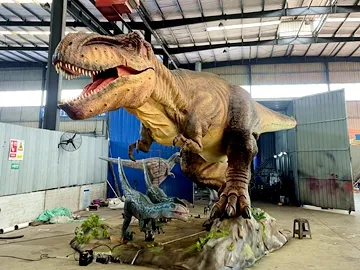
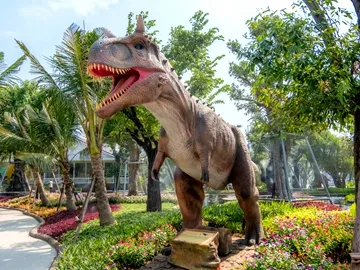
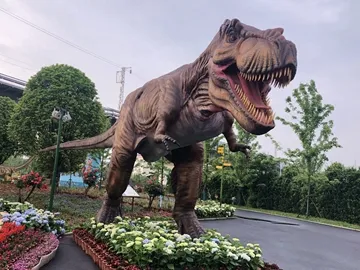
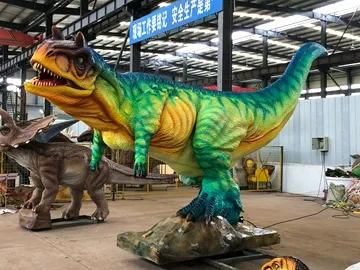
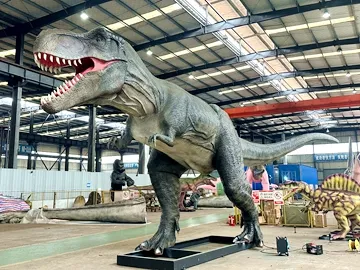
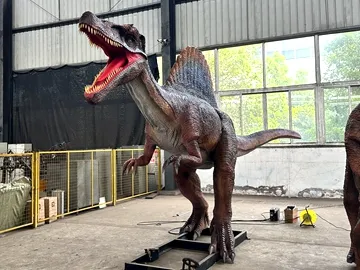
See all animatronic dinosaurs →
Frequently asked questions
What is an animatronic dinosaur made of?
A welded Q235 steel frame, carved foam for volume, and a 5–7 mm silicone skin with translucent colour coats layered on top. Joints run on DC motors through a relay control board.
How long does a custom build take?
It depends on size, joint count and how fast the design is approved. Design sign-off moves the date most, not workshop capacity. The lead time breakdown covers the stages.
Can one animal be used outdoors all year?
Yes, with sealing at the cable entry, the control cabinet and the base. The skin and frame are built for outdoor service; the electrical enclosure is where water gets in if it is going to.
How many movements should we order?
Four to seven covers most builds. Head, jaw, tail and sound give the biggest visible return per unit of cost. Blink and body movement only pay off when visitors get close.
Do you install on site?
Yes, with our own crew. Installation is quoted separately from the product price, and the site checklist above is what we need from you before the crew travels.
What does the warranty cover?
Two years on the core electronics. Skin and mechanical wear parts are consumables with a documented maintenance routine rather than a warranty item. Details are in the warranty terms.
Can the design be changed mid-production?
Colour and small detail changes usually can be absorbed. Changes that touch the frame or joint layout affect tooling already built, so they are re-quoted rather than absorbed.
How is a large animal shipped?
In sections sized to the transport unit, crated for export. A 12 m piece travels as several units and is assembled on site, which is why the access route gets checked first.
Can we visit the factory?
Yes. Take the factory tour as a first look, then arrange a visit to see a build in progress.
Do you make species not shown on the site?
Yes. Any species can be sculpted from reference material; everything currently in production is listed in the animatronic dinosaur range.
Tell us the species, the length and the site
We will come back with what the build involves — joints, skin, base, access and the numbers — before anything is committed. Photos of the space are more useful than a long email.