

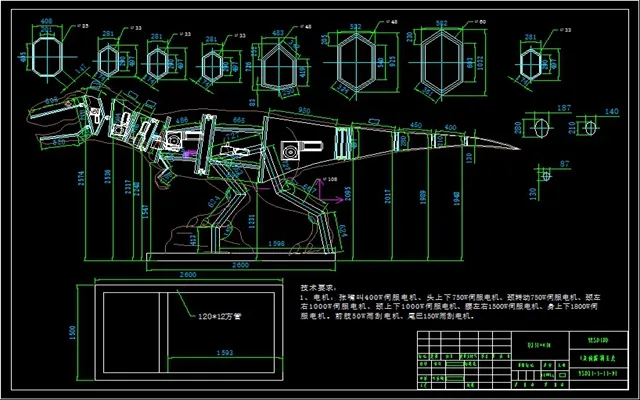
Measure and draw
Performer measurements go onto the drawing with the species proportions, the sight lines and the head pivot position. You approve the drawing before sculpting starts.
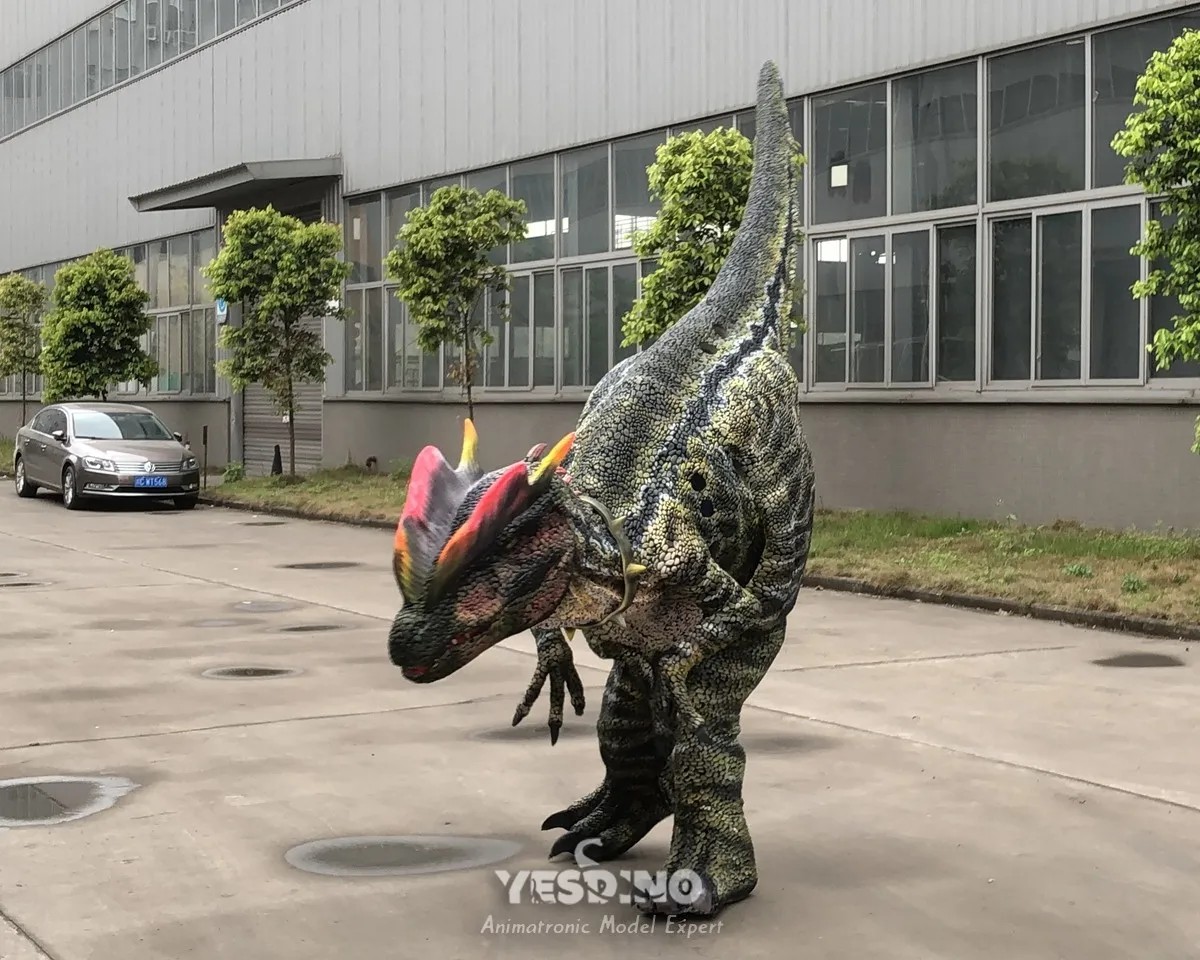
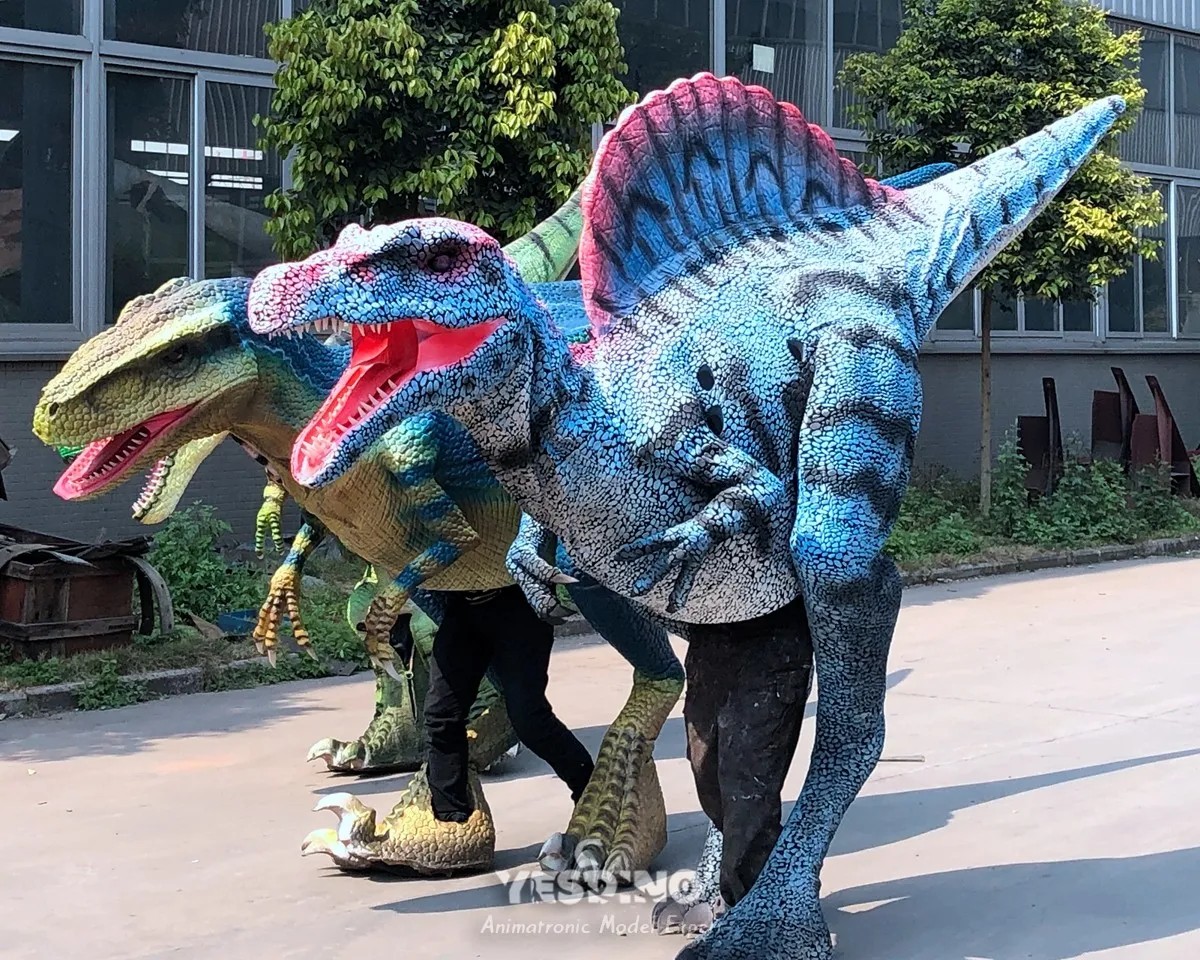
Our realistic dinosaur costumes are designed for stage performances, exhibitions, theme events and commercial promotions. They are lightweight, flexible and easy to operate, helping performers create vivid and interactive dinosaur experiences. We offer popular species such as T-Rex, Velociraptor, Triceratops and Carnotaurus, with worldwide shipping available.
A realistic dinosaur costume is a wearable suit that puts a performer inside a sculpted body, so the animal walks, turns its head, blinks and reacts at human speed. It is not a mascot suit scaled up, and it is not an inflatable. The useful distinction is mechanical: a costume has a rigid frame carrying the weight, a skin stretched over it, and a person whose hands and legs drive the animal from inside.
Buyers judge a costume from photographs, which means the skin and the paint get all the attention. In service, the frame decides almost everything. A fibreglass and aluminium shell spreads the load across the performer's shoulders and hips; a soft suit hangs it all on the shoulders. That single difference sets how long a performer can work, how quickly they can turn, and whether the suit survives a season of hotel appearances.
On our suits the frame is a lightweight alloy and fibreglass shell, padded at the shoulders, chest and hips, with the head carried on a pivoting collar rather than on the wearer's neck. The wearer holds two hand grips and looks out through mesh panels set into the neck and the jaw line, so the head can move without the sight line moving with it.
A costume works because the proportions are wrong for a human. The head sits forward of the performer's head, the torso is deeper than a person's chest, and the legs are set wide. From three metres away the brain reads it as an animal; the illusion breaks mainly at the hands and the feet, which is why good suits hide both — forelimbs are short and non-weight-bearing, and the feet are oversized sculpted boots with the wearer's own foot inside.

The outer layer is a stretch silicone skin with translucent colour coats, the same material system used on our large animatronic models. It wrinkles at the joints, holds a matt finish outdoors, and can be patched locally instead of replaced.
| Type | How it moves | Where it works | What it does not do |
|---|---|---|---|
| Silicone / fibreglass realistic suit | Wearer-driven legs; head, jaw, eyes and tail on internal rods or small servos | Theme parks, festivals, film, brand events, museum programming | Long continuous wear in heat without a fan and a planned rotation |
| Inflatable suit | Constant blower pressure holds the shape; the wearer shuffles inside | Party hire, fun runs, low-cost photo moments | Close-up realism, fine head movement, calm wind conditions |
| Mascot costume | Foam shell, fixed face, wearer's arms are the character's arms | Retail promotions, character meet-and-greet with children | Looking like an animal rather than a cartoon |
| Animatronic model (not wearable) | Motors and pneumatics on a steel frame, remote or show-controlled | Fixed exhibits, parades on a float, stage shows | Walking through a crowd, improvising with visitors |
Swipe the table sideways on a phone.
If the booking is a walkabout act that has to hold a crowd for twenty minutes, the realistic suit is the only one of the four that does the job. If the animal has to stand in one spot all season, a model is cheaper per hour of operation. The costume feature page goes deeper on performer experience; the models are on the animatronic dinosaur range.
These are the six things that decide whether a suit gets used every weekend or ends up in storage. We design against all six, and we will tell you which ones your site makes harder.
A sealed suit is a greenhouse. Every suit we build carries a fan in the head or chest with an intake that cannot be blocked by the wearer's arms, and the battery for it sits in a hip pack so the weight is not on the neck.
The wearer cannot see through the eyes. Mesh windows sit in the neck sides and under the jaw, and a handler walks ahead at events. We mark the field of view on the drawing so you can see what the wearer will and will not see before you sign off.
The head is the heaviest single part. Carrying it on a pivoting collar instead of the neck is what makes a two-hour event possible; the trade is a slightly larger shoulder profile, which the skin hides.
The fan, the head servos and the sound module run from a rechargeable pack. We size the pack to the length of your show rather than to a fixed number of hours, and a spare pack swaps in without taking the suit off.
A costume is entered through a back or side opening with the frame already assembled around the wearer. One assistant is enough. Practise the entry before the first event — it is the step that takes longest on the day.
Skin wipes down, mesh panels rinse, joints get checked for loose fasteners. The parts that wear are consumables we stock: fans, mesh, hand grips, servo horns. A suit that is cleaned after each event lasts several seasons.
The species you pick changes the wearer's job. A short, deep-bodied animal is harder to balance than a long, low one, and a big head costs more than a small one in both weight and price.
The crowd-pleaser and the heaviest head in the range. The body is deep, so the wearer's stride shortens and turning takes a wider arc. Best for open floor space and staged appearances rather than weaving between tables.
Lower, faster and easier to wear. The head is light, the sight lines are better because the neck is longer, and the suit reads well in close-up. The usual choice for film work and for acts that need to move through a crowd.
The frill moves the weight forward and outward. It is a stable suit to stand in and a slow one to turn, which suits photo areas and museum programming better than walkabout.
Narrow body, short forelimbs, a head that reads as aggressive from the side. Popular for horror-themed events because the silhouette is lean and the movement is quick.
Other species are built to order — Spinosaurus, Parasaurolophus, Dilophosaurus, Ankylosaurus and fantasy creatures. The constraint is not the sculpt; it is whether the wearer can carry the head and still see. We will say so before you order rather than after.
The finished animal size follows from the wearer's height, not the other way round. A 1.75 m performer in a T-Rex suit produces a 2.2–2.5 m animal; put a 1.9 m performer in the same shell and the proportions change with them. That is why we ask for the height, shoulder width and shoe size of the person who will actually wear it, and why a suit bought for one performer is not automatically right for their replacement.
Send the measurements with a reference photo of the animal you have in mind and we return a dimensioned drawing before anything is cut.
| Product type | Wearable realistic dinosaur costume |
|---|---|
| Species | T-Rex, Velociraptor, Triceratops, Carnotaurus, Spinosaurus, Parasaurolophus, custom |
| Animal height | 2.0 m – 4.5 m, set by wearer height and species |
| Shell | Lightweight alloy frame with fibreglass panels |
| Skin | Stretch silicone with hand-painted translucent colour coats |
| Movement | Head turn, jaw, eye blink, tail sway; arm and neck rods manual or servo-assisted |
| Wearer support | Padded shoulder and hip harness, hand grips, pivoting head collar |
| Ventilation | Fan with shielded intake, battery in hip pack |
| Sound | Optional speaker module with triggered roars |
| Use | Indoor and outdoor; light rain only, not standing water |
Same workshop as the large models, which is why the skin and the paint match. The difference is that every stage is checked against a person's body rather than a steel base.
Performer measurements go onto the drawing with the species proportions, the sight lines and the head pivot position. You approve the drawing before sculpting starts.
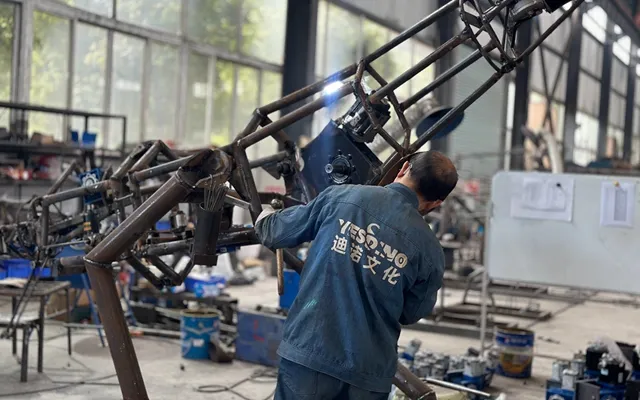
An alloy frame is built to the wearer's shoulder height, then fibreglass panels are laid over it to hold the body shape and carry the head's weight.
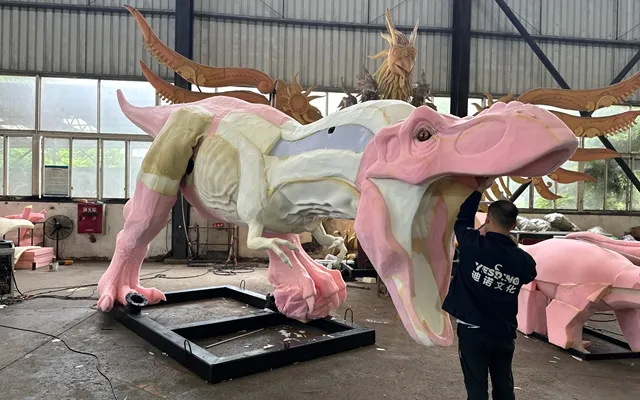
Foam is carved over the shell for muscle and skin folds. The jaw, brow and nasal ridges are exaggerated slightly — a true-scale head reads as flat from three metres away.
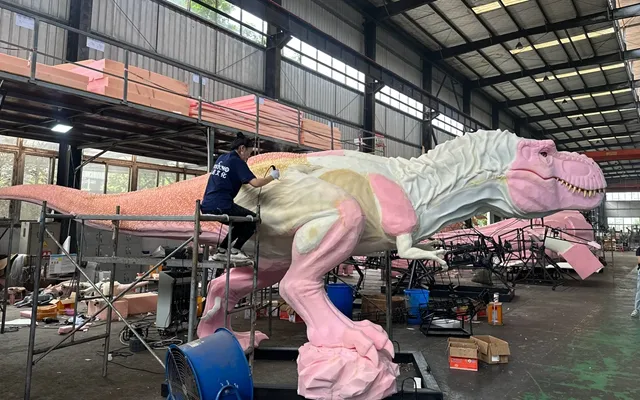
Stretch silicone is laid over the sculpt with scale texture pressed in by hand. Panels at the joints are cut on a curve so the skin folds instead of tearing when the wearer moves.
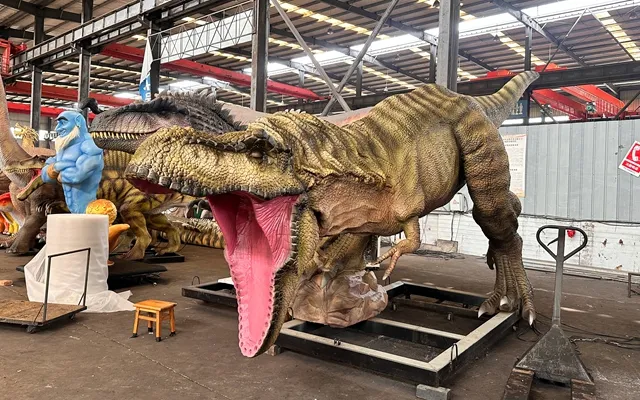
Translucent colour coats go on in layers so the skin keeps depth instead of looking like painted rubber. A matt sealer goes over the top for outdoor use.
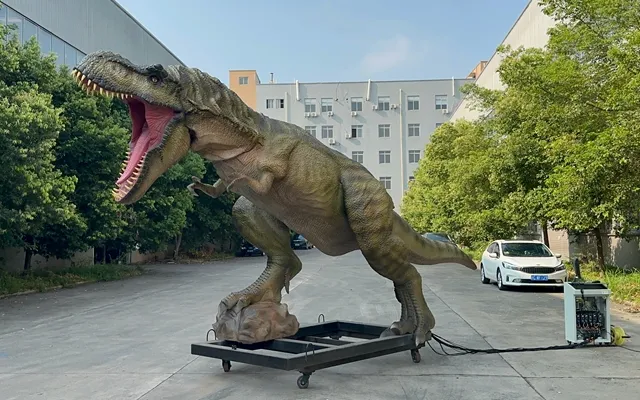
The wearer gets in. Head travel, jaw clearance, fan airflow and the field of view are checked, then adjusted. The suit ships in a padded crate with the harness, battery, charger and spare mesh.
Freight, import duty, destination certificates and on-site setup sit outside the product price, so they are quoted separately or handled by your side. We list them up front so the budget you take to your finance team is the whole number, not the factory number.
One unit is fine — there is no minimum order. Most first orders are a single suit plus a spare battery, and a second suit follows once the act is booked.
The price is set by species, animal height, how many movements are powered, the level of skin and paint detail, and whether sound is included. Because those choices vary per order, we quote per project rather than publishing a list price. Send the species, the wearer's measurements and the show length, and you get a written quotation with a dimensioned drawing.
Yes for short appearances, but a handler is what we recommend for events. The wearer's sight lines are through mesh windows at the neck, not the eyes, so somebody walking ahead keeps the path clear and answers questions from the public.
It depends on ambient temperature, the fan setting and the individual. Rather than quote a fixed number, we size the battery pack and the fan to the session length you tell us, and most operators work in rotations with a second wearer or a rest period. Outdoor summer events are the case to plan around, not indoor ones.
Light rain is fine; standing water and heavy downpour are not, because water reaches the fan intake and the head servos. If your calendar is mostly outdoor, tell us at the design stage — we change the intake position and the sealer, and that is cheaper than fixing it later.
The skin wipes down with a damp cloth and a mild detergent, mesh panels rinse and dry flat, and the suit hangs on its internal frame rather than folding. Store it dry, out of direct sun, with the battery removed. The handler notes that ship with the suit list the order to do it in.
Yes. Send a reference photo, a sketch or a colour direction and we sculpt to it. Custom colour work costs less than custom sculpting, so if the budget is tight, start from a species we already build and change the palette.
Send four things — species or a reference photo, the wearer's height and shoulder width, indoor or outdoor use with the event country, and how long each session runs — and we will come back with a written quotation and a drawing showing what the wearer will see and carry.