

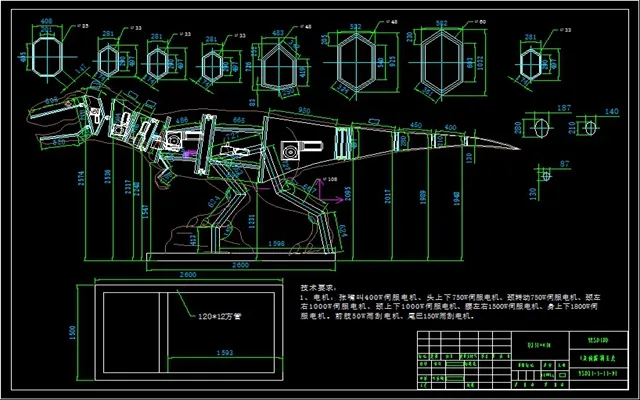
Concept and drawing
Your reference becomes a dimensioned drawing with the wing behaviour, the movement list and the mounting fixed. This is the stage to change your mind at.
Professional manufacturer of lifelike animatronic dragons for sale, including electronic moving models & flying dragon props. Customizable life-size exhibition creatures for theme parks, films, and events.
An animatronic dragon is a life-size mechanical creature with no fossil to copy, which makes it a different engineering brief from an animatronic dinosaur. There is no correct anatomy to be measured against, so the buyer is buying a silhouette, a movement vocabulary and an effect — wings that open, a head that tracks a crowd, sometimes fire. What has to be right is the mechanics behind those three.
A dinosaur is mostly a body with a head on the end. A dragon adds three expensive problems: wings that have to hold a shape under load, a neck that is long enough to need counterbalancing, and an effect system if fire or smoke is specified. Each of those is priced separately because each one changes the frame.
The other difference is that a dragon is nearly always a focal point rather than part of a set. It stands in an atrium, at the head of a queue line, or on a stage, and it is designed to be photographed from one specific direction. That lets us put the detail budget where the camera is instead of spreading it around a full body — which is how a dragon ends up looking more expensive than it is.

Head, jaw, brow ridge and chest carry the sculpting and paint detail. The flank and the far side can be built simpler, which is where a dragon budget is usually saved.
There is no way to add wings to a finished frame. Choose the wing behaviour first, then the size of the creature follows from it.
Wings stay furled and open on a cue — a reveal, a photo moment, a show start. The mechanism is a single pair of actuators with a lock at full extension, which keeps weight and cost down.
Best for: entrances, stage reveals, mall atriums.
Two or three flaps per minute, built to look heavy rather than fast. Membrane panels are tensioned so they do not slap together at the bottom of the stroke, and the frame is braced for the torque.
Best for: large creatures meant to feel enormous.
Wings fixed open as sculpture. No mechanism, no maintenance, and the cheapest way to get the silhouette. Most outdoor seasonal pieces use this and put the movement into the head and neck.
Best for: outdoor installations, rooftops, parade floats.
A fourth option exists and is worth asking about early: a suspended dragon with moving wings and a static body, hung from a ceiling structure. It removes the base and the legs from the budget and puts the movement where people look — overhead.
| Effect | How it behaves | What it needs from the site | Indoor / outdoor |
|---|---|---|---|
| Fire burst from the mouth | Short, timed bursts triggered with the roar; not a continuous flame | Clearance above and in front, a fuel line or cartridge access, a fire plan and a trained operator | Outdoor and large atriums; check local rules before specifying |
| Cold mist or fog | Low-lying mist from the mouth or the chest, harmless to touch | Fluid reservoir access and a drain path; indoor spaces need ventilation | Both |
| LED eye and chest glow | Programmed with the movement; colour change on cue | Nothing beyond mains power | Both — the safest effect to add |
| Sound | Roar, breath and footsteps from speakers in the body, triggered from the same controller | Volume limit agreed with the venue; the operator can cap it | Both |
Swipe the table sideways on a phone.
Fire is the one line item that is decided by your venue rather than by us. If the site cannot support it, a mist and light combination reads convincingly at night and costs far less to run — and it does not need an operator standing by with an extinguisher.
| Product type | Life-size animatronic dragon / fantasy creature |
|---|---|
| Design | Custom sculpt from your reference, sketch or brief — no fixed catalogue shape |
| Length | 2 m to 20 m+, with height set by the mounting |
| Frame | Anti-rust treated welded square steel tube, braced for wing torque |
| Body and skin | High-density foam over the frame, silicone skin with hand-pressed scale texture |
| Wings | Folded and opening, slow flap, or static spread; membrane in coated fabric or silicone |
| Movements | Head turn, jaw, neck, eye blink, wing open/flap, tail sway, body lift — 3 to 12+ axes |
| Drive | Brushed DC gear motors with relay board; servo for jaw, eyes and slow wing motion |
| Control | Programmable controller with show loop, visitor sensor and staff trigger |
| Effects | Optional fire burst, cold mist, LED glow, triggered sound |
| Power | 110 V or 220 V mains |
| Mounting | Floor base, plinth, wall bracket or ceiling suspension |
Freight, duty, destination certificates and installation sit outside the unit price and are quoted separately. For a dragon that will hang, the rigging and the ceiling load calculation belong to the venue and are worth settling before the design is frozen.
The sculpt starts from your reference rather than from a mould we already own, so stage one carries more weight on a dragon than on any other product we make.
Your reference becomes a dimensioned drawing with the wing behaviour, the movement list and the mounting fixed. This is the stage to change your mind at.
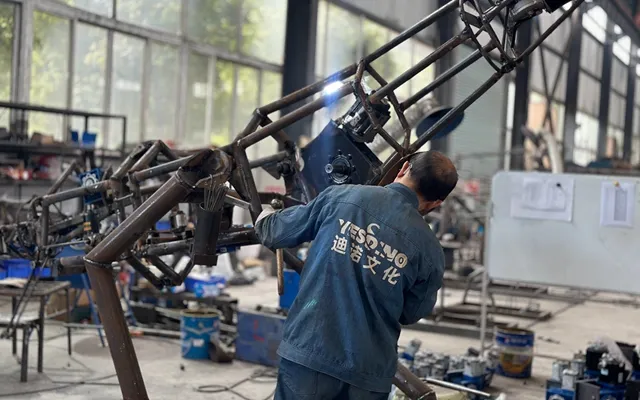
Steel tube is welded to the drawing and braced where the wings and the neck load it. The base or the suspension points are built to the site's fixing plan.
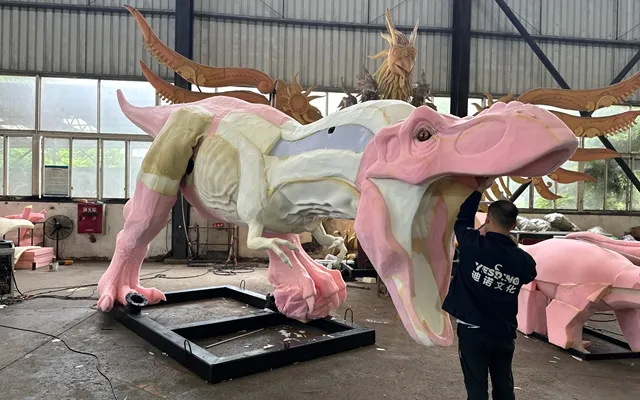
Head, brow, jaw and chest are carved first because they carry the character. The flank and the back are shaped afterwards.
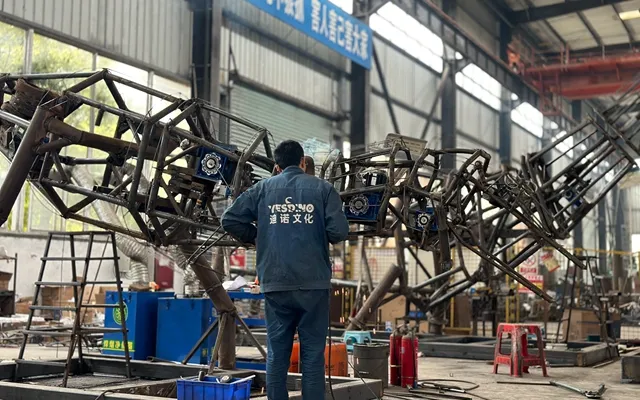
Head, jaw, eye and wing drives go in, wiring is routed through the frame, and the control cabinet is placed where it can be reached without opening the creature.
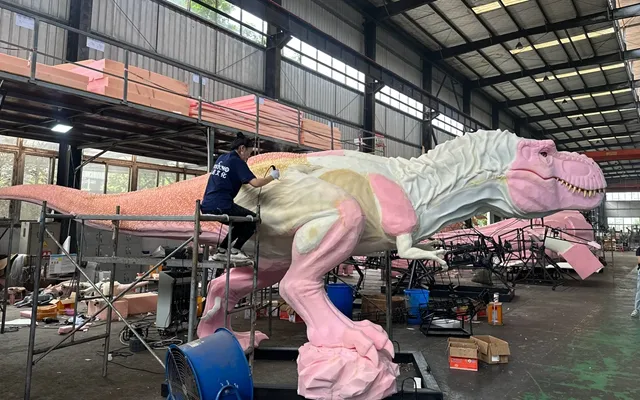
Scale plates are pressed into silicone by hand and the wing membrane is tensioned. Colour goes on in translucent coats so the surface has depth under both daylight and stage light.
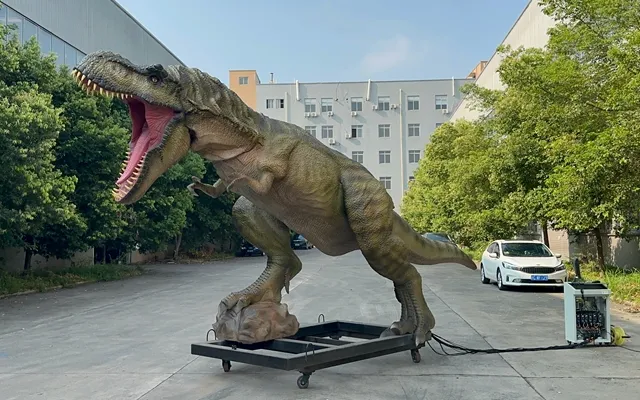
The show loop is programmed, the effects are timed to the movement, and the whole creature is run for a full cycle before it is crated.
Wing behaviour, neck length, the number of moving axes and whether fire is included drive the price, so every dragon is quoted individually. Static wings and a base-mounted body are the two choices that keep the budget lowest; slow flapping wings plus fire is the combination that pushes it highest.
We build from a description, a sketch or a reference image. Where the reference is a protected character design, the practical route is to keep the proportions and the mood and change the details, and we will say so at the drawing stage rather than after the sculpt.
It depends on the venue, not on the mechanism. Fire needs clearance, a fuel access point, a fire plan and a trained operator, and many indoor spaces do not allow it at all. Cold mist plus LED glow is the usual indoor substitute and it reads well at night.
Yes, and a suspended dragon is often cheaper than a standing one because the legs and the base drop out of the build. The ceiling structure and the load calculation belong to the venue; send us the suspension points and the safe working load and we design to them.
It runs from the approved drawing, so the schedule starts when the drawing is signed rather than when the enquiry arrives. Sculpting, mechanisms and paint are sequential, and a change of wing behaviour after the frame is welded puts the schedule back. We give a dated plan with the quotation.
Yes. Outdoor seasonal pieces are built with a UV-sealed skin, a sealed control cabinet and removable wings so the creature can be crated flat. Ask for the storage notes at order stage — the way it is packed is what decides whether it survives three winters.
Send a reference image or a description, the space it has to fill, whether it stands or hangs, and what should happen when someone walks past. We will return a written quotation with a drawing showing the wing behaviour and the movement list.