


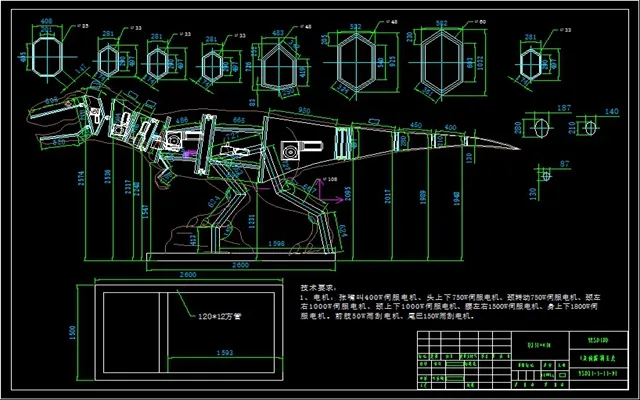
Reference to drawing
Your reference becomes a dimensioned drawing with the movement list and the mounting. This is the cheapest place to change your mind, so use it.
Our custom animatronics service is built for clients who need themed moving models beyond standard catalog products. We can customize appearance, size, movement, sound effects, control methods and scene requirements based on your project needs. Custom animatronics are widely used in theme parks, museums, shopping malls, exhibitions, stage events and branded attractions.
Every unit we make is built to a drawing, so in one sense all of it is custom. The distinction that matters commercially is narrower: a catalogue species reuses a sculpt and a movement set we already have, while a custom build starts from a reference that does not exist in our workshop — a character, a prop, a creature from a film or a brand campaign.
On a catalogue animal, most of the engineering is already solved: the frame proportions, the skin pattern, the joint layout. A custom build pays for that work again from zero. Three stages get more expensive — the drawing, the sculpt (no mould exists, so a master has to be carved) and programming, because the movement has to be designed rather than copied.
What does not get more expensive is the material. Steel, foam, silicone and paint cost roughly the same whatever shape they end up in. That is why a well-briefed custom figure is often closer in price to a catalogue one than people expect, and why a vague brief is the expensive option — every redraw after carving starts costs the same as the first one.
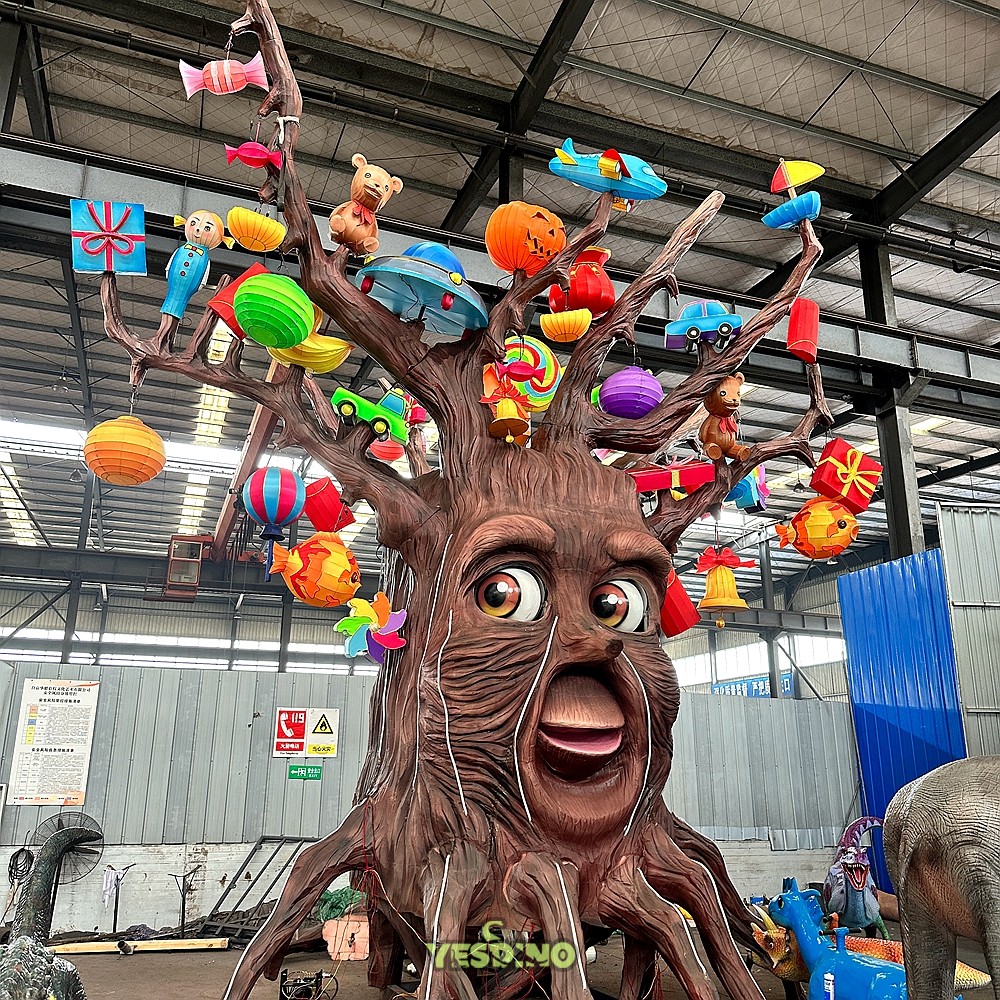
One clear front and side view plus a scale is enough to start. Photographs of a physical model, a turnaround from a game asset or a hand sketch all work; what does not work is a paragraph of description with no shape.
| Variable | Range | Effect on price | Effect on schedule |
|---|---|---|---|
| Character / species | Any creature, figure or object, real or invented | Highest single driver — a new sculpt means a new master and a new mould | Adds the sculpt stage in full |
| Size | 0.5 m to 20 m+, or scaled to a site | Surface area drives material and paint time; height drives frame bracing | Large units add sectioning and crate design |
| Movement | Static pose to 12+ powered axes | Priced per axis; slow precise motion needs servo rather than a gear motor | Programming and test time scales with the count |
| Surface | Silicone, fur, feathers, FRP, mixed | Feathers highest per square metre, silicone material-led, FRP lowest | Fur and feathers are the slowest to lay |
Swipe the table sideways on a phone.
With those five we can return a drawing and a quotation. Without the date we can still quote, but the schedule number will be a placeholder.
Some briefs are better solved another way, and we would rather say so before you spend money. A creature that only needs to be seen from one direction rarely justifies a full sculpt. A figure that has to walk freely through a crowd is a costume, not a model. A design that only has to be seen at night is cheaper as a silhouette with lighting than as a detailed sculpture.
We also turn down requests to reproduce a protected character design exactly. The workable version keeps the proportions and the mood and changes the identifying details — and if that will not do for your purpose, better to know at the drawing stage than after the sculpt.
The difference from a catalogue order is that stage one and stage three carry the whole risk. Approve the drawing carefully; check the sculpt in photographs before the mould is taken.
Your reference becomes a dimensioned drawing with the movement list and the mounting. This is the cheapest place to change your mind, so use it.
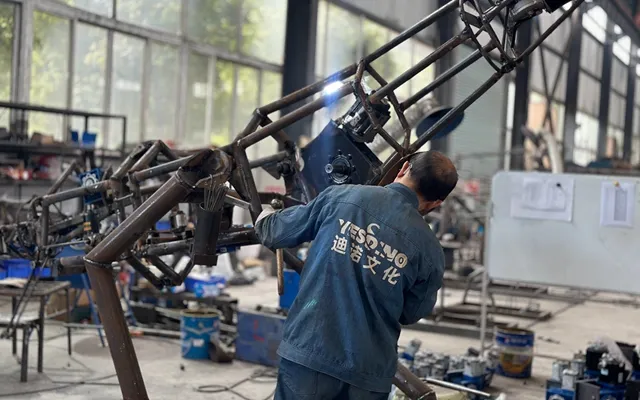
The frame is built to the drawing with fixing points for the site and bracing where the moving parts will load it.
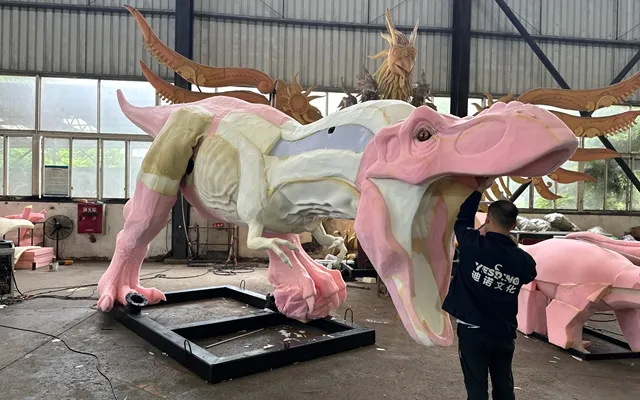
The master is carved by hand. We send photographs of the sculpt in progress — this is the last moment where shape changes are cheap.
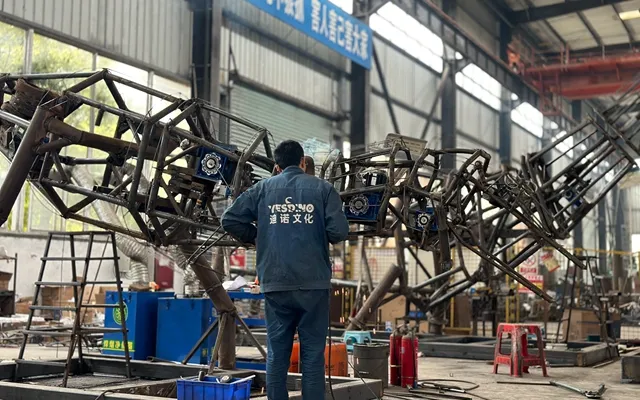
Drives go in where the drawing puts them, wiring is routed inside the frame, and the controller is located for access.
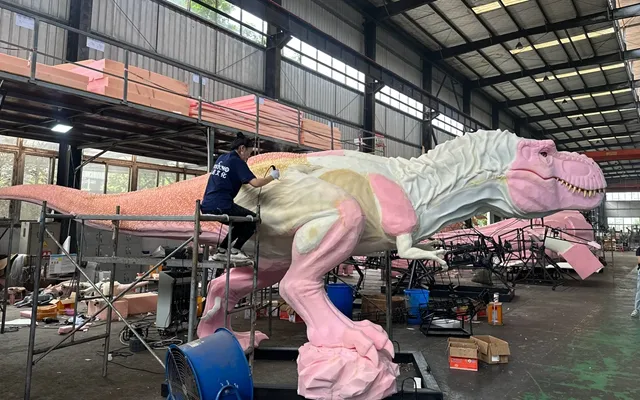
Surface is built to match the reference — scale, bark, fur, cloth — then painted in translucent coats and sealed for the site.
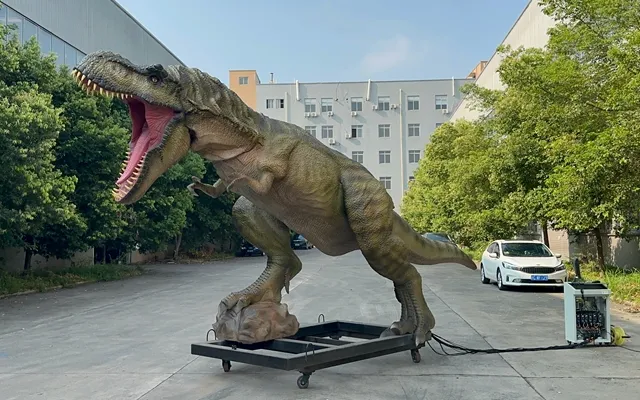
The movement sequence is written, run against the sound and lighting, and filmed for your approval before crating.
There is no list price, because two custom briefs of the same size can differ by the sculpt and the movement count. Send a reference with a scale and a movement list and we return a written quota- tion. If the budget is fixed, tell us the number first — it is easier to design to a budget than to cut one afterwards.
We build from a reference, but where the design is protected we keep the proportions and the mood and change the identifying details. If exact reproduction is essential, the licence has to come from the rights holder and we work to that.
It runs from the approved drawing. Sculpting from scratch, then mechanisms, then surface, then programming are sequential and cannot be compressed much without risking the result. A working schedule comes with the quotation, and a change of shape after the mould is taken restarts the sculpt stage.
Send the rough idea plus a photograph of where it will stand and the height it has to reach. We will propose a shape and put it on a drawing. Most of our custom work starts from a sketch or a written description rather than a finished design.
Yes, if it is designed that way from the start. Tell us it has to travel and the build changes: bolted sections, keyed joints, removable limbs, and a crate that doubles as the transport frame. Retrofitting that after the fact is much more expensive.
Yes. Most custom work is a single unit for a specific site or production, and there is no minimum order. What we do not do is produce a licensed character line at retail scale — that is a different kind of manufacturing.
Front view, side view, a scale, the movement you need and the date it has to be on site. That is enough for us to come back with a drawing and a written quotation.