


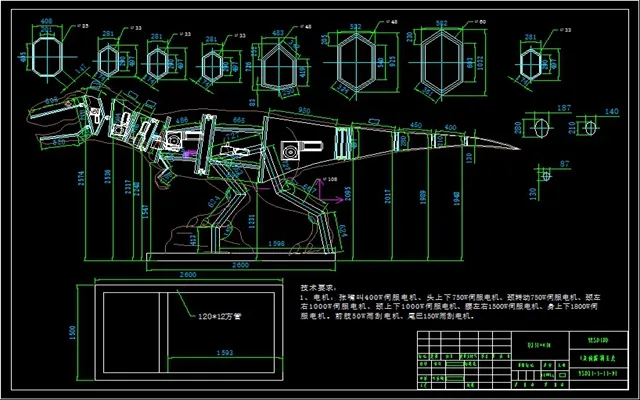
Drawing with the rider in it
Species, rider position, seat height, walk loop and stop positions all go on one drawing. This is where the ride is actually designed.
Our animatronic dinosaur rides are created for theme parks, playgrounds, shopping malls and family entertainment venues. These ride-on dinosaur products combine realistic appearance with stable structure and interactive movement, making them ideal for children’s attractions and commercial events. We support customization in dinosaur species, seat design, colors and control functions.
"Dinosaur ride" covers two different products. One is a rideable mount: a life-size dinosaur a visitor sits on while it walks a short track or turns in place. The other is a small tracked or wheeled unit in a dinosaur shell, usually coin-operated, carrying one or two children. They share a look and nothing else — different frame, different drive, different safety case, different price.
| Type | Who rides | How it moves | Throughput | Best for |
|---|---|---|---|---|
| Rideable animatronic mount | One rider on a saddle, with an attendant walking alongside | Legs driven by the frame, walking a fixed loop or turning in a small area | Slow — a few riders per cycle, photo value is high | Zoos, safari parks, dinosaur trails, photo concessions |
| Tracked or wheeled ride unit | One or two children, seated and belted | Chassis on wheels or a guide track, shell moves with it | Higher — short cycles, several units in a row | Malls, family entertainment centres, indoor play areas |
Swipe the table sideways on a phone.
The choice is usually made by the venue rather than by the buyer's taste. A trail with soft ground and no attendant wants the tracked unit. A paid photo experience on a hard path wants the mount, because the animal walking under a child is the thing people pay for.
A display animal is built to hold its own weight and move. A ride has to hold a rider, stop safely with that rider on board, and survive being climbed on by people who are not being careful.
The spine and the hip area are braced far more heavily than on a display piece, and the load path runs from the saddle down through the legs into the base — not through the skin. Rider limits are set on the drawing for your unit, because they depend on the frame and the seat.
A shaped saddle with a back stop, a handhold the rider can reach without letting go of the animal, and a foot support. On child units, a belt and an adult-height attendant position.
Ride units do not get the full movement set of a display dinosaur. Head turn, jaw and tail are fine; a fast lunge or a deep body drop is not, because it moves the rider. The walk cycle is tuned for a smooth ride rather than a dramatic one.
An emergency stop on the unit and a second control with the attendant. The controller returns the animal to a stable standing pose rather than cutting power mid-stride.
Operating speed and cycle length are configurable, and we set them to what your local rules and your insurer ask for rather than to a factory default. Tell us the market at the brief stage.
Step areas, the saddle edge and the flanks get the wear. Those panels are built replaceable, and the skin around them is specified heavier than on a display animal.
Because a ride has a loop, the footprint matters more than the animal's length. Send a plan view of the space and we will draw the loop on it.
Daily: check the saddle fixings, the handhold, the belt and the stop button before the first rider. Weekly: look at the leg joints and the foot pads, which take the load. The controller logs faults, so an intermittent stop is diagnosable rather than mysterious.
Consumables ship as a kit with the unit — foot pads, saddle covering, fasteners, and the belt where one is fitted. These are the parts that wear on any ride, and having them on site is the difference between a ten-minute fix and a lost weekend.
The first stage carries more weight on a ride than on a display unit, because the rider position has to be designed into the frame rather than added to it.
Species, rider position, seat height, walk loop and stop positions all go on one drawing. This is where the ride is actually designed.
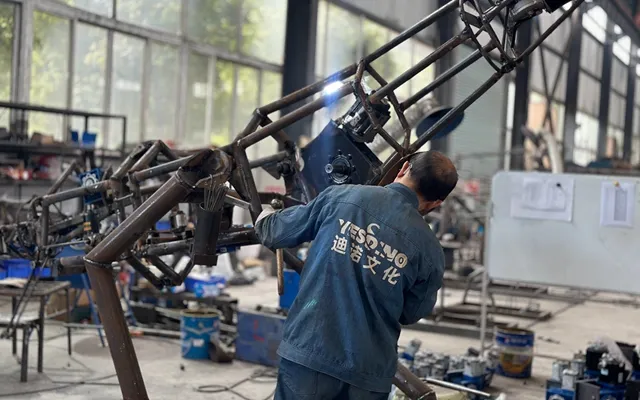
The spine, hips and leg mounts are braced for a rider on top, and the base is built for your surface and fixing plan.
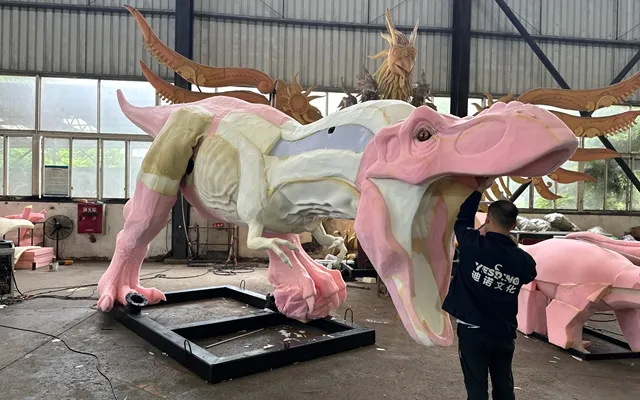
The body is carved so the saddle sits into the back rather than on top of it — which is what stops the rider sliding and what makes the animal still read correctly from the side.
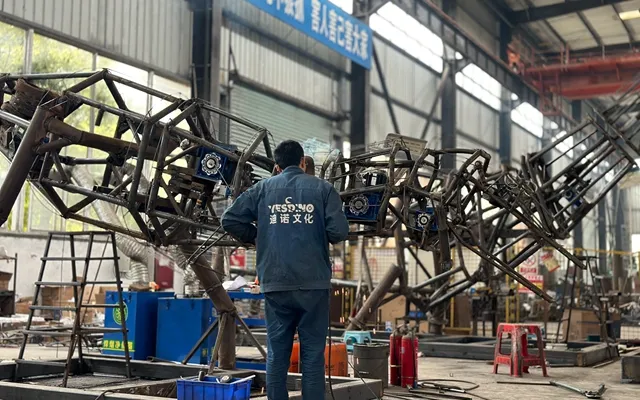
Leg drives, the walk cycle and both stop circuits go in together, then the controller is set to return to a stable standing pose on any stop.
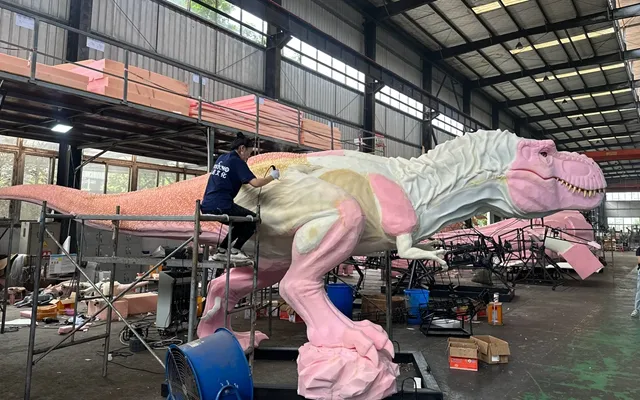
Standard skin elsewhere, heavier replaceable panels at the step areas, saddle edge and flanks. Paint is sealed for the surface it will operate on.
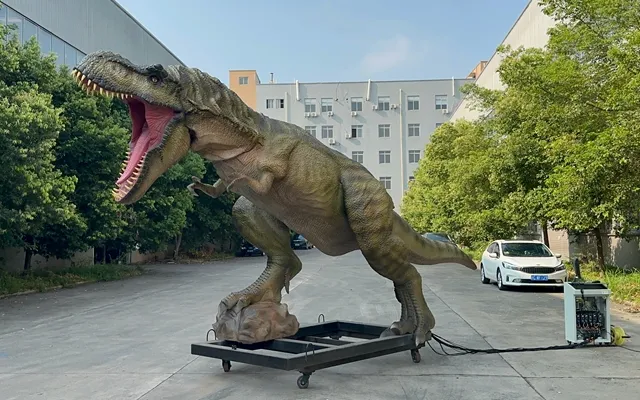
The unit is run through the full cycle with a rider load, the stops are checked, and the operating notes are written for whoever will run it day to day.
Species, rider capacity, the walk cycle, whether it is a mount or a tracked unit, and the surface it runs on all move the price. Send the venue type, the space and how many riders an hour you want to handle, and we quote the configuration that fits rather than a generic unit.
It is set on the drawing for your unit, because it depends on the frame, the seat and how the load is carried. Tell us the rider profile you expect — children only, or adults as well — and the frame is designed to it. It cannot be raised afterwards.
Yes. Every configuration we build assumes a person controls the cycle and watches the loop. That is also what insurers usually ask for, and it is where the second stop circuit lives.
The tracked and wheeled units can. A walking mount needs a hard, level path and enough clearance for the walk cycle, which most mall floors do not have — for indoor work the tracked unit is normally the right answer. Ceiling height, floor protection and noise limits decide the rest.
Mains where the unit stays in one place, battery where it has to move between positions. Battery units carry a charger and a swappable pack; the operating notes give the charge cycle for your configuration rather than a generic figure, because it depends on how often the ride runs.
Yes — we have built rides around licensed and invented creatures as well as dinosaurs. The rider position still has to be designed in from the start, so send the reference at the brief stage rather than after the frame is built.
Send a plan view or a photograph of the area, the rider profile you expect, and the surface it will run on. We will come back with a drawing showing the walk loop, the rider position and the stop points, plus a written quotation.