


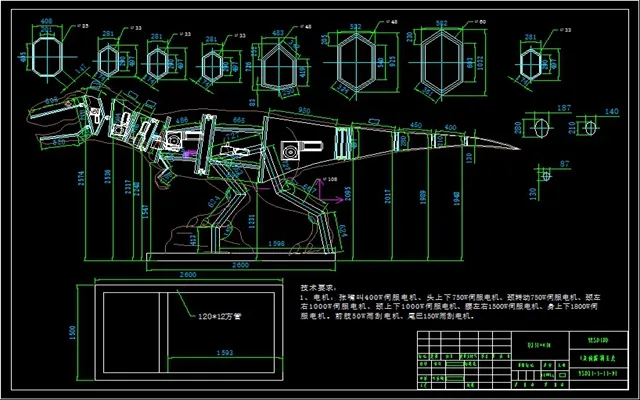
Species brief and drawing
Species, size, pose and movement list go onto a drawing with the surface choice. You approve the shape before sculpting.
Our animatronic animal models are suitable for zoos, museums, parks, shopping malls and themed commercial spaces. We manufacture realistic life-size and custom-made animal models with movement, sound and durable outdoor-friendly finishes. Clients can customize species, size, posture, color and control functions according to the project environment.
An animatronic animal is a life-size mechanical animal built on a welded steel frame, sculpted in foam, covered in either fur, feather or silicone skin, and driven by motors so the head, jaw, eyes, neck, tail and limbs move. The zoo or museum buys it for the same reason it buys a dinosaur: it can be placed where a live animal cannot, shown at any hour, and kept in a pose that tells a story.
A dinosaur is a single design problem — nobody has seen one, so the sculpture defines the truth. An animal is a comparison problem. Visitors know what a tiger looks like, so the eye, the muzzle length, the paw shape and the way the shoulder moves are all being checked against memory. That pushes the cost into the surface: fur direction, feather layering, whisker placement, and a paint job that has to hold up in daylight rather than under stage lighting.
It also changes the movement brief. A dinosaur is expected to roar and lunge. A red panda is expected to blink, tilt its head and chew. Small, quiet movements are harder to fake than large ones, because the eye has more to compare against — which is why the servos on a small mammal cost more of the budget than they do on a T-Rex.

The steel frame, drive system and controller come from the same production line as our dinosaurs. What changes is the skin build, the movement set and how quietly it has to run.
The surface is chosen per species, not per order. A fur animal and a scaled animal are different builds from the frame outward, and pricing follows the surface more than the size.
Bear, tiger, panda, wolf, fox, deer, goat, sheep, horse. Fur is laid over a shaped foam body in direction, with a shorter pile at the muzzle and around the eyes. Ridable and walkable versions use a heavier frame and a reinforced saddle area.
Most requested: panda, tiger, bear, horse.
Crane, peacock, ostrich, parrot, eagle, owl. Feathers are individually shaped and layered, which is slow work, so a bird costs more per metre than a mammal of the same height. Neck and head movement carries the performance.
Most requested: crane, peacock, parrot.
Crocodile, alligator, lizard, snake, turtle, frog. Silicone skin with moulded scale texture and a gloss or matt topcoat. These are the animals that survive outdoor installation best, because there is no fur to clog or fade.
Most requested: crocodile, python, lizard.
Mammoth, woolly rhino, saber-toothed cat, giant sloth, ice-age deer. These are built like dinosaurs — silicone skin, heavy frame — and often sit alongside a dinosaur trail rather than a living-animal exhibit.
Most requested: mammoth, woolly rhino.
Dolphin, orca, shark, whale, seal. Usually mounted overhead or half-emerged from a plinth, with the movement set built around the tail and the jaw rather than the legs.
Most requested: dolphin, orca, shark.
Giant beetles, butterflies, spiders and scorpions, plus dragons and other invented species. These live on the animatronic insect range and the animatronic dragon range.
Often scaled up 10–20× for impact.
| Surface | Best for | Outdoor life | Repair | Effect on price |
|---|---|---|---|---|
| Synthetic fur | Mammals viewed at 1–3 m; indoor and covered outdoor | Fades under direct sun; needs a roof or a seasonal rotation | Patch and re-lay a section | Moderate — labour-heavy in laying direction |
| Shaped feathers | Birds that will be seen close up and from the side | Indoor preferred; wind damages long feather runs | Individual feather replacement | Highest per square metre |
| Silicone skin | Reptiles, amphibians, extinct megafauna, anything permanently outdoors | Best of the three; 5–7 mm skin with translucent colour coats and a UV sealer | Local patch with the same silicone | Material-led rather than labour-led |
| Sculpted hard shell (FRP) | Static animals, or the rigid parts of a moving one — beaks, horns, shells | Excellent, but nothing moves | Repaint or re-mould | Lowest per unit area |
Swipe the table sideways on a phone.
The practical rule: if the animal stands outdoors all year, specify silicone even if the reference animal is furry. A fibreglass sculpture is the cheaper answer when nothing has to move — the sculpture page covers that comparison.
Movement lists are priced per axis, so the useful question is not "how many movements" but "which ones does the visitor actually watch". For a mammal at eye level, the eyes, the ears and the jaw do most of the work; a wide tail sweep adds cost and is rarely noticed.
We build to two drive types. A brushed DC gear motor with a relay board handles the large, continuous motions — tail, neck, limb. A servo handles anything that has to stop in a precise position or move slowly: eyes, ears, jaw, fingers. Most animals end up with a mix, and the controller is programmed so the movement reads as one behaviour rather than a set of parts starting and stopping.
A programmable controller runs a loop, can be triggered by a visitor sensor, and can be switched to a still "resting" pose outside opening hours. Sound is triggered from the same board, so the roar or the call lands with the jaw rather than after it.
| Product type | Life-size animatronic animal model |
|---|---|
| Species | Any living, extinct or invented animal |
| Length / height | 0.5 m to 20 m+, scaled to the site |
| Frame | Anti-rust treated welded square steel tube |
| Body | Hand-sculpted high-density foam over the frame |
| Surface | Silicone skin, synthetic fur, shaped feathers, or FRP shell |
| Drive | Brushed DC gear motors with relay board; servo where position or slow motion matters |
| Control | Programmable controller, show loop, visitor sensor, staff trigger |
| Power | 110 V or 220 V mains |
| Operating range | −25 °C to 45 °C |
| Warranty | 2 years on core electronics |
Every stage happens in our own workshop in Zigong — steel, sculpting, skinning, painting, control and testing. Nothing is subcontracted, which is why a change of species mid-project does not mean a change of supplier.
Species, size, pose and movement list go onto a drawing with the surface choice. You approve the shape before sculpting.
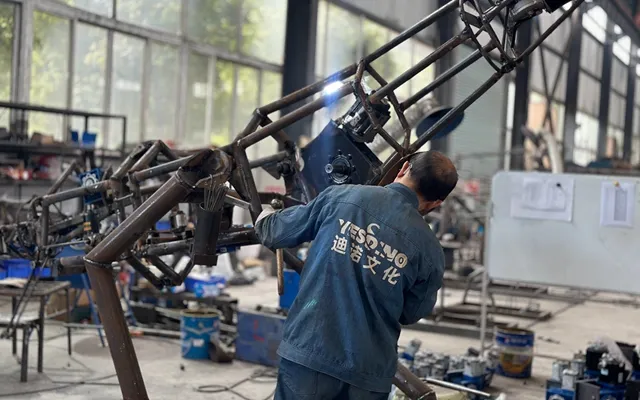
Square steel tube is cut and welded to the animal's proportions and treated against rust. The base is designed for your foundation, not ours.
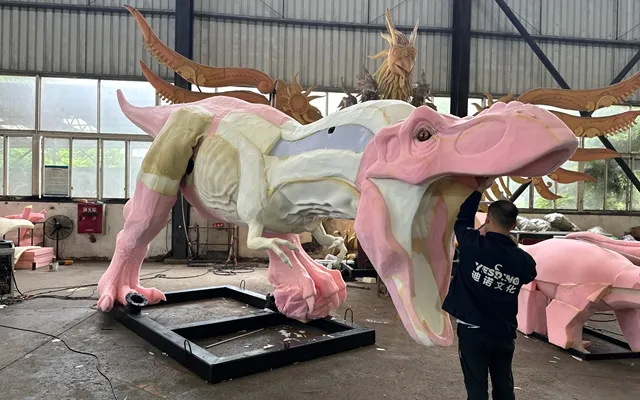
Foam is carved to the anatomy — muzzle length, shoulder mass, paw shape. This is the stage that decides whether the animal is recognised at a glance.
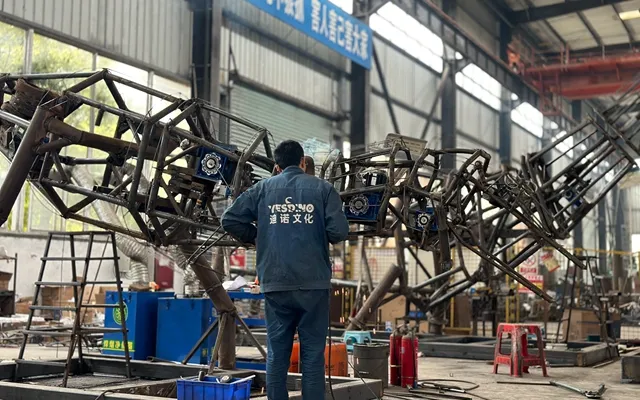
Motors and servos are mounted at each moving joint, wiring is routed inside the frame, and the control cabinet is positioned where a technician can reach it.
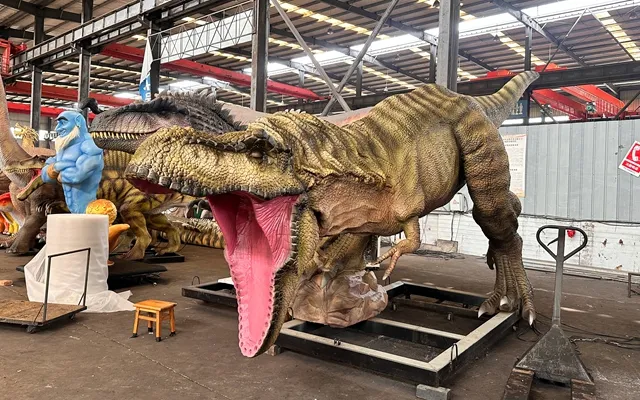
Fur laid in direction, feathers layered, or silicone textured and painted. Colour is built in translucent coats so the surface reads as skin or pelt rather than paint.
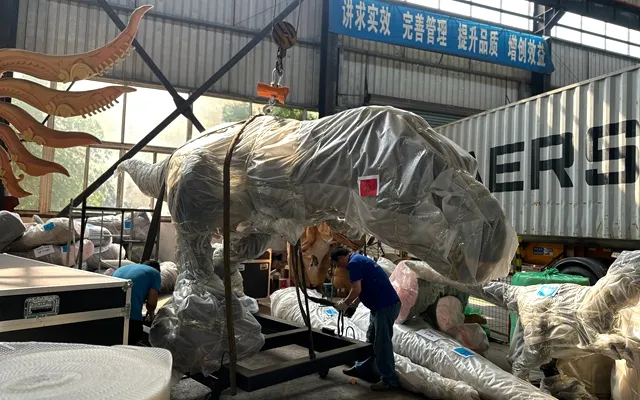
The animal runs a full movement cycle and a sound check, then ships in foam-lined crates with numbered assembly drawings or with our installers on site.
Freight, import duty, destination certificates and installation labour are quoted separately, because they depend on the port, the site and who is doing the groundwork. We list them at quotation stage so the total budget is visible in one place rather than appearing later.
Installation is either our own team on site or numbered assembly drawings with remote support, depending on the country and the size of the order.
Size, species, surface and the number of powered movements set the price, so we quote per project. As a rule the surface matters more than the length: a feathered bird of the same height costs more than a furred mammal, and a silicone reptile costs more than a static sculpture of the same animal. Send species, size, indoor or outdoor, and the movement list you have in mind.
No. A single animal is a normal order, and most first orders are one or two pieces used to test a trail or a campaign before a larger phase.
Yes, with a heavier frame and a reinforced saddle or platform area. Ridable animals are specified separately from display animals because the load case is different — tell us at the brief stage, because the frame cannot be upgraded after it is built.
Fur fades under direct sun and holds water, so for a permanent outdoor position we recommend silicone even on a species that is furry in life. If the animal has to look furry and stay outside, the workable compromise is a covered position or a seasonal swap between two surfaces.
Daily checks are visual — skin or fur damage, loose fasteners, unusual noise at a joint. Consumables such as motor brushes, servo horns and fan filters ship as a kit with the animal. Core electronics carry a 2-year warranty, and we support diagnosis remotely from photographs and a video of the movement.
Yes. Send the photographs plus any dimension you know — shoulder height is the most useful single number — and we build the sculpt to that reference. If the photo is a specific individual animal, send several angles, because the markings are what people recognise.
Tell us the animal, the size you want it at, whether it lives indoors or outdoors, and what it should do when a visitor walks past. We will come back with a written quotation and a drawing showing the pose, the movement list and the surface specification.