


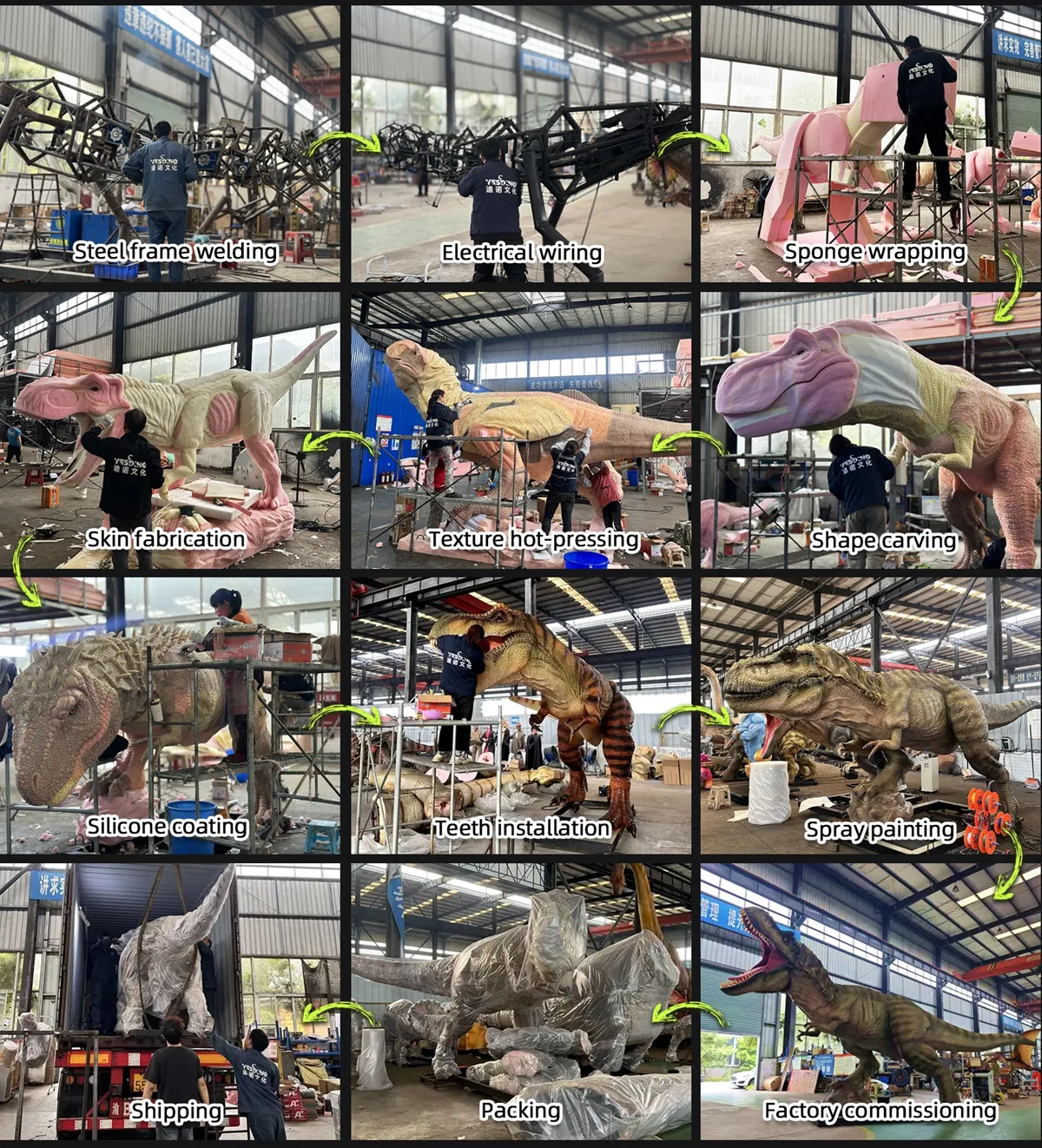
Production Process
Baryonyx is the predator you put next to water. The skull is long, low and narrow like a crocodile's, the teeth are conical rather than blade-shaped, and the hands carry a claw that in the original specimen is the largest yet found on any dinosaur's thumb.
SKU YKL-080: five metres long, 0.65 m across, 2.2 m at the head. A compact build of an animal that reached eight or nine metres, sized for trails and indoor exhibits.
The jaw is the whole identity
Two features separate this animal from every other theropod on a trail, and both are in the head. The snout is long and shallow, with a slight upward curve at the tip and a notch where the upper jaw meets the lower — a shape built for gripping rather than for shearing. And the teeth are round in section, more like pegs than blades, set in a row that interlocks when the jaw closes.
It was probably a fish-eater, and the model should let a visitor work that out. We sculpt the jaw line narrow and keep the gape smaller than a tyrannosaur's; a wide, dramatic mouth on this head looks wrong immediately, because the animal's anatomy was never built for it.
The thumb claw
The claw is the other signature. Large, curved, and set on a hand that was clearly capable of holding something — the first specimen had fish scales in its stomach cavity. On the model it is a separate moulded element on the thumb, sized from the fossil, and it reads at two metres better than anything else on the animal.
The forearm scratch group is worth keeping for exactly this reason: it is the movement that puts the claw in front of the visitor's eye.
Six movement groups
Head left and right, neck up and down, jaw open and close with a roar, blinking eyes, tail sweep, forearm scratch. On a five-metre build the neck travel is short, so the head turn does most of the work — slow it down and let the animal hold a pose, rather than sweeping continuously.
Independent drives with end-of-travel protection, run from a loop, a proximity sensor or a floor mat. Near water, put the sensor on the path side rather than the pond side, so the animal reacts to visitors instead of to reflections.
Beside water, and what changes
This animal gets placed near ponds, fountains and splash features more often than any other build. That is a specification decision, not a styling one.
Splash is fine; standing water is not. If the feet sit in a wet area, the base frame needs raising on a plinth above the waterline, and the cable route should come in from above rather than across the ground. Tell us the distance to the water at enquiry and we'll adjust the coating on the lower third of the body to match.
Finish and delivery
Welded Q235 steel frame with anti-rust treatment, foam volume, silicone five to seven millimetres, translucent layered colour. A common finish is a dark olive body with a pale throat and a warmer tone along the jaw — the countershading that suits a fish-eater, and it reads well against water.
Rated −25 °C to 45 °C, 110 V or 220 V configured at build. Ships in sections with base frame, control cabinet, sound system, wiring diagram and calibration sheet. Freight, duties, certificates and installation are quoted separately from the product price.
What the first specimen showed
The original Baryonyx skeleton was found in a clay pit in Surrey in the 1980s, and it came with two pieces of evidence that changed how the animal is understood: fish scales and small bones in the stomach region, and that outsized claw. Together they built the picture of a predator working the water margins rather than hunting large prey on open ground.
It also turned out to be the first spinosaurid found outside Africa and South America, which is why it appears in European museum displays more often than its relatives. If your exhibit already has a Spinosaurus, this animal is the smaller, earlier cousin that lets you tell that story properly instead of repeating the same silhouette twice.
Enquiry
Send a photo of the spot and tell us how close the water is. If the animal is going into a themed fish-eater exhibit rather than a general trail, say so — the posture and the palette are different for the two jobs.
Where to go next
If you are still comparing options, start with the installation guide for pads and access — it lines up the builds by length and reach. Site work is covered in the wiring concealment notes, and the park layout and theming strategies lists the factors that move the price.
For ideas on placing it, see layout strategies for themed trails. The rest of the range is on animatronic dinosaurs, and if this one is the wrong size for the slot, animatronic lotosaurus for exhibition halls is the closest alternative.
Product Accessories

Packaging and Container Loading



