
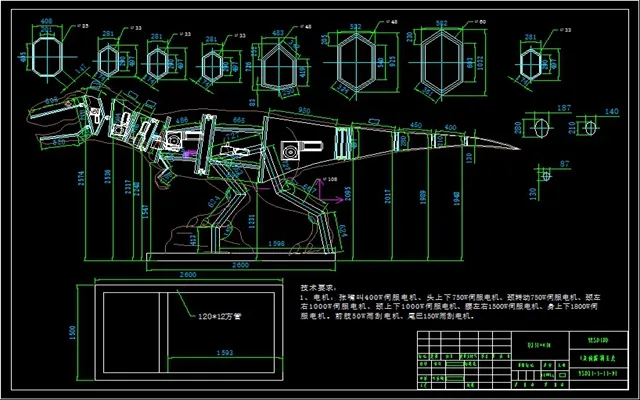
Drawing and pose
Species, size and pose are drawn against the site. The pose is fixed at this point, so it is the decision to spend time on.
Our fiberglass sculptures are designed for theme parks, shopping malls, scenic areas, museums and commercial decoration projects. We produce custom FRP sculptures in a wide range of styles, including dinosaurs, animals, cartoon characters and themed display pieces. All products can be customized based on your drawings, ideas, dimensions and installation requirements.
People search for a realistic dinosaur meaning one of three things, and the three are built in completely different ways: a static sculpture in fibreglass, an animatronic model that moves, or a wearable costume. The animal can look identical in a photograph and cost five times as much as the next option, so the first useful question is not "which dinosaur" but "does it have to move".
| What you are buying | What moves | Needs power | Best for | Upkeep |
|---|---|---|---|---|
| Fibreglass sculpture (FRP) | Nothing. Fixed pose, sculpted once. | No — unless lit | Entrances, rooftops, gardens, roundabouts, permanent outdoor displays, photo landmarks | Repaint every few years |
| Animatronic model | Head, jaw, eyes, neck, tail, limbs, breathing, sound | Yes, mains | Theme parks, museums, exhibitions, shows where a crowd stops to watch | Joint checks, electronics |
| Wearable costume | The performer walks it | Fan and head only | Walkabout acts, festivals, film, brand events | Skin cleaning, consumables |
Swipe the table sideways on a phone.
Cast in fibreglass, the dinosaur holds its shape for years in weather, needs no power and no technician, and can be made at any size the site allows. That is why most first installations that are meant to be permanent background — a gate marker, a trail figure, a specimen in a diorama — are sculptures rather than machines.
Roughly half the enquiries we receive for a moving dinosaur end up as a sculpture once the site is described. These are the conditions that push the decision that way.
A figure at the end of a trail, on a roof, in a garden or on a roundabout usually has no mains feed and no way to add one. A sculpture solves it, and a small solar cell can light it if you want it seen at night.
An animatronic is at its best with a sensor or a show loop and somebody who can reset it. A site without staff on hand does better with a sculpture that simply stands there.
Beyond about 15 metres, movement adds less than silhouette and colour. Money spent on a bigger, better-painted sculpture usually reads further than money spent on a moving jaw.
Gelcoat and UV-stable paint handle sun, frost and rain with a repaint every few years. Moving parts outdoors need sealed cabinets, drainage and a service visit schedule.
Five sculptures fill a trail for about what one animatronic centrepiece costs. If the goal is a route that feels populated, static is the arithmetic that works.
A sculpture sets a scene. An animatronic is the reason people stop. If your marketing promises a show, buy the show; if it promises a world, the sculpture carries it.
The reverse also holds. If the model is the thing visitors came to see, or it stands where a crowd gathers for ten minutes, a static figure will be walked past. That comparison is on the animatronic dinosaur range, and the wearable version is on the realistic costume range.
The outer shell is glass-fibre reinforcement laid into a mould with polyester or epoxy resin. The mould itself comes off a hand-carved master, which is why the sculpt quality is set before any fibreglass is used — the mould only copies what was carved.
Inside the shell there is a steel armature. A dinosaur two metres tall is mostly hollow, and a hollow shell that size will distort in wind and heat unless it is braced. The armature also provides the anchor points that fix the figure to its foundation, and it is the part that decides whether the piece survives its first storm.
The visible surface is gelcoat — the pigmented outer layer that carries the base colour and seals the laminate — followed by paint and a UV-stable clear coat. Gelcoat is what makes a fibreglass figure look like a solid object rather than a painted shell, and it is also the layer that can be polished back if a piece is scuffed.
| Product type | Static realistic dinosaur sculpture (FRP) |
|---|---|
| Species | Any dinosaur, prehistoric animal or fantasy creature |
| Length | 0.5 m to 20 m+, in one piece or in transportable sections |
| Shell | Hand-laid glass-fibre laminate over a carved master mould |
| Surface | Pigmented gelcoat, painted detail, UV-stable clear coat |
| Armature | Internal steel frame, treated against rust, with fixing points |
| Pose | Fixed; set at the sculpt stage and not adjustable later |
| Finish options | Matt, satin or gloss; realistic wet-look eyes; optional internal lighting |
| Installation | Ground anchors on a concrete pad, or a steel base plate for hard standing |
| Outdoor life | Years with a repaint cycle; no moving parts to service |
The same workshop that builds our animatronic models, which is the reason a sculpture and a moving dinosaur can stand next to each other and look like the same species.
Species, size and pose are drawn against the site. The pose is fixed at this point, so it is the decision to spend time on.
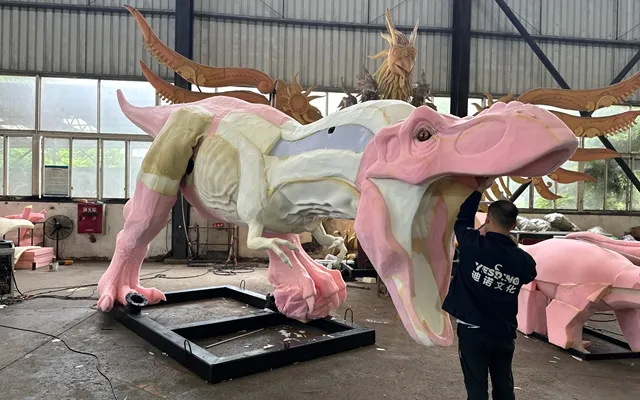
Foam and clay are carved to full size by hand. Every detail that will appear on the finished piece — skin folds, scale rows, teeth, claws — has to exist here.
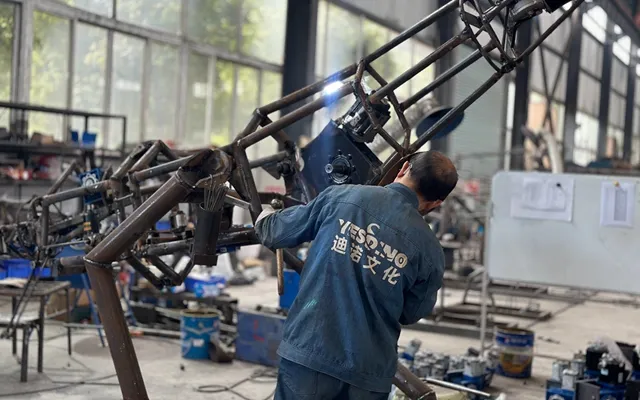
A split mould is taken off the master. In parallel the internal steel armature is built to carry the shell and to fix it to the foundation.
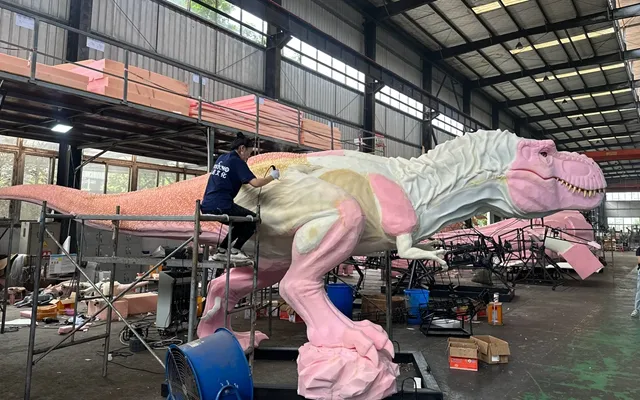
Gelcoat goes into the mould first, then glass-fibre and resin in layers. The shell is pulled, trimmed and bonded to the armature.
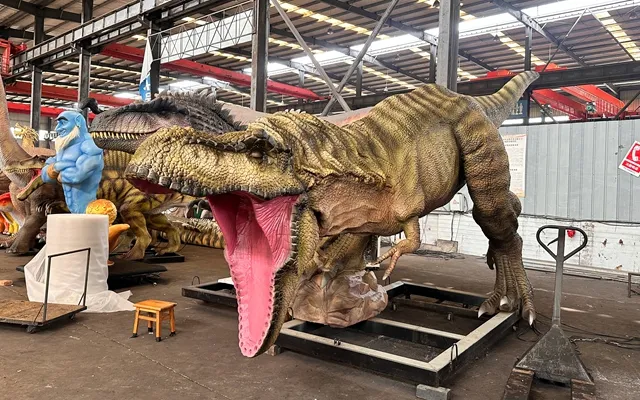
Base colour in the gelcoat, then airbrushed patterning — countershading, stripes, mottling — and a UV-stable clear coat over the top.
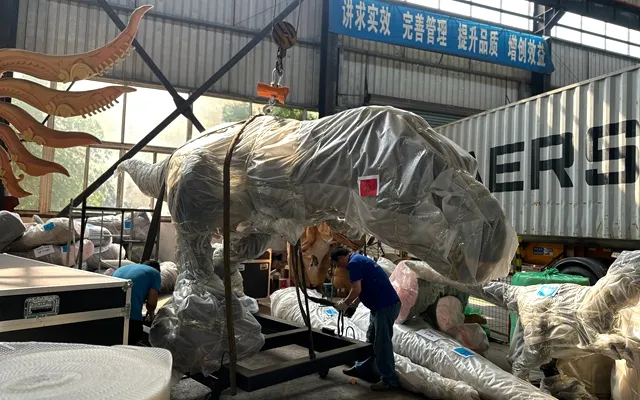
Large pieces ship in bolted sections with numbered joints, or in one piece if the route allows. Fixing drawings for the concrete pad go with the crate.
Freight, duty, destination certificates and installation labour are outside the unit price and are quoted separately. For a large outdoor piece the concrete pad is usually the biggest site cost, and it belongs to your contractor.
Send a photograph of the position and the approximate dimensions available, and the drawing comes back sized to the space rather than to a catalogue.
It depends which of the three you are buying and at what size. A static fibreglass sculpture is the lowest of the three for the same animal, an animatronic model is the highest, and a wearable costume sits between them depending on species. Send the species, the size and whether it has to move and we will quote the specific option rather than a range.
It means the animal's real adult length, which varies enormously by species: a Velociraptor is around 2 m, a Triceratops around 8 m, a Tyrannosaurus around 12 m and a Brachiosaurus far longer. We build to the species' true scale, or to a smaller size if the site cannot take the full length — the proportions are kept and the figure is scaled down as a whole.
Yes, with the right topcoat and a repaint every few years. The parts that age are the paint and the clear coat, not the laminate. Frost is fine; standing water at the base is not, so the pad needs to drain.
Not economically. The armature of a sculpture is built to hold a shell, not to carry drives, and the skin is bonded to the laminate rather than stretched over a moving body. Treat the choice as permanent and decide on movement before the drawing is approved.
Figures are designed as bolted sections when the finished size will not fit a container or the access route. Joints are numbered and keyed so the assembly order is unambiguous, and a fixing drawing for the pad goes with the crate. Installation is either our team on site or your contractor following the drawing, with remote support from us.
Yes — any animal, real or invented, at any size. The same mould and laminate process is used for elephants, gorillas, deer and fantasy creatures. Moving versions of the same animals are on the animatronic animal range.
Send a photograph of where it will stand, the space available, the species you have in mind, and whether it has to move. We will tell you which of the three builds fits that position, and quote it with a drawing.