Production Process
The bamboo is the tell. A standing panda with a stalk in its paws reads as a statue holding a prop; the same animal seated, knees up, both hands working the stalk toward its mouth, reads as an animal eating. That is the design argument for a seated build, and the reason the pose was fixed before the movement list. SKU YAA-010: 2.1 m seated height, 0.95 m long, 0.75 m across.
Why the seated pose carries the eating
A seated panda has a shorter reach envelope than a standing one. The shoulders sit closer to the head, the arms work in a smaller arc, and the bamboo arrives at the mouth along a path the arm can travel. That sounds like a limitation, and it is the reason the behaviour reads.
Seated, the animal's mass stacks over a 0.95 m by 0.75 m footprint with the head at 2.1 m, above most visitors — which is where a panda's head is when it sits and eats. Standing builds are taller and less convincing at this job, because the arm travels further and the grip point drifts.
Where the seated pose works
Zoo interpretation areas, panda-themed indoor exhibits, mall atriums, museum galleries with a bamboo set. The footprint is the useful part: under a square metre of floor with the height doing the visual work, so the animal fits a corner where a standing build would block a route.
The eating action happens at head height, so a bench or a low wall two or three metres in front catches the whole movement without visitors crowding the animal's knees.
What moves: the arm, not the head
Neck, head turn, jaw, blink, and both arms working the bamboo. The arms are the hard part and the part worth commissioning time. A free swing is easy; an arm that closes on a fixed point near the mouth, holds, and returns along the same path is a different problem, because the hand has to arrive where the bamboo is, every cycle, without drifting.
Tune the jaw and the grip together. The chew is small and slow, the lift slower than you expect, and the pause at the top with the bamboo at the mouth is the frame people photograph. Speed up the return and the animal looks like it is snatching. The ear flick and the blink are small enough to leave at factory motion, and both are cheap to change later.
Mould, pigment and the black-white edge
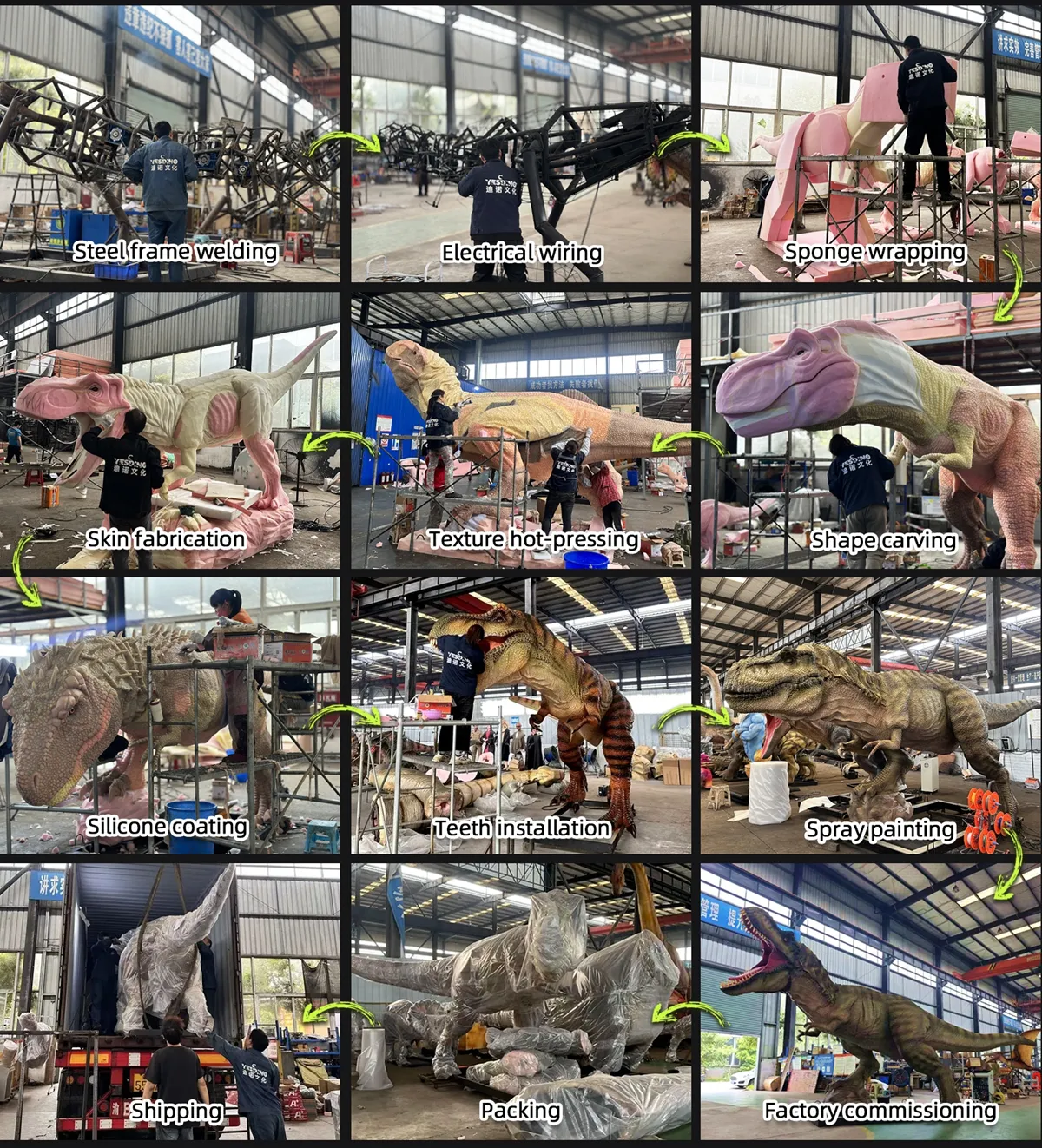
Q235 steel frame with rust-proof treatment, foam carved to volume, 5–7 mm silicone, colour sprayed in translucent layers. The black and white boundary is where a panda build shows its quality: a hard painted edge reads as a costume, where a soft transition with the fur texture carried across it reads as fur.
That transition is made in the mould and the pigment, not with a brush afterwards. Rated −25 °C to 45 °C, 110 V or 220 V per destination, core electronics on a two-year warranty. The bamboo is part of the assembly rather than a decoration bought later: its length and weight are set by the grip point.
Sections, arms last
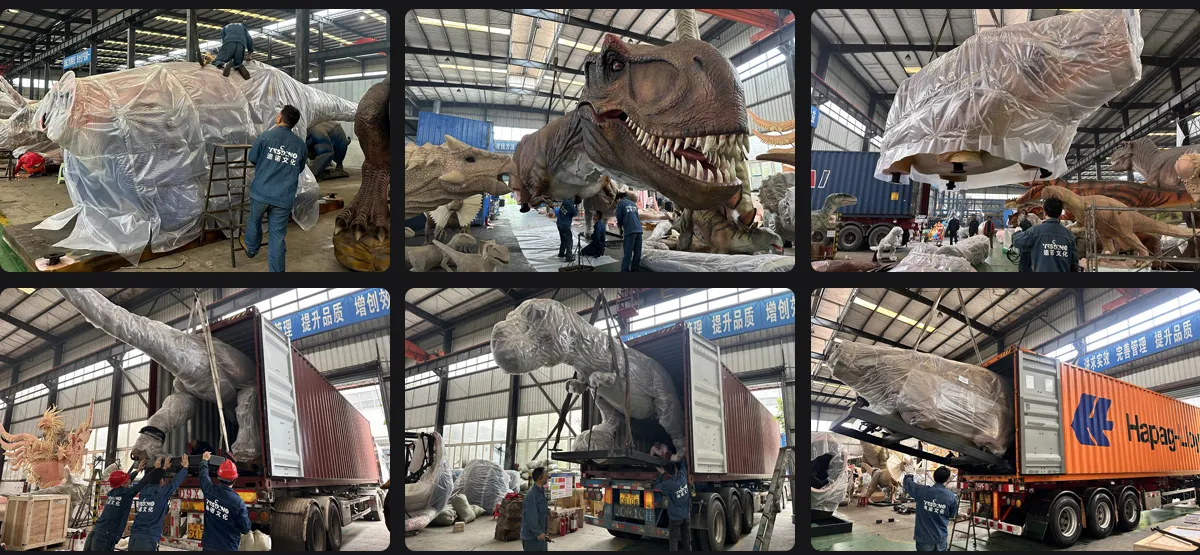
The animal ships in sections — seated body, legs, head — because a 2.1 m seated volume is awkward rather than heavy. Assembly happens on site on the base frame, arms last, with the grip checked against the bamboo before the loop is enabled.
Service access is behind the seated back, the one place a panda build has room. Plan that clearance: an animal pushed flat against a wall turns a cabinet check into a two-person job with the animal pulled out of position.
What the set drawing tells us
Send the floor plan, the ceiling height above the head, and the direction visitors come from. If the panda goes into a themed set, send the set drawing: a set that puts the mouth at a different height changes the build.
Where it is the wrong choice: a trail or a paddock seen from a distance, where the seated pose hides the legs and the silhouette reads as a lump. Seated builds are close-range pieces, and this one depends on the face and the hands being seen at a few paces.
Enquiry
Tell us the space, the viewing distance, and whether the bamboo belongs to a themed set. If you already have a bamboo prop, send its dimensions, since the grip is built around one specific shape. Freight, duties, certificates and installation are quoted separately from the product price.
Where to go next
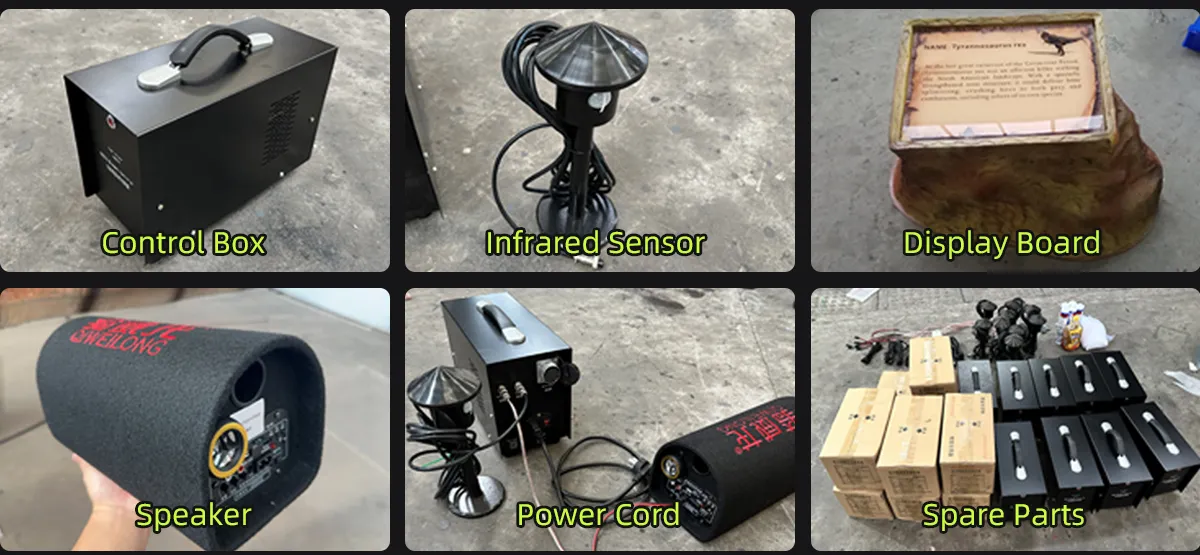
Worth reading before you commit: the size guide covering 3 m to 12 m builds for how the sizes compare, the spare parts and repair kit list for what the ground has to carry, and the installation guide for pads and access for where the money actually goes.
For ideas on placing it, see layout strategies for themed trails. The rest of the range is on animatronic animals, and if this one is the wrong size for the slot, animatronic sika deer for zoo displays is the closest alternative.
Product Accessories
Packaging and Container Loading