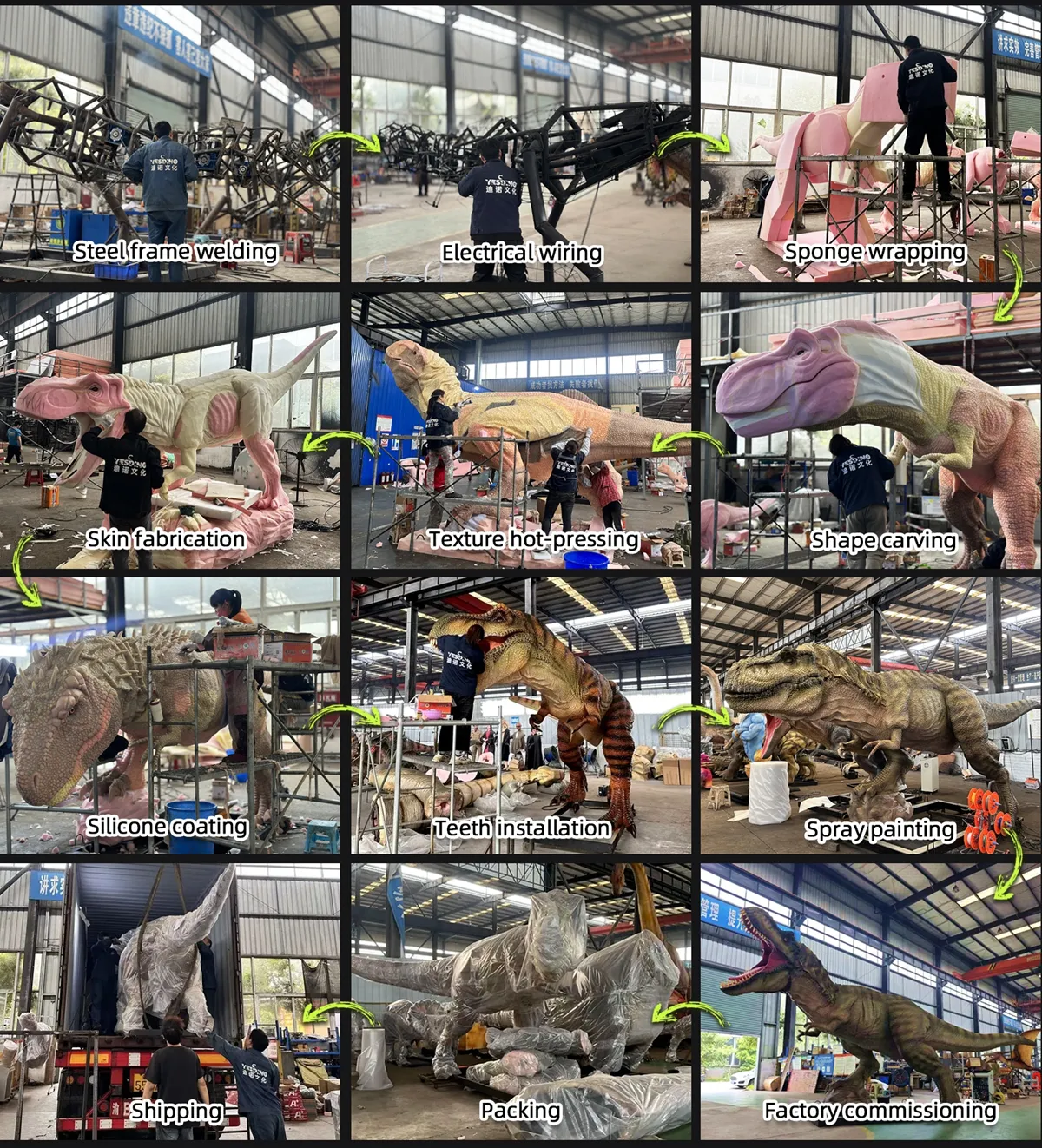
Production Process
Saturday at a farm park: five goats at the petting-area fence, four of them real, and the longest queue is at the one that stands still. A 1.6 m animatronic goat does one job there — it holds a pose while a parent frames a photo, and it is still holding it when the next family arrives. SKU YAA-026 measures 1.6 m along the curve of the body, 1.5 m at the head.
Why 1.6 m is a height, not a goat
A domestic goat is a small animal, and at 1.6 m along the curve this build is already generous. The 1.5 m height is not a goat measurement, it is a photo measurement: the head sits where an adult holds a phone, and a child standing beside it comes up to its shoulder.
That is the trade. A true-to-size goat at knee height would be more accurate and weaker as a prop — adults photograph it from above, and in a crowd it disappears below waist level. If accuracy is the brief, this is the wrong unit. If the brief is a photo point that works without a staff member arranging people, the height is doing the work.
Where a petting area wants it
Petting areas, entrance lawns, farm shop forecourts, the shaded corner where families stop for a drink. Ground matters more than walls. On grass or rubber matting the animal sits at the right height; on gravel it will shift over a season unless the base plate is set on a paved pad.
Distance is short by design. Visitors come within arm's length, which is the point of a petting area, and that changes what the finish has to survive: more hands, more sunscreen, more rain on the way past.
What moves: three groups, not seven
Head turn and neck, jaw, tail, with ear and blink as the small movements that carry most of the read. Three main groups is the right number here, because a short loop with long pauses suits the way people stand beside an animal: a photo, ten seconds of watching, then on to the next pen.
The group worth tuning is the neck. Lower the head slightly, slow the turn, and the animal looks like it is deciding whether to come closer — which is the behaviour people recognise from the real goats at the fence.
Build and skin for contact
Q235 steel frame, rust-proof treated, high-density foam carved to volume, 5–7 mm silicone with pigment sprayed in translucent layers. Skin thickness is what a visitor feels through the hand, and layered colour means a scuff shows as a lighter patch of the same tone rather than a white scar.
Rated for −25 °C to 45 °C. A farm park in direct summer sun will find the top of that range on the animal's back, and shade or a canopy costs less than a repaint. Power is 110 V or 220 V configured for the destination, with core electronics on a two-year warranty.
One morning, no lift
One crate, one base frame, one control cabinet. The animal passes a standard double door without dismantling, which is a practical reason farm parks pick this size: installation takes a morning rather than a day with a lift.
On grass, a ground spike or a ballasted base plate; on paving, four bolts. Proximity sensing and floor-mat triggering are both available, and in a petting area the mat tends to suit better — the animal reacts when someone stands in front of it rather than when they walk past behind it. Parameters are set at commissioning and left with you as a record.
Sizes that do not suit this build
Send the surface, the photo point you have in mind, whether the animal stays outdoors all year, and the height of the fence or rail beside it, since the head turn is set toward the side visitors come from.
Where this size fits badly: a walk-through trail or a paddock seen from a path, where animals are expected to be lifelike at a distance. At 1.6 m it is a close-range piece, and at ten paces the proportions read as a large goat. A taller build covers that job better.
Enquiry
Send a photo of the spot and the surface under it, plus the fence height and the side visitors approach from. If the goat will stand next to live animals, say so — coat colour is matched at build, and matching it later is a second job. Freight, duties, certificates and installation are quoted separately from the product price.
Where to go next
If you are still comparing options, start with the cost breakdown with the seven price factors. Site work is covered in the wiring concealment notes, and the park layout and theming strategies lists the factors that move the price.
For ideas on placing it, see exhibit planning walkthrough. The rest of the range is on animatronic animals, and if this one is the wrong size for the slot, animatronic panda eating bamboo, 2.1m seated is the closest alternative.
Product Accessories

Packaging and Container Loading