Production Process
Ten metres of wing is not a big bird, it is a structure with a bird on it. Stand underneath and the first thing you notice is not the beak but how far the tips travel: a slow flap at that span sweeps a volume of air you can feel on the ground. SKU YAA-020: 10 m from wingtip to wingtip, 4 m tall.
Why ten metres changes the engineering
At a ten-metre wingspan the wing becomes the primary structure. Hinge loads scale with span, not with body weight, so the shoulder carries a load set by the length of the lever, and the hinge, the spar and the base are all sized from the span down rather than from the body up.
That is the difference between this and a three-metre bird. A small build is carried by its body frame; this one is designed from the wing roots outward, and the mast and base exist to hold the wing rather than the other way round. The bird is the payload, and the drawings show it that way round.
Open ground and the wind question
Open ground with a long sightline: park entrances, lake edges, festival plazas, the approach to a resort. The bird reads from twenty metres or more, where the span shows against sky, and it needs that distance — close up, the wing is a wall.
Wind is the siting question rather than the weather. A 4 m structure carrying 10 m of wing presents a large area to any breeze, so the site wants shelter from the prevailing direction, an orientation that puts the wing edge-on to it, or both. Ask what the site looks like in its windiest month before the position is fixed.
What moves: a slow flap
Wing flap, neck and head, beak, body breath. The flap is the whole show and its rate is the design decision: at this span the wing accelerates slowly and stops slowly, and a fast cycle reads as a kite.
Set the flap so the tips lag the root. That lag is what makes a large wing look heavy, and it comes from the joint sequence rather than from the motor. Add a park position at the end of the loop — wings folded or held level — so the bird can be stopped in a pose rather than mid-stroke at closing time.
Spar, panels and feather seams
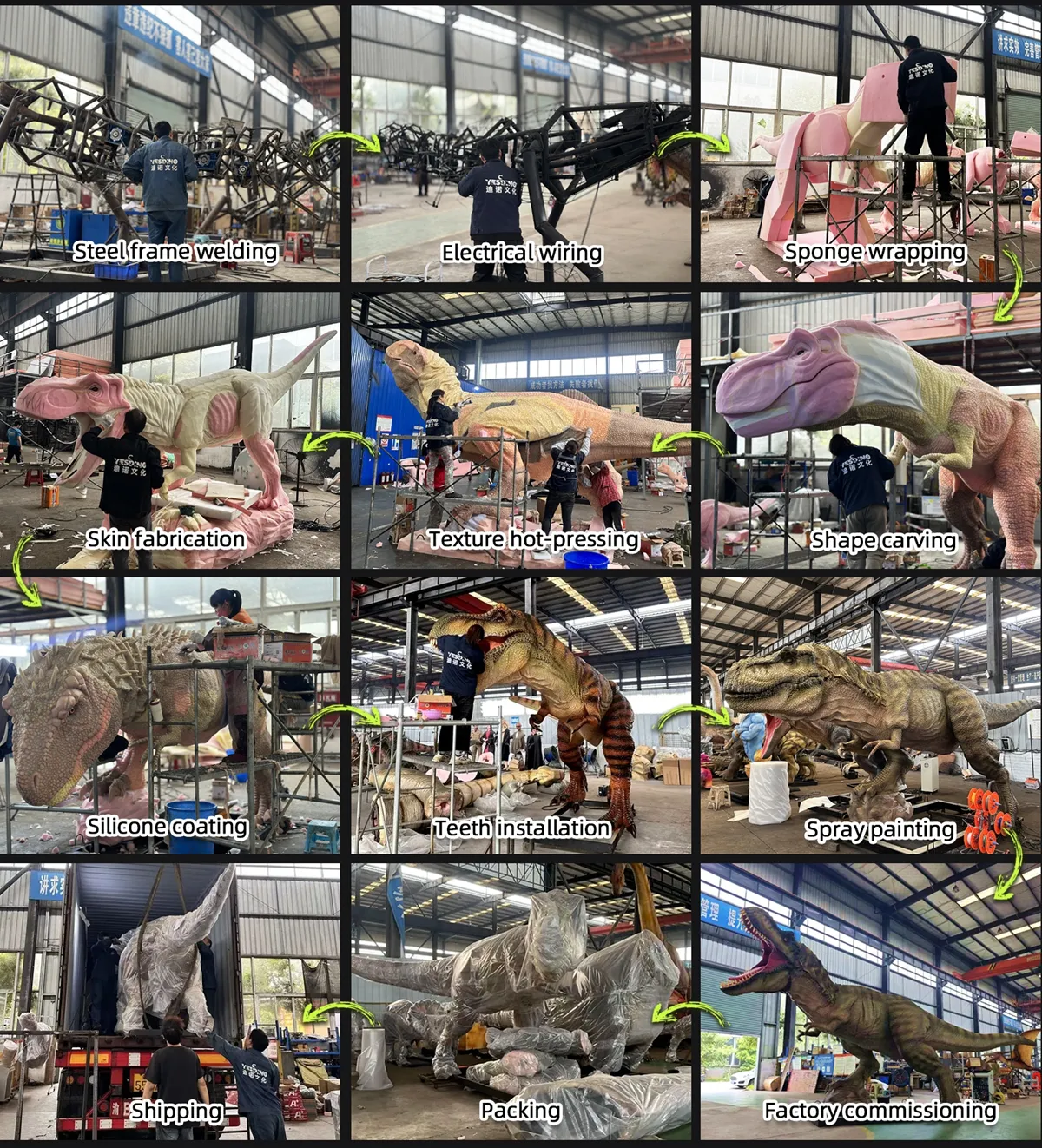
Q235 steel frame, rust-proof treatment, foam carved to volume, 5–7 mm silicone, pigment sprayed in translucent layers. On the wing the skin is laid over a spar structure, and the panels between spars move most in wind; those are the joints to inspect after a season outdoors.
Feather texture across a 10 m wing is done in sections and matched at the seams, with the seams placed where the wing folds so they read as feather lines rather than as joints. Rated −25 °C to 45 °C, 110 V or 220 V to destination, electronics on a two-year warranty.
A lift job, sequenced
The wing ships in sections and assembles on site around the mast. This is a lift job, with a crew and a base designed for the load — a ballasted frame, a concrete pad, or both, depending on the ground.
Sequence it: base and mast, wing roots, outer sections, with hinge travel checked by hand at each stage. Guy lines during assembly, and a service position that lets a person reach the shoulder joint without scaffolding. On a build this size, installation planning sets the delivery date as much as production does.
What the site plan needs to show
Send the site plan with the proposed position, the ground surface, the prevailing wind direction, and anything overhead — trees, cables, roofs. Send the viewing distance you expect, since a landmark read and a close-up read want different siting.
Where this size is wrong: a wooded trail, a narrow walkway, or a site with no room to stand back. A 10 m bird in trees is a wall of silicone at three paces, and the same design at a smaller span suits a trail better.
Enquiry
Send the site photo, the ground plan and the wind direction for the season you open. If the bird goes near water, say how near, because the base detail changes with the ground. Freight, duties, certificates and installation are quoted separately from the product price, and the base design belongs to the installation quote rather than the animal.
Where to go next
Worth reading before you commit: the spare parts and repair kit list for how the sizes compare, the installation guide for pads and access for what the ground has to carry, and the rental cost breakdown for where the money actually goes.
For ideas on placing it, see layout strategies for themed trails. The rest of the range is on animatronic animals, and if this one is the wrong size for the slot, animatronic ice age squirrel for exhibitions is the closest alternative.
Product Accessories

Packaging and Container Loading