Production Process
Most park entrances have the same problem: a fence, a ticket window, and a stretch of ground that has to tell visitors they have arrived. A 4.1 m tyrannosaur does that job from the car park, and 13 m of body keeps it reading once people are close. It is the middle of the range, and the size that fits a gate without a crane on site.
Thirteen metres long, 1.7 m across the body, 4.1 m at the top of the skull.
Thirteen metres, four point one up
Two things make this size useful at a gate. The head at 4.1 m clears a 2.5 m entrance canopy and shows above a boundary fence, so the animal is visible before the turnstile. And at 1.7 m wide the body fits a planted island between two walking lanes.
What it does not do is loom. Four metres is below the height of a two-storey building, so where the brief is a silhouette over the roofline, a taller build is the answer. Here the animal works at ground level, at the scale of a person walking past its feet.
Gate lines and ticket queues
The best position is usually just inside the gate, angled across the queue rather than parallel to it. Visitors waiting in line then see the head in three-quarter view, and the queue itself becomes the viewing area, which saves building one. Keep three metres between the head and the fence line: the skull swings wide and a queue pressed against the barrier gets the full travel.
For a photo point, stand the animal with the entrance sign behind it and the sun across the face. A west-facing position gives warm light at closing time, when most visitors take the picture they post.
Head and hip, tuned as one
The head is heavy and the neck is short, so head turn and body lean read together. We tune the lean to start a beat before the turn, so the animal shifts its weight rather than swivelling a skull on a post. The jaw follows on its own delay, and that offset does more than a bigger gape.
The forelimbs are small and two-fingered and get a short press, not a reach; at 4.1 m the arms are above adult head height, so visitors see them against the sky and a big gesture looks like a wave. Tail sway is low amplitude for the same reason it is on any long build: the tip travels further than the base.
Skin that works an entrance
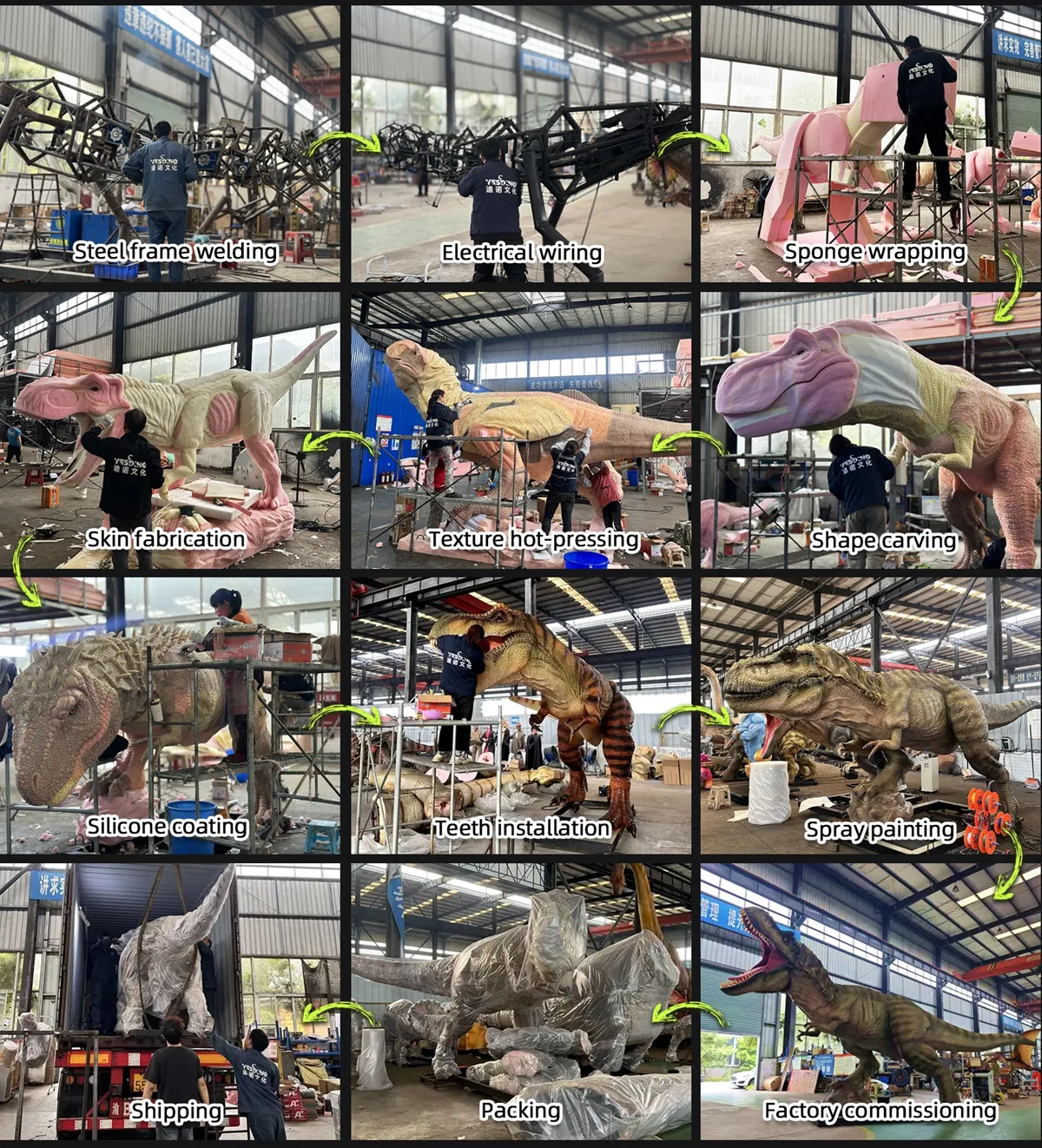
Q235 steel frame with rust treatment, high-density foam carved to volume, silicone skin at 5–7 mm, colour in translucent silicone layers. Entrance animals get touched at the tail and leaned on at the base, so those two areas carry extra skin thickness and a repair kit with matching pigment goes out with the animal.
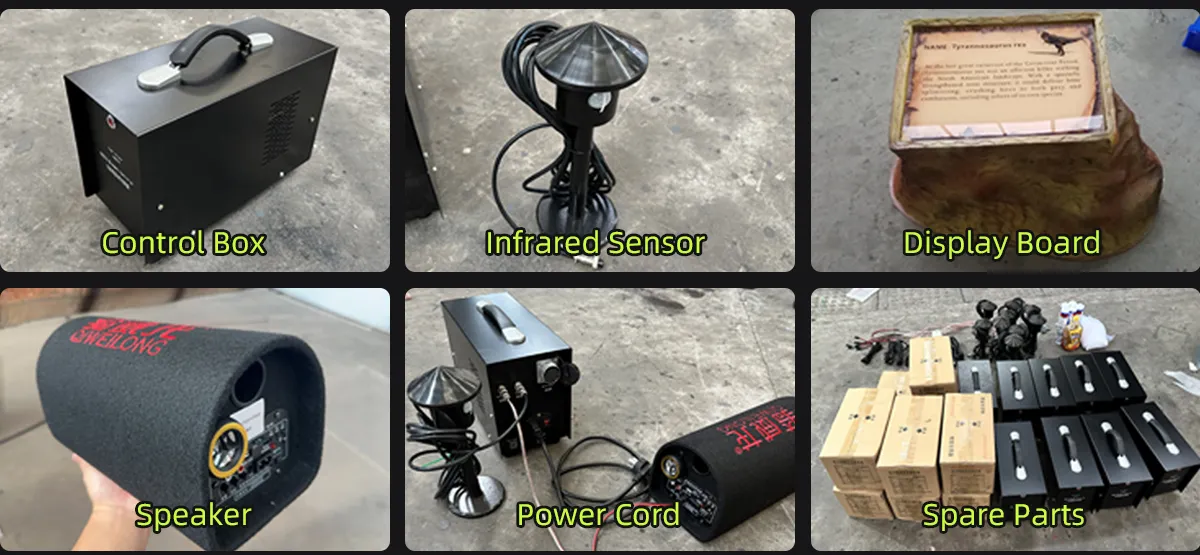
Working range is −25°C to 45°C, 110V or 220V set for the destination. At a gate the animal runs long hours, often from before opening to after closing, so the drive runs on timed cycles with the proximity sensor taking over at peak. Parameters are set at commissioning and left on file.
Off the truck, no crane
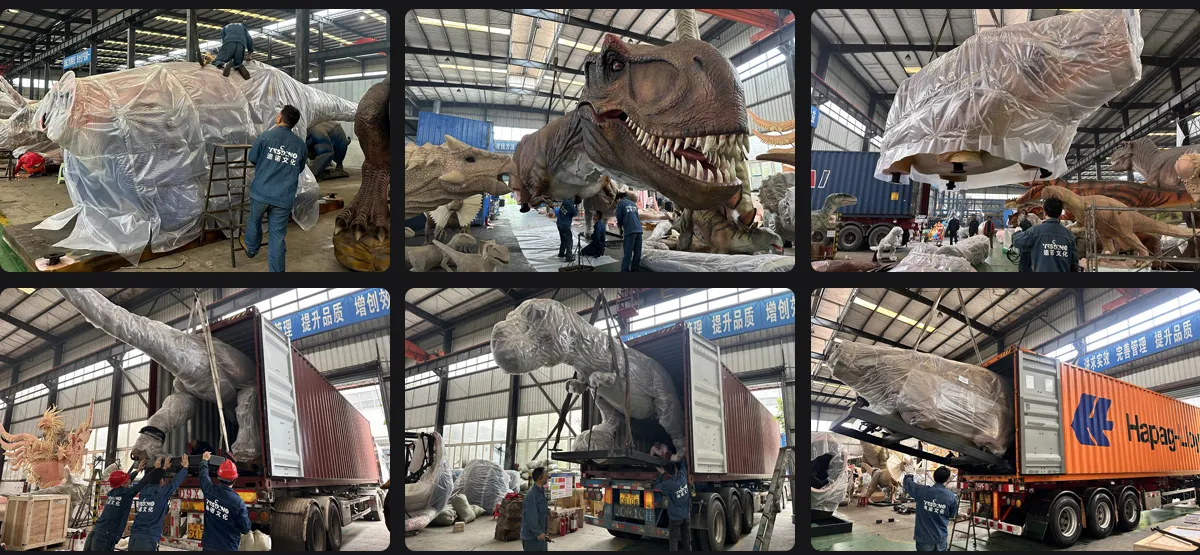
The build travels in four sections plus the base frame, and each section is within the reach of a telehandler or a truck-mounted loader. That is the practical difference at this size: no mobile crane booking, no road permit for a heavy lift, and a crew that can start the morning the truck arrives.
Order: base frame on the pad, anchor plates set, hips and torso, front body onto the coupling, neck and skull, tail, then skin closure. The cabinet sits behind the animal with the door on the service side, and the sensor goes at about 1 m behind a planter or sign so it picks up visitors on the approach rather than the queue standing still. Roughly one second of delay keeps it from firing at every passer-by.
Before you order
Send the entrance plan, the gate width, the queue layout, the ground surface at the display, and the power drop. Tell us the height of any canopy or signage over the spot, since the skull needs room to lift through its travel.
Two cases where 4.1 m is the wrong answer. A forecourt where the animal has to be seen from a main road two hundred metres away, which needs more height than 4.1 m. And a site where the display sits on a slope or a bridge deck, because the base wants level ground and the load wants a pad rather than a raised structure.
Enquiry
Send the entrance drawing, a photo taken from where visitors arrive, and the gate and canopy dimensions. Tell us the power situation and whether the animal faces the queue or the ticket window.
Freight, duties, certificates and installation are quoted separately. The section weights and the movement list come with the quote.
Where to go next
Two things come up in almost every enquiry on this build: how the size compares with the alternatives, and what it takes to get it on site. The park layout and theming strategies sets out the length options side by side, and the cost breakdown with the seven price factors covers pads, access and assembly. Budget planning sits in the spare parts and repair kit list.
For ideas on placing it, see outdoor placement notes. The rest of the range is on animatronic dinosaurs, and if this one is the wrong size for the slot, animatronic plateosaurus for theme parks is the closest alternative.
Product Accessories
Packaging and Container Loading