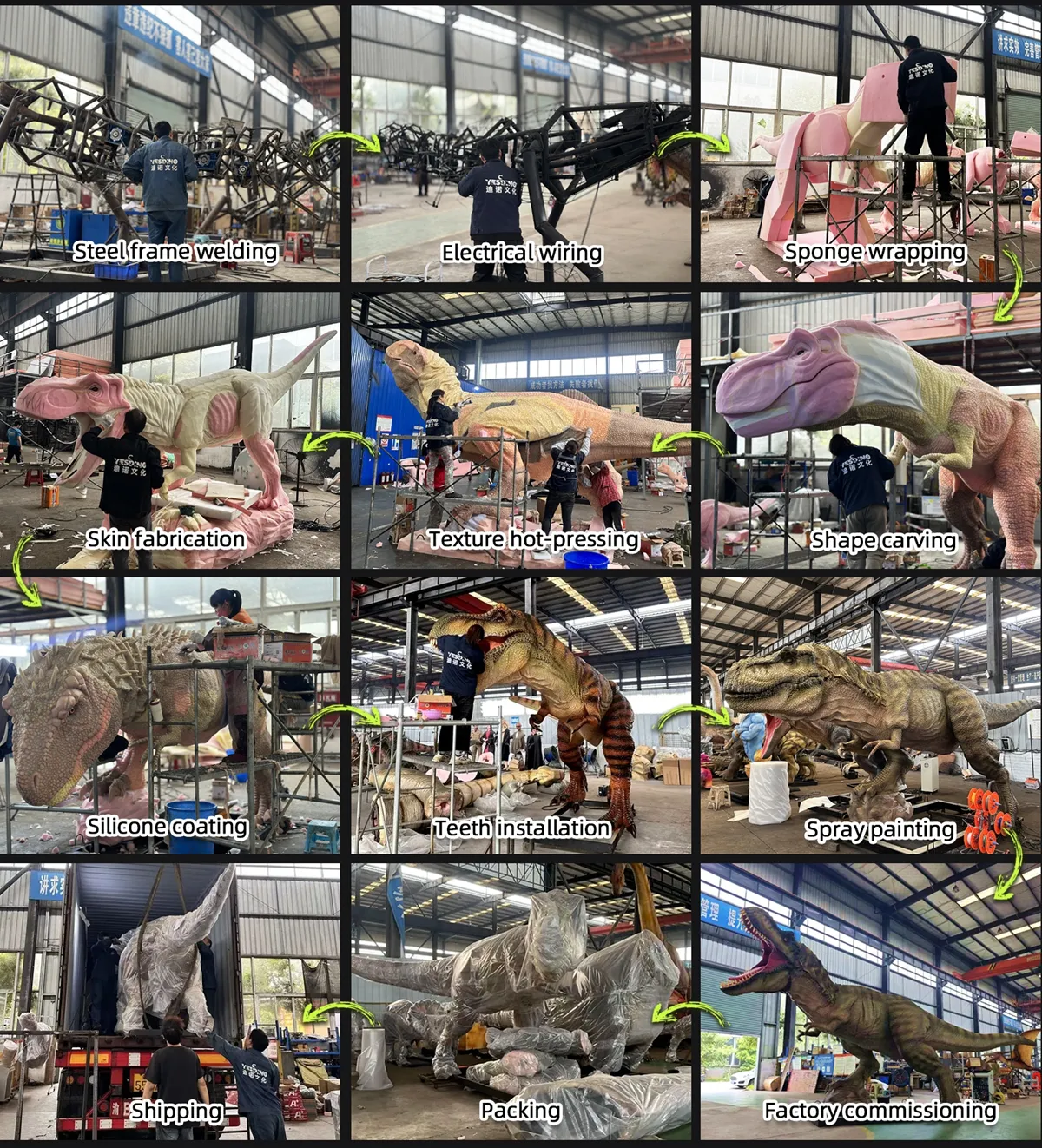
Production Process
A scene, not a statue on its own
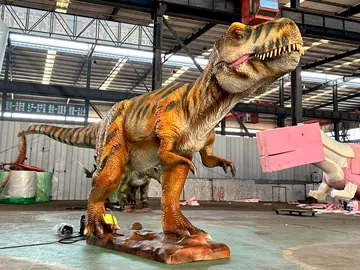
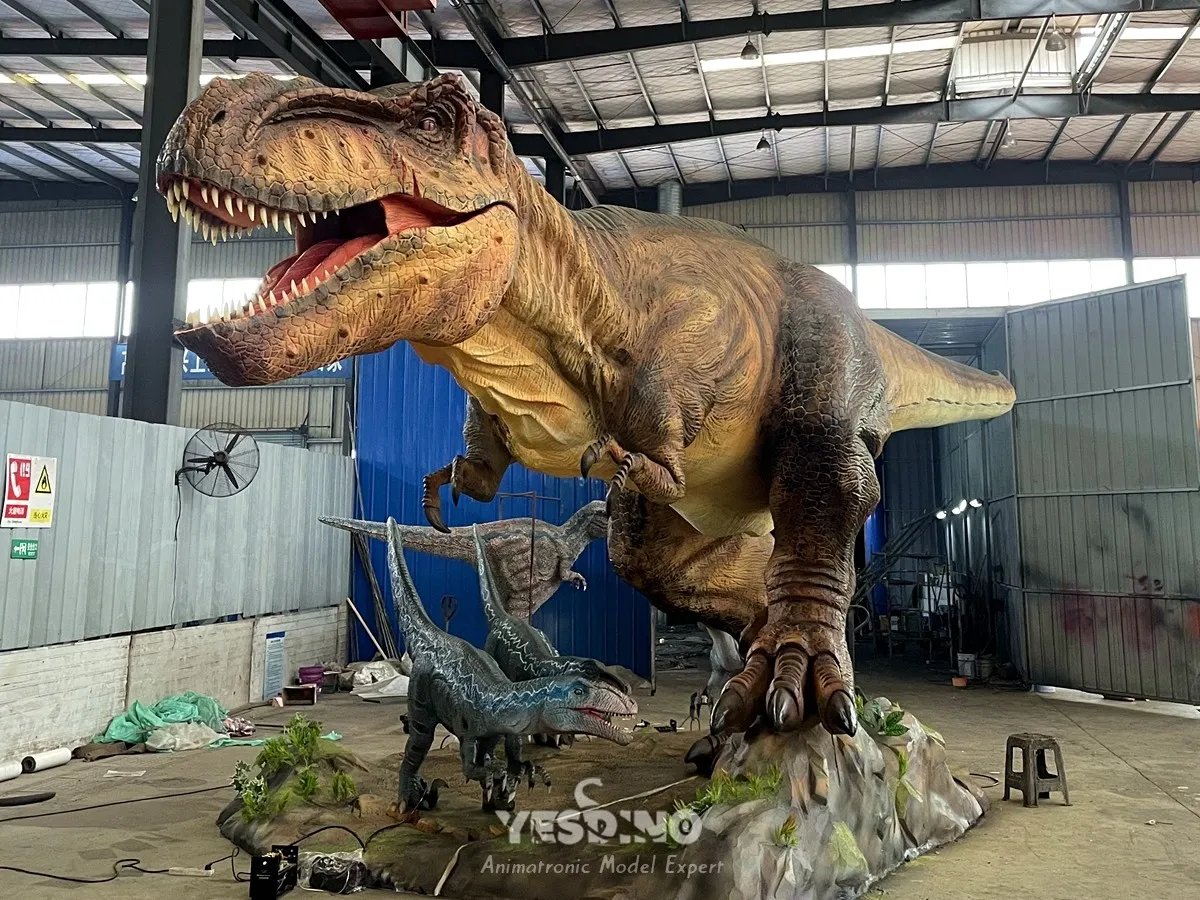
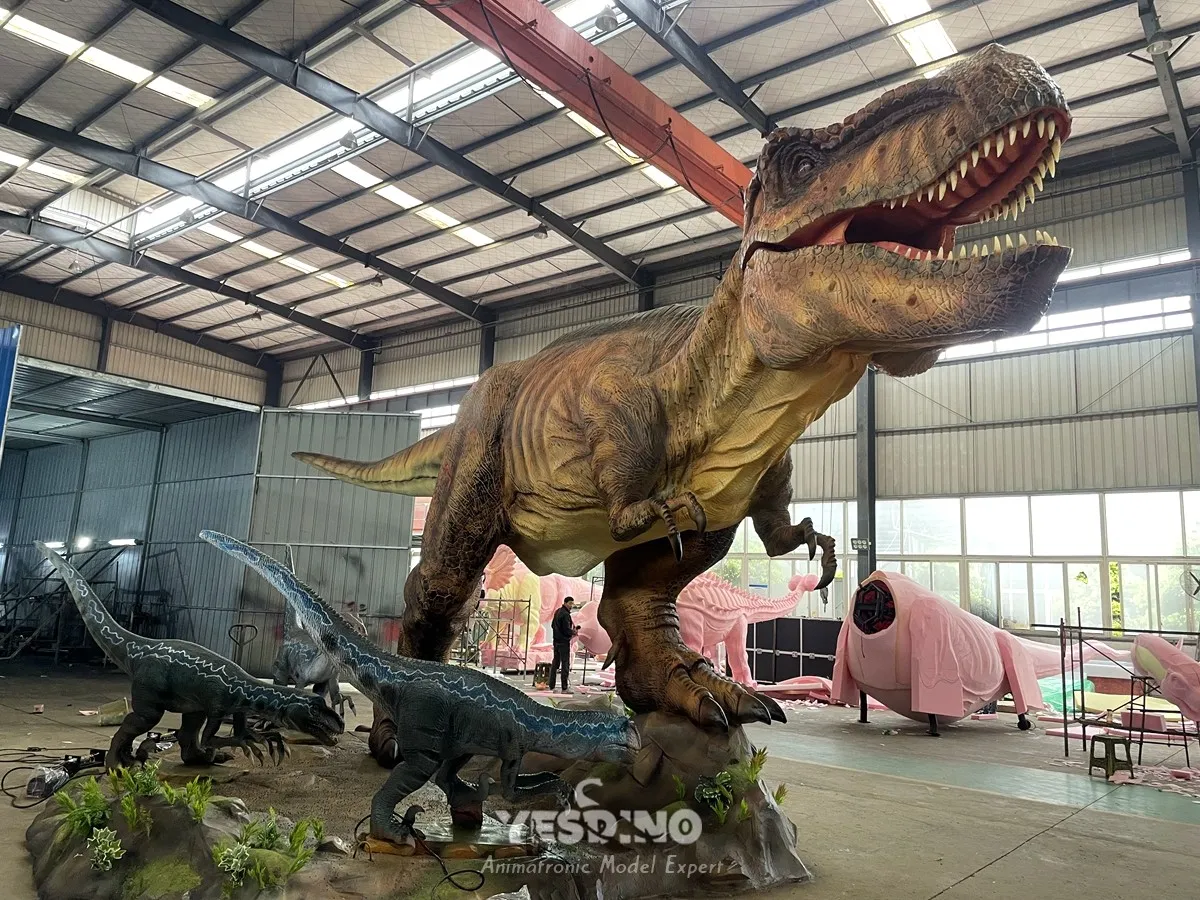
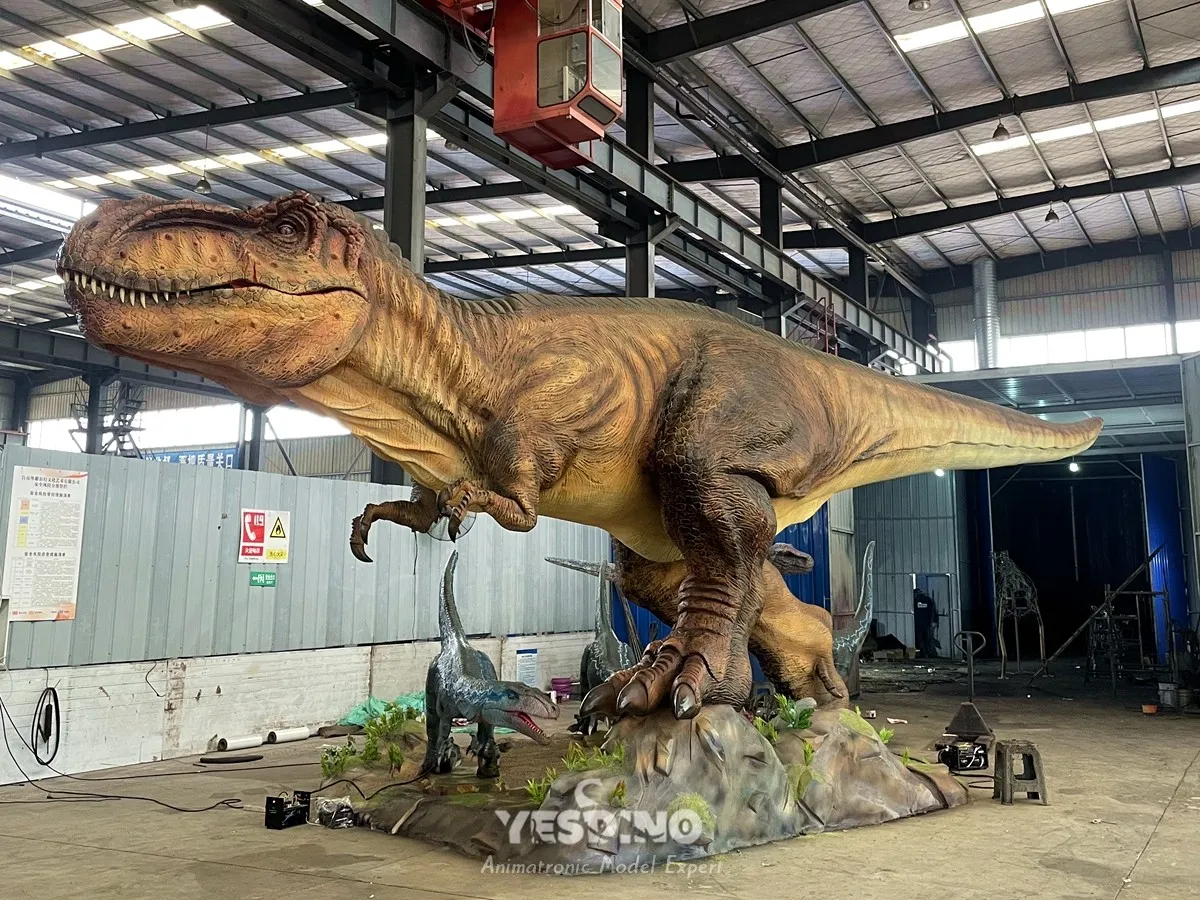
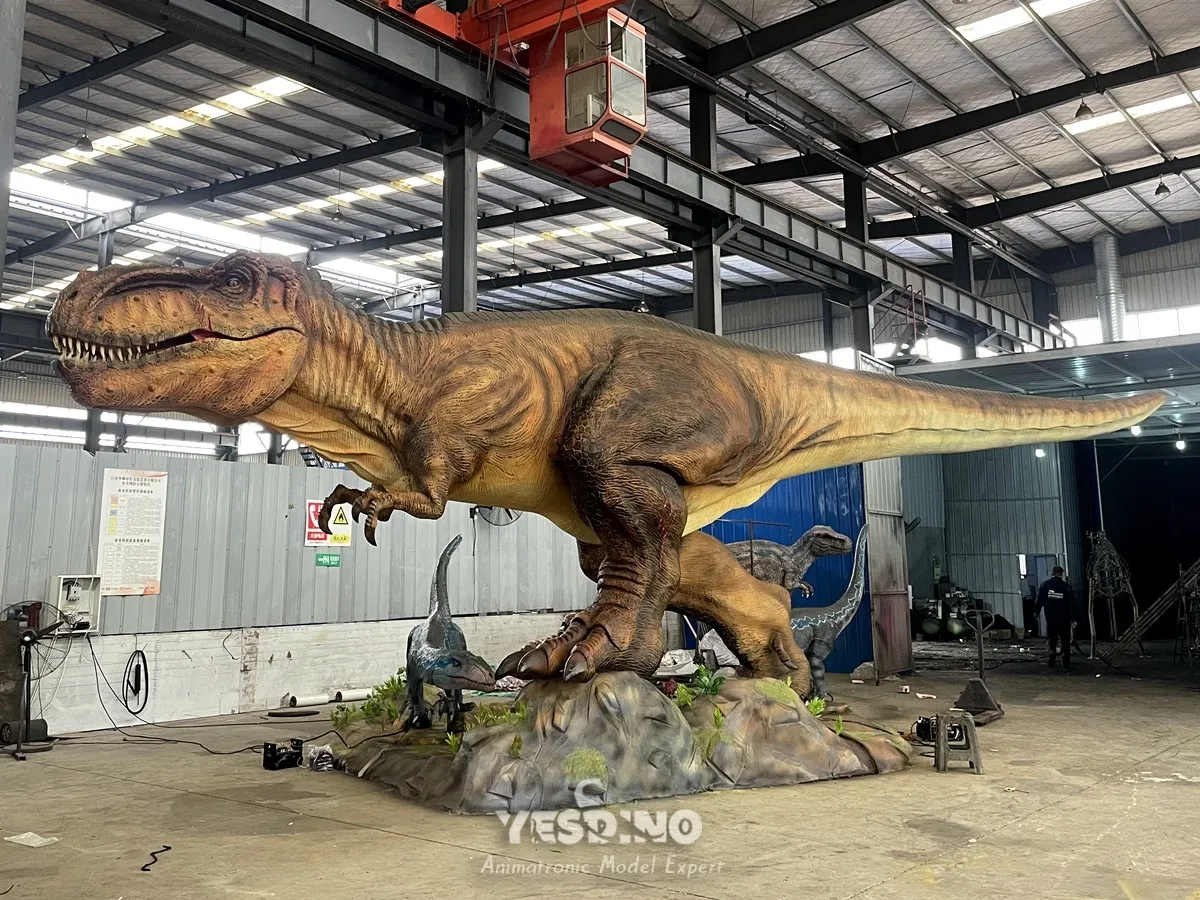
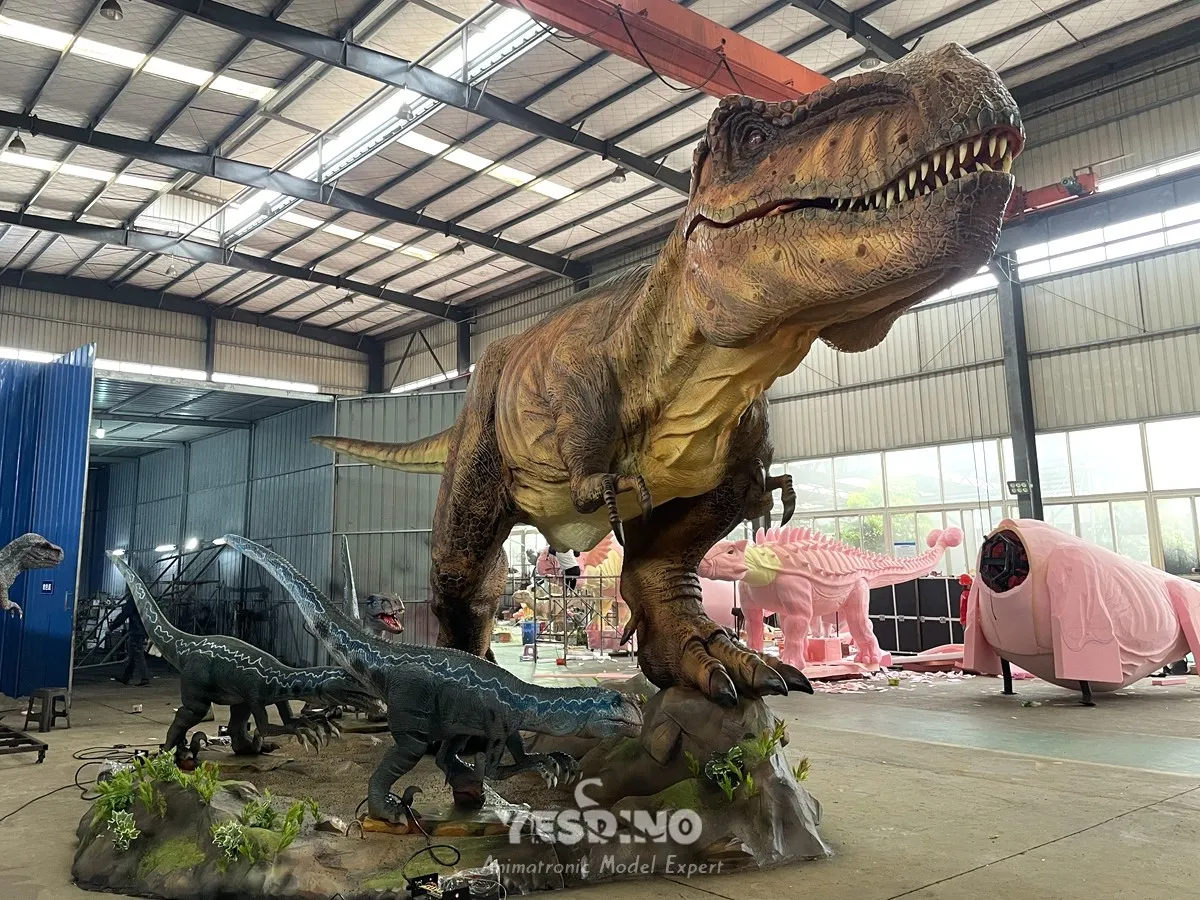
A 15 m Tyrannosaurus standing by itself in an open field reads as a large object from the car park. Put three 3 m Velociraptors around its feet and the number stops being a spec sheet figure and becomes something visitors feel before they read a sign. The small animals are what tell the eye how big the big one is.
That is the practical argument for buying these four together. Four animals from four suppliers means four colour palettes that do not quite match, four control systems with four different remotes, four lead times and four crews arriving on four days. Built in one workshop to one palette, the group looks designed rather than assembled - which is the difference between a photo stop and a walk-through exhibit.
What is in the set
- Tyrannosaurus, 15 m - the centrepiece. Give it the widest sightline you have, ideally 20 m or more of clear approach so the head is not cropped by trees.
- Three Velociraptors, 3 m each - placed 6 to 10 m from the T-Rex, staggered off a straight line. Raptors read as a pack when they face slightly different directions.
- One layout drawing at 1:100 - marked with viewing angles, the power drop and the service access point for each animal.
The three raptors can be built in different poses - one head down, one mid-stride - so the set does not look like the same file printed three times.
What actually moves
On the T-Rex: head turn, jaw with the roar, neck, tail sweep and forelimbs, with body rise if the viewing distance is short enough to notice it. That is five to seven joints, which is the range most builds land in. On the raptors, three or four each - head, jaw, tail - because at 3 m the head is the whole read.
Each animal keeps its own cabinet and its own relay board. A single start button, or a sensor on the walkway, fires all four together, so the roar lands when someone walks in rather than on a timer that goes off at an empty path. Where a joint has to hold a pose against gravity - a raptor head held up mid-lunge - that joint is specified as servo with its own controller. It is a different cost class, not a trim option, and it is worth naming before the quote.
How it is built
Q235 steel is cut, welded and braced into the skeleton first, because that stage decides what the animal can physically do later. Wiring and limits go in before any skin, routed around the joints so nothing chafes once it starts moving. Foam is carved by hand for volume and muscle line, then the scale texture is worked into the surface rather than printed on. The 5-7 mm silicone goes on in layers, and colour goes on in translucent coats so the depth still shows through under direct light.
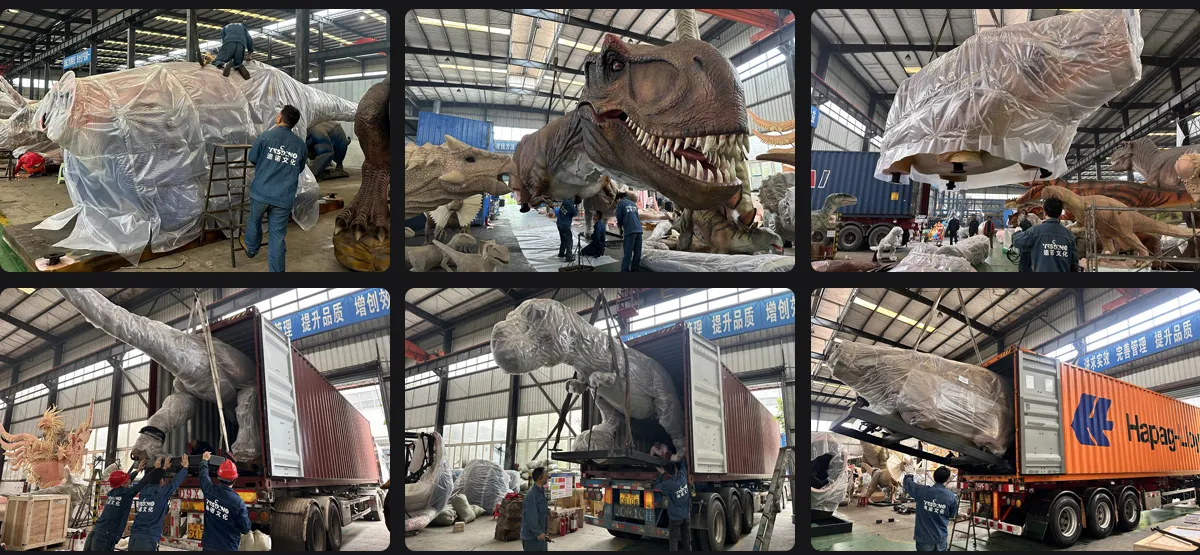
Every unit runs its full cycle before packing, and that test is filmed. You see the animal that ships, not a stock clip.
Siting, installation and upkeep
The 15 m travels in sections and needs a crane or forklift on site, plus ground bearing and anchoring designed for wind load. The 3 m units are light enough to move by hand, which is why they are the ones you reposition after opening week.
Raptors sit at visitor height and get touched. Either keep them 1.5 m behind a low barrier, or expect to re-seal the seams once a season - both are normal, the second is just a job you are scheduling. Maintenance across the set is a morning a month: run the cycle daily before opening and listen for a change in sound, check seams and base seals monthly, and exercise the joints monthly in the off season rather than leaving them still.
Technical specifications
| Item | Spec |
|---|---|
| Set composition | 1 × Tyrannosaurus 15 m + 3 × Velociraptor 3 m |
| Length | 3 m to 15 m across the four units |
| Height | Proportional to length, fixed on the shop drawing |
| Frame | Welded Q235 steel, anti-rust coating |
| Body and skin | Carved foam volume, 5-7 mm silicone skin, translucent colour coats |
| Movement | T-Rex 5-7 joints, Velociraptor 3-4 joints |
| Drive | 450 W brushed DC motors, relay control board |
| Power | 110 V or 220 V single phase |
| Environment | -25 °C to 45 °C, sealed cabinet for outdoor service |
| Shipping | Sectional; crane or forklift on site for the 15 m unit |
| Warranty | 2 years on core electronics |
What the price covers
Inside the product price: the four animals framed, skinned, wired and tested; the specified movement set and control boards; export packing for the transport sections; two years of warranty on the core electronics.
Outside it: freight and insurance, import duty and taxes at both ends, certificates your market requires, installation with crew travel, crane, local labour and site power, foundation and site works, and delay costs from permits, weather or site conditions. Those are real project costs and they vary by country - budget them separately rather than expecting them folded into a product figure.
Questions buyers ask about this set
Can we start with the T-Rex and add the raptors later?
Yes. The 15 m is quoted on its own, and the three raptors are quoted as a group. If you add them in a second order, send the original colour reference so the palette still matches.
Do the four animals run from one button?
Yes. Each keeps its own cabinet for servicing, but the trigger is shared - one button or one walkway sensor starts the whole scene.
Can the raptors be a different species at the same length?
Yes. Anything in the 3 m band can be sculpted to the same layout without changing the site plan.
More models and sizes are on the animatronic dinosaur range, and the movement options and site checklist are set out on the animatronic dinosaur features page. If you are still choosing sizes, the 3 m to 12 m size guide covers what changes at each band.
Product Accessories
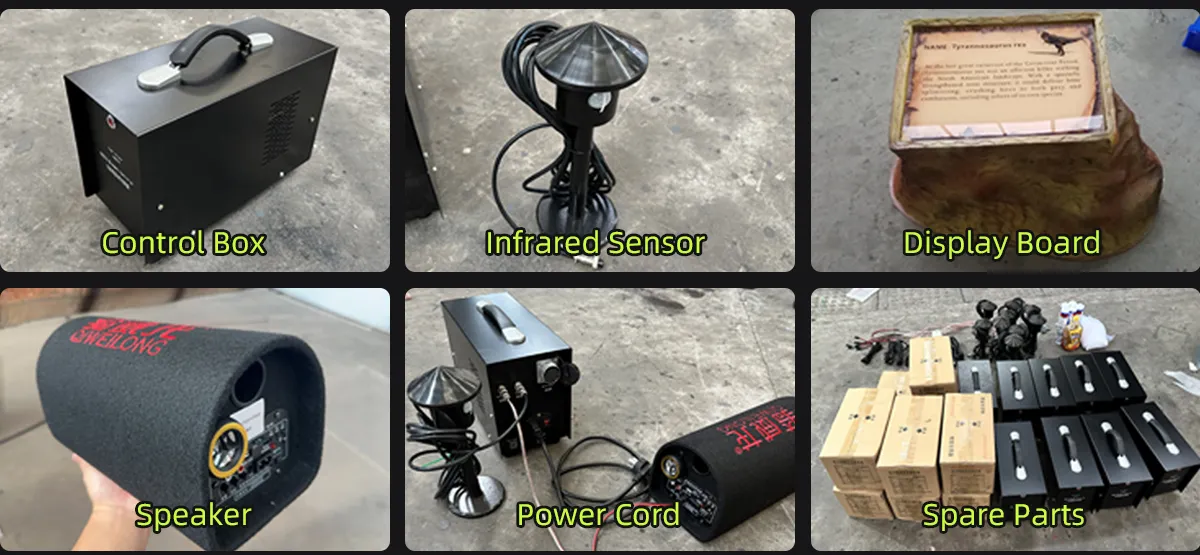
Packaging and Container Loading