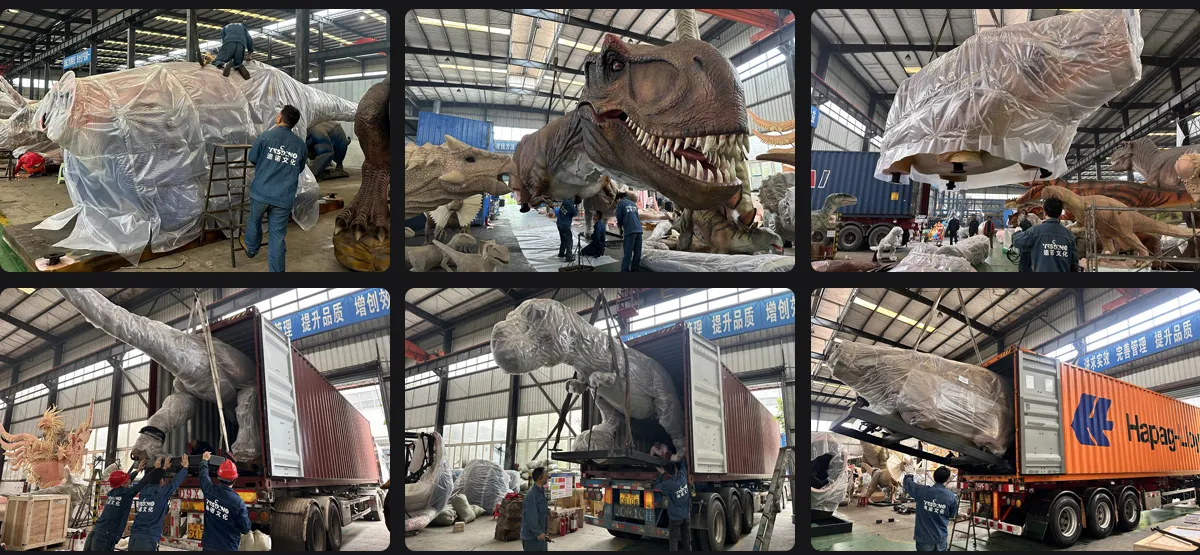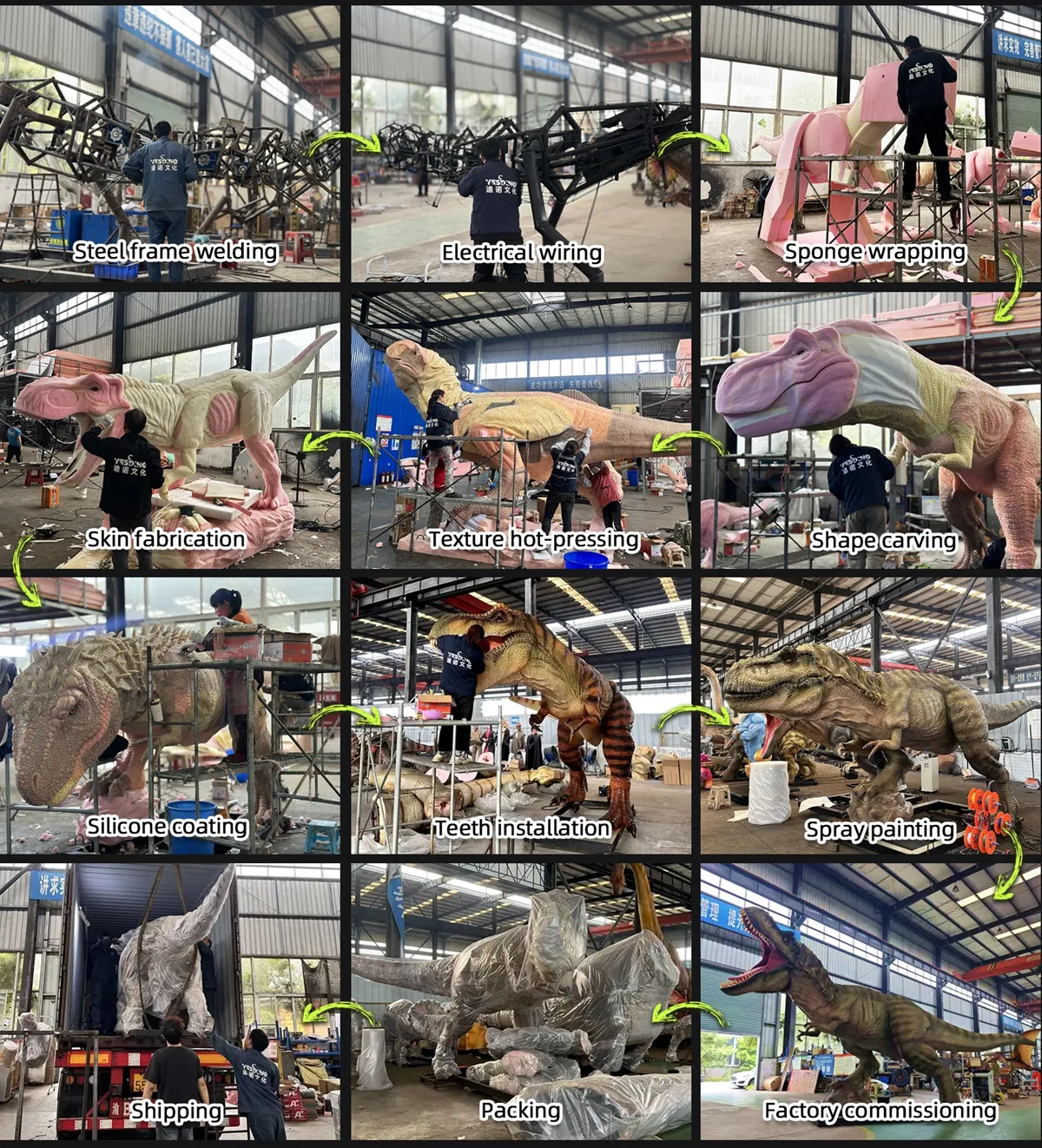
Production Process
Two animals the same length can look like different species from ten metres. A six-metre predator built on a slim frame reads as a large theropod standing in a clearing; the same length built 1.1 m across reads as something with weight in front.
It measures 6 m long, 1.1 m across the body, 2.1 m to the top of the skull. Compared with our other six-metre T-Rex, the extra is all width.
One point one metres across
Width at the chest is what makes a predator look strong, and it is the cheapest thing to add and the hardest to hide. At 1.1 m across the shoulders sit wide enough that the neck emerges from a mass rather than a tube, and the forelimbs have something to hang off.
The trade is floor and access. A 1.1 m body wants a 1.5 m gate minimum, and the base plate runs 1.4 m wide to keep a top-heavy animal stable. On a path under 2.5 m, the slim six-metre build is easier to place; this one is for slots with room around it.
Six metres on a themed trail
The build suits a clearing, a wide bend or a viewing platform where visitors approach from three-quarters. At 2.1 m tall the head is above adult height, so the face is seen slightly from below at 3 m, which is the angle that makes a heavy skull look heavy.
Set it 1 m back from the path edge, tail arc clear behind. On a themed trail the animal is usually the largest object in its section, so the planting wants to be low — a 2.1 m animal in front of mature conifers loses its outline.
What moves, and why the shoulder matters
Neck turn, head tilt, jaw, tail sway, blink, breathing. The neck turn carries the shoulders slightly with it on this build — about 4 degrees of body rotation at the chest. That coupling is deliberate: a wide animal that turns its head while the chest stays still looks like a head on a post.
Two-fingered hands and small forelimbs move in a short lift on the second beat of a sequence. They are close to the chest, so they read as part of the body rather than arms, and stay out of reach of the path.
The trigger sits in a themed rock at 1.0 m beside the approach, 0.7 s delay. A wide animal turning towards a visitor covers ground with its head faster than a narrow one, so the turn is capped short of the path edge by about 0.5 m.
Frame, foam and a heavy front end
Q235 steel frame, rust-treated, foam-carved volume, silicone at 5–7 mm over translucent colour layers. The front of this animal carries more foam than the rear, and foam is light, but the frame inside it is braced more heavily at the shoulder to hold the neck actuators and the skull's weight.
Two people can still lift the head section by hand at the lifting points welded above the shoulder. Colour is layered rather than painted on top, so a scuff on the flank shows a lighter tone in the same family, and patching is done with pigment. Rated −25°C to 45°C, 110 V or 220 V at build, electronics under a two-year warranty.
Getting it off the truck
Ships as head, two body sections, tail in two parts, legs, base plate, cabinet, sound system and documentation. The body splits at the hips, so the widest piece is 1.1 m and the longest is a little over 2 m — both manageable on a flatbed with a tail lift.
Order: base plate, legs, rear body, front body, tail, head, then power and calibration. The cabinet sits at the rear behind a lockable panel with 800 mm of access, which is more room than the front gives and keeps the technician clear of the head while it is powered up. Anchoring is four M16 anchors into a pad, or ballast where the ground will not take drilling.
Before you order
Send the slot from two angles, the gate and door widths on the route, the ground surface and the voltage. Tell us the viewing distance as well, since a 1.1 m body is worth the extra only where people get within 6 m.
This build is wrong for a narrow trail, and wrong for a slot where the animal is seen mostly from the front at 15 m or more — at that distance the width disappears and a slimmer six-metre animal looks the same. Shipping, duty and installation are quoted separately from the animal.
Enquiry
Send the photos and the route widths, and we will confirm the section split and the anchor layout for the ground you have. If the animal has to move between seasons, say so now; the base changes.
Where to go next
If you are still comparing options, start with the size guide covering 3 m to 12 m builds — it lines up the builds by length and reach. Site work is covered in the rental cost breakdown, and the pneumatic versus hydraulic comparison lists the factors that move the price.
For ideas on placing it, see family-facing prop selection. The rest of the range is on animatronic dinosaurs, and if this one is the wrong size for the slot, 13m t-rex for event decoration is the closest alternative.
Product Accessories
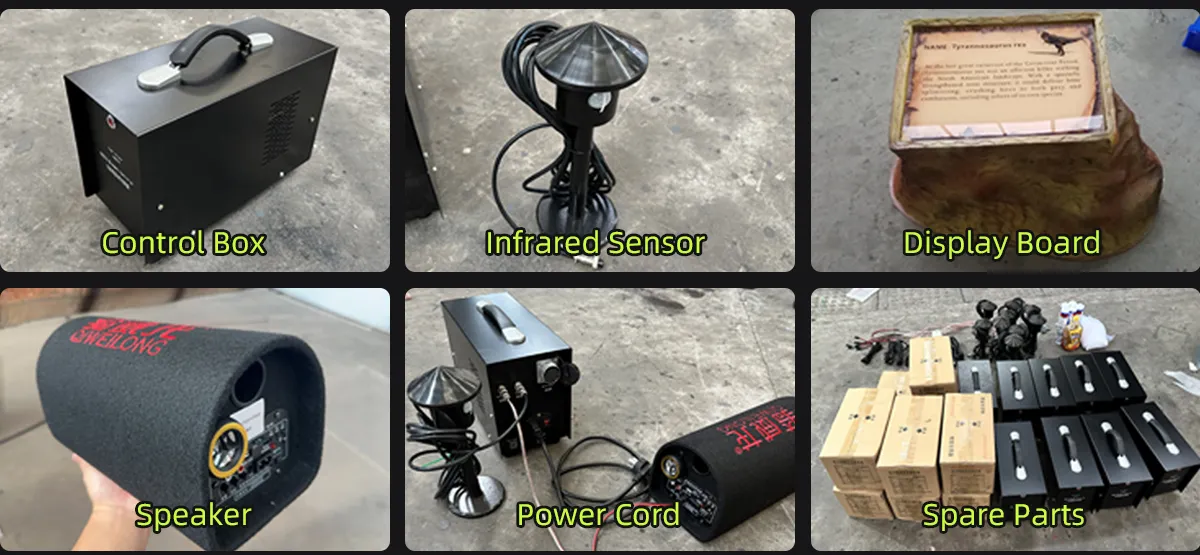
Packaging and Container Loading