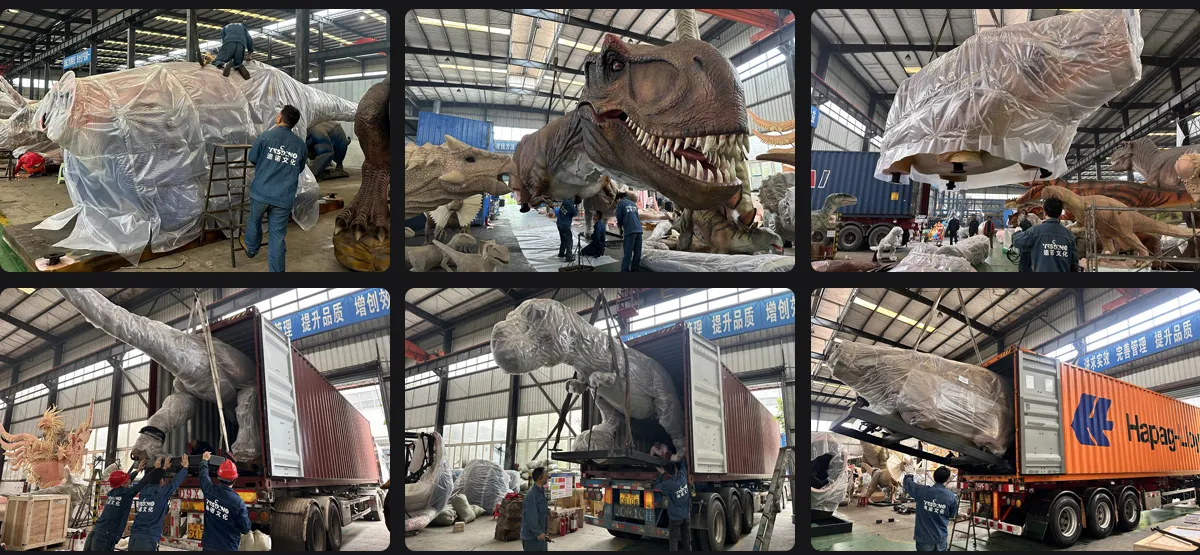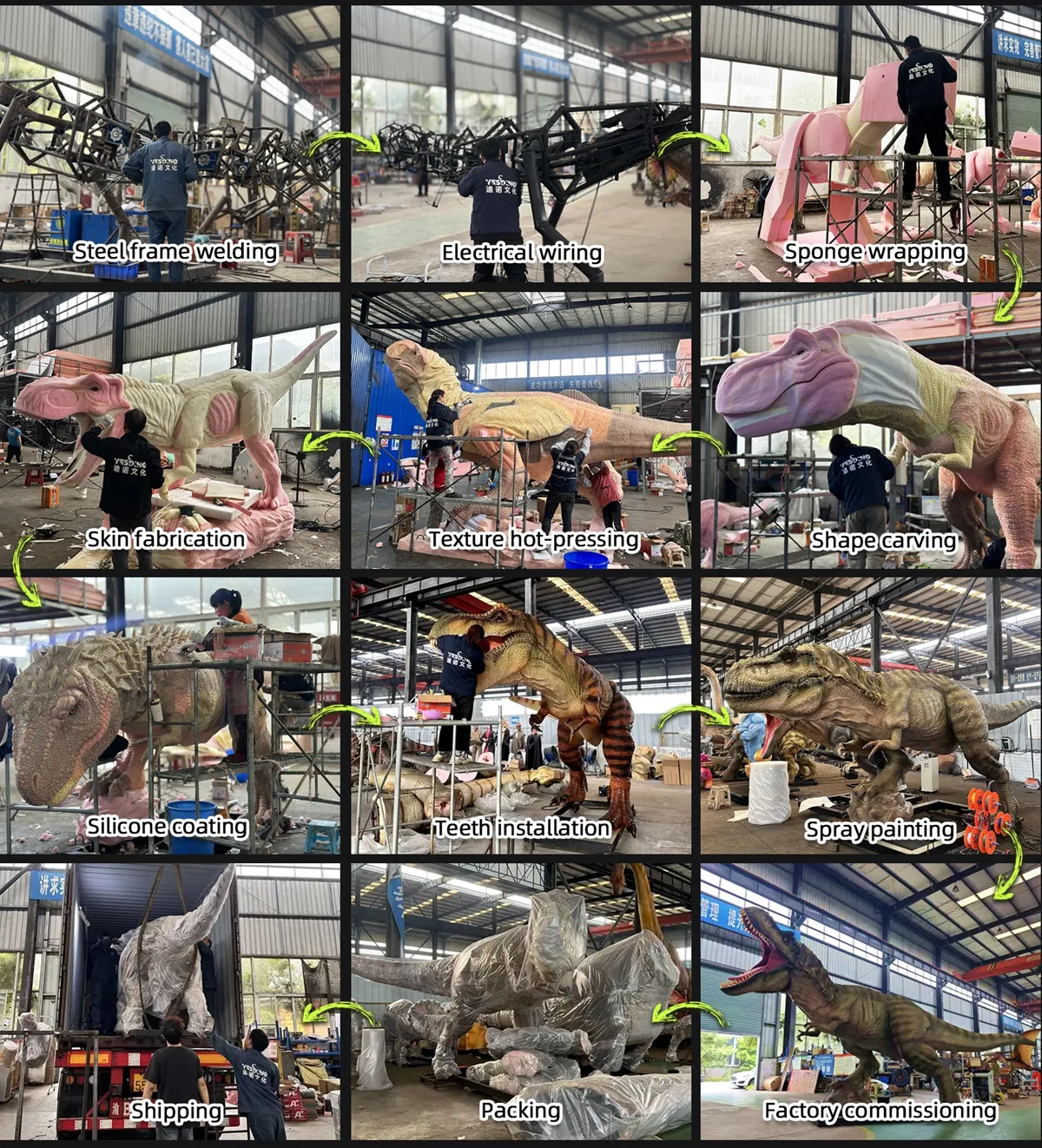
Production Process
Walking the trail, you see the sail first — a serrated edge above a hedge, moving slightly — and the head appears over the planting about fifteen metres later. Nobody has read a label. The animal has already done its job.
Eight metres long, 1.4 m across the body, 2.4 m to the top of the sail. As scenery, those proportions matter more than the detail, because the visitor meets the silhouette before they meet the skin.
Why 8 m works as decoration
A decorative animal has to hold a view from 8 m to 20 m, where eyes and teeth are invisible and outline is everything. Eight metres of back and sail with a long snout gives a profile that reads at that range; a 5 m build reads as a large shape and little more.
The sacrifice is close inspection. At 2.4 m the head sits above most adults and the skin detail was budgeted for distance, so a guest who walks up and studies the jaw will find it simpler than a museum piece. That is a fair trade for scenery and a poor one for an exhibit hall.
Planting, queue lines and photo walls
Three placements come up often. Behind a 1.2 m hedge, where the sail and neck show above the greenery and the legs stay hidden — the hiding sells the illusion and saves you the cost of finishing the feet. Beside a ride queue, 2 m back from the rail so the head turns over the waiting line. At a photo wall, side-on, head at the end where the family stands.
Work the sightline backwards from where people will stand. If the first view is at 6 m, angle the animal 15 to 20 degrees off the path so the flank and the sail edge both show. Straight-on to the path gives you a chest and a pair of legs.
What moves, and what to leave out
Neck, head, jaw, blink and tail, on a timed loop rather than a proximity sensor. For scenery this is the right call: a sensor set in planting fires at branches, at dogs, at a bin bag in the wind, and a decorative animal that reacts to nothing in particular stops reading as an animal.
A 25 to 40 second loop, head turning away and back with the tail on a slow sweep, catches the eye of someone walking past. Sound we usually leave out, or set very low with the speaker in the chest: a queue line already has narration and ride noise.
Weather, water and colour
Steel frame in Q235 with rust treatment, foam volume, silicone skin 5 to 7 mm, translucent colour layers. The build runs from −25°C to 45°C, and the parts that age outdoors are predictable: the top edge of the sail, the snout, and any horizontal surface where water sits.
Two details come out of that. The spine along the top of the sail is set at a slight fall, so rain runs off the trailing edge instead of pooling. And the hip joint, where water arriving down the back meets the leg, gets a drip edge and a second seal — that joint is where a decorative animal looks tired by its second winter.
Getting it into the ground
Four sections arrive crated: head and neck, torso, tail in two. At 1.4 m body width they travel on a flatbed and pass a 1.5 m gate. On soil, ground screws at four points, 900 mm deep, with the frame sitting on a gravel bed so the base does not hold water; on a paved surface, a bolted plate instead.
The cable route wants planning before the planting goes in, not after. We run the supply in conduit 400 mm below grade to a cabinet set behind the animal, and the service side faces away from the public — if the front is a hedge, the back needs 800 mm of clear ground for a person to work. Assembly is one day for two people.
Before you order
Send photos from the visitor's first viewpoint, the height of any planting in front of the position, the ground surface and the distance to power. Tell us whether the animal is a surprise around a corner or a marker seen from the entrance — the facing changes with the answer.
Where we would suggest something else: a site that wants visitors to walk right up and touch the animal, because the finish here is built for distance; a position in full afternoon sun with no shade and a dark colour scheme, which will need a repaint sooner than the budget expects; and an indoor atrium with under 3 m of ceiling, since the sail cannot be trimmed.
Enquiry
Send a photo from the main path, the planting height, and where the power comes from. Tell us how close visitors get and whether the animal is on a loop or a trigger. We will mark the footprint, the buried cable route and the service side on your photo before anything is fabricated.
Where to go next
Two things come up in almost every enquiry on this build: how the size compares with the alternatives, and what it takes to get it on site. The installation guide for pads and access sets out the length options side by side, and the wiring concealment notes covers pads, access and assembly. Budget planning sits in the park layout and theming strategies.
For ideas on placing it, see visitor routing ideas. The rest of the range is on animatronic dinosaurs, and if this one is the wrong size for the slot, animatronic spinosaurus for holiday events is the closest alternative.
Product Accessories
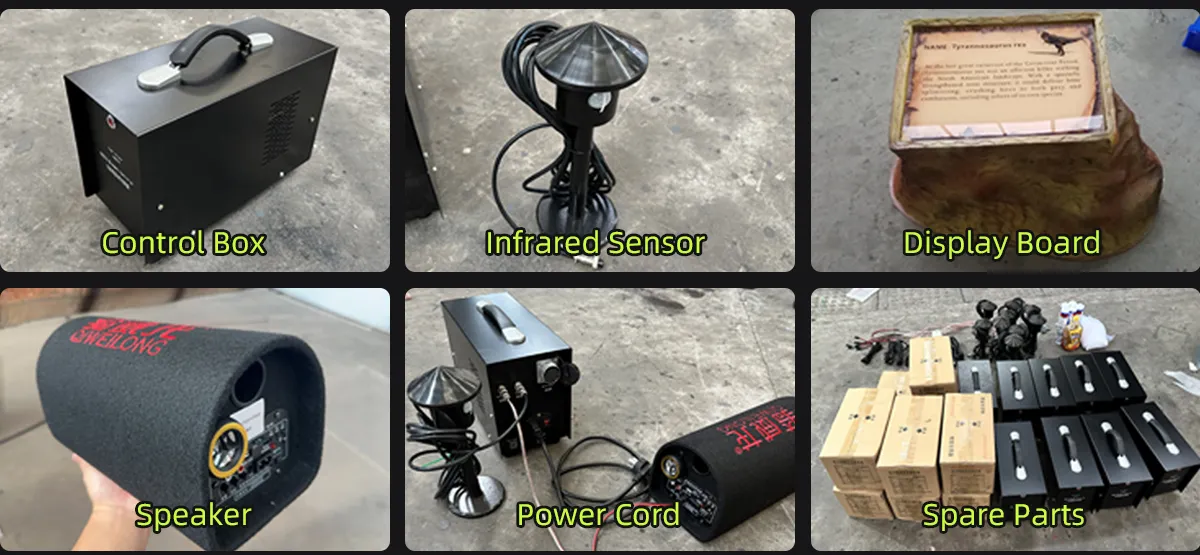
Packaging and Container Loading