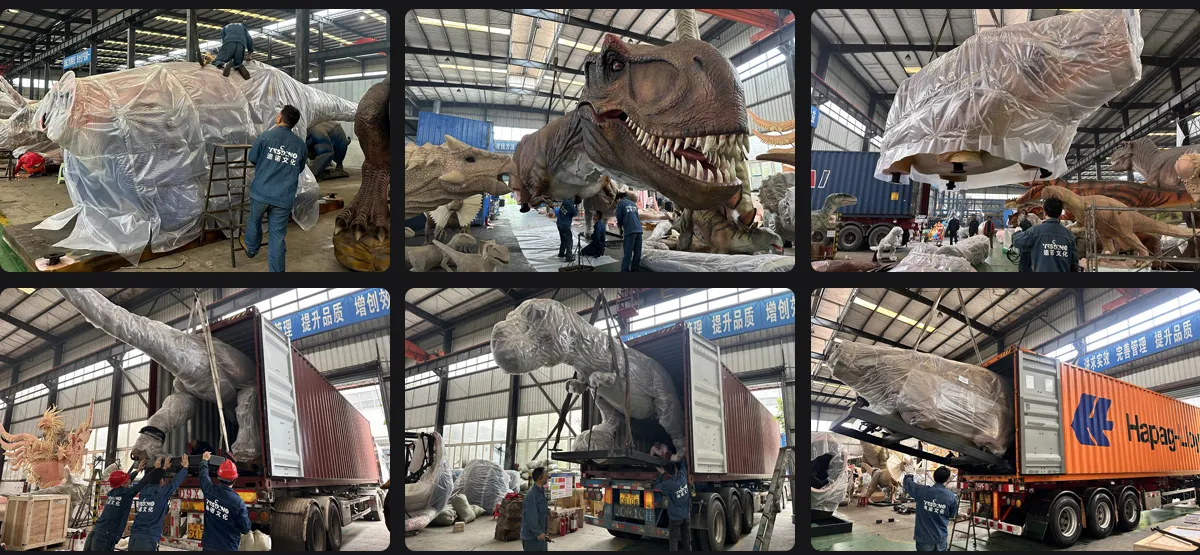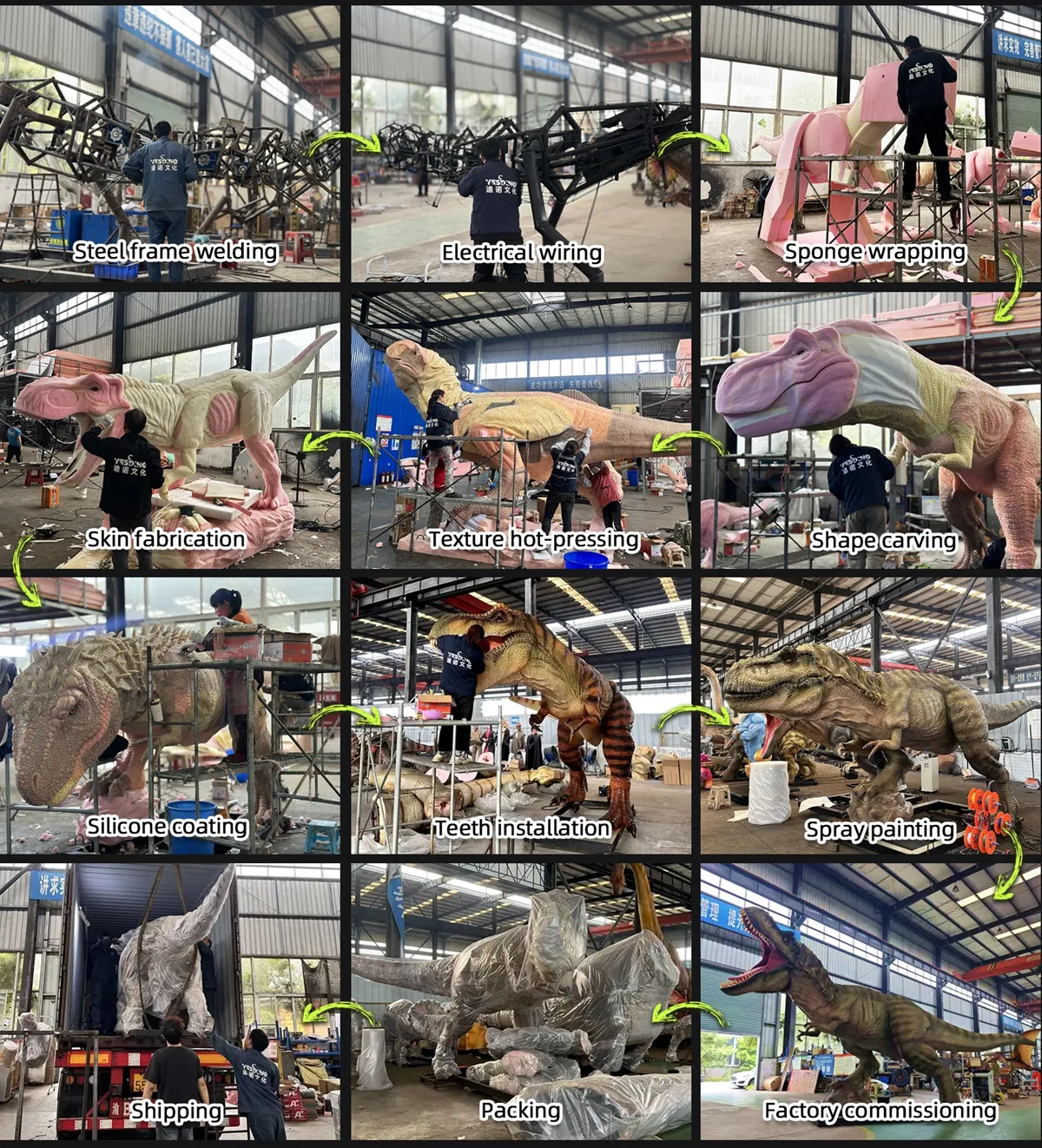
Production Process
Two metres at the head is the number that decides where this animal goes. It clears a normal ceiling, fits a doorway, and still gives a six-metre body enough presence to hold its own on an outdoor trail.
This is the larger Parasaurolophus build: 6 m long, 0.75 m across, 2 m to the top of the crest, 170 kg.
Silicone, and why it matters here
The skin on this build is silicone rather than fabric — five to seven millimetres over carved foam, coloured with translucent silicone airbrushed in layers. For an outdoor herbivore that is the right call: it holds up to rain, it can be wiped clean, and damage from a branch or a thrown stone is patched locally with matching pigment instead of repainting a panel.
It also carries the crest better. A hollow crest is a shape with a soft edge, and a soft material blurs that edge within a season.
The crest, and the sound that goes with it
The tube running from the snout to the back of the skull is hollow, and the current reading is that it resonated — a low, carrying call rather than a roar. On the model we sculpt the crest as a tapering tube with the bend and the nostril opening implied, so the profile holds from the side.
The sound file is pitched low with a longer decay than a theropod roar. High screams coming out of a hadrosaur is the most common error on these models, and anyone who knows the animal hears it immediately.
Six movement groups
Head left and right, neck up and down, jaw open and close with the call, blinking eyes, tail sweep, forearm scratch. The neck is the group to set carefully: a hadrosaur lifts its head slowly and holds it. Short dwell times and small travel read as browsing, which is what this animal is for.
Independent drives with end-of-travel protection; loop, proximity sensor or floor mat. On a trail, the sensor trigger is worth having — the head coming up as a group approaches is what makes people stop walking.
Where a herbivore earns its place
A trail made only of predators becomes exhausting: every animal is shouting. A hadrosaur between two theropods resets the rhythm, gives children something that isn't threatening, and makes the next predator land harder.
Placement is normally mid-trail, at a widening where visitors can walk around it rather than squeeze past. Two of them at different head heights read as a herd, and the second is cheaper because the tooling is done.
Finish and delivery
Welded Q235 steel frame with anti-rust treatment, foam volume, silicone five to seven millimetres, translucent layered colour. Standard scheme is a green-grey body with banded flanks and a warmer crest — enough contrast on the crest to read at twenty metres without looking painted.
Rated −25 °C to 45 °C, 110 V or 220 V configured at build, two-year warranty on core electronics. Ships in sections with base frame, control cabinet, sound system, wiring diagram and calibration sheet. Freight, duties, certificates and installation are quoted separately from the product price.
Placement on a trail
Put this animal where visitors walk past its flank rather than towards its face. A hadrosaur is a side-on silhouette: the crest reads from the side, the body reads as heavy from the side, and approaching head-on gives a small face with a lot of animal behind it.
At 2 m the head is at adult eye level, so the animal works best at the inside of a bend, angled about three-quarters to the path. Leave a metre and a half on the head side for people to stop without blocking the route, and keep the sensor on the path side so the animal reacts to arrivals rather than to a reflection in a window.
One detail worth settling early: the crest is the part that catches on things. A 2 m animal on a trail passes under branches, and a crest that sits proud of the skull is the first thing to take a knock. Siting it a metre clear of overhanging planting costs nothing at the design stage and avoids a repair in the first season.
Enquiry
Send the trail layout, the viewing distance and whether the animal will stand beside another herbivore. We'll come back with a posture and a sound recommendation rather than a catalogue page.
Where to go next
If you are still comparing options, start with the installation guide for pads and access — it lines up the builds by length and reach. Site work is covered in the wiring concealment notes, and the park layout and theming strategies lists the factors that move the price.
For ideas on placing it, see layout strategies for themed trails. The rest of the range is on animatronic dinosaurs, and if this one is the wrong size for the slot, animatronic t-rex for sale, 15 metres is the closest alternative.
Product Accessories
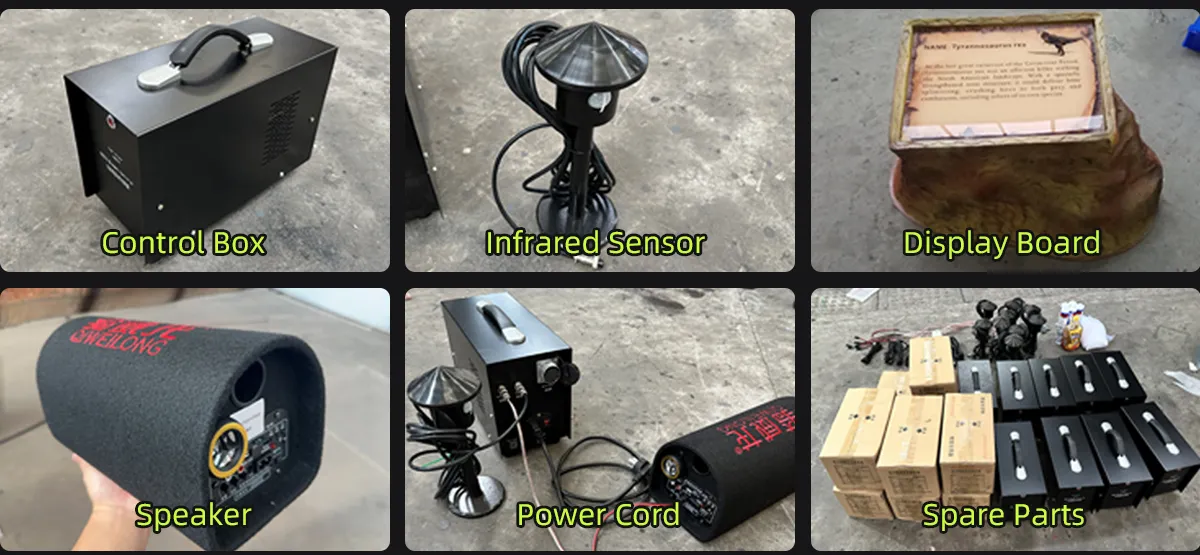
Packaging and Container Loading