|
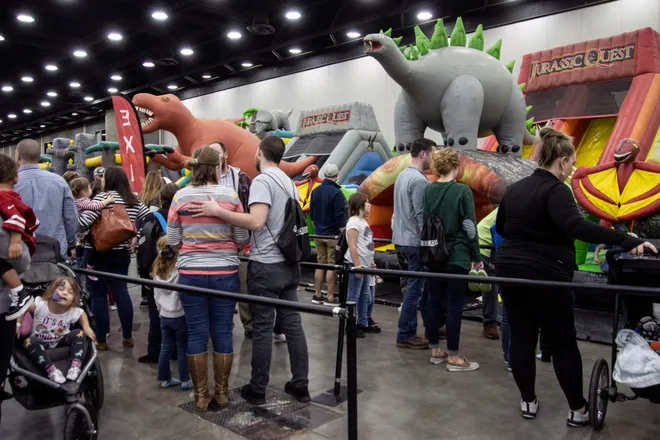
Creative dinosaur models should be placed at 3–5 key photo zones, each 30–50 meters apart, to prevent crowding. Set one-way walking routes with arrows and fences, keeping paths at least 2 meters wide. Staff can guide visitors during peak hours, moving groups every 5–8 minutes for smoother crowd flow. Photo ZonesGrand EntranceA life-sized Tyrannosaurus rex skull replica stands at the main entrance of the attraction, standing 6.2 meters tall with a jaw that opens and closes in sync with a looping low-frequency roar audio track. Visitors can step within 1.5 meters of the "living" giant and capture a dramatic close-up shot — no queuing required. The structure uses a modular fiberglass skeleton with individual transport pieces sized at a maximum of 2.4 x 1.8 x 1.5 meters, enabling full on-site assembly and calibration within two days. The entire system incorporates an infrared motion sensor: when a visitor enters the 1.5-meter detection zone, the jaw servo motors automatically trigger the opening-closing animation paired with the audio loop, requiring no staff operation. The joint drive system combines a servo motor with a harmonic reducer., delivering 0.1-degree positioning accuracy and a maximum jaw opening angle of 65 degrees. Each eye socket houses a dual-layer lens assembly: the inner layer is a programmable RGBW LED matrix (single-chip power 0.5W, four-color), while the outer layer is a 3mm curved acrylic protective cover. Holiday-themed lighting variations (Christmas red, Halloween purple, National Day gold) can be deployed via a software update in under 10 minutes — no hardware modifications needed. The entrance T. rex model's visual control range is substantial: a 6.2-meter skull is identifiable from highway sight distances of approximately 800 meters, significantly influencing navigation decisions for self-driving visitors. After installing this entrance model, conversion rates for nearby roadside guidance signs increased by approximately 25%. The exterior skin requires a matte waterproof topcoat reapplication every six months — the polyurethane-modified acrylic system delivers tensile strength of no less than 8MPa and adhesion rating 5B per ISO 4624. The coating drying window is approximately four hours and does not affect daily operations. At normal trigger frequency (800-1,200 activations per day), the joint mechanism's design fatigue life exceeds 500,000 cycles. Infrared sensors undergo quarterly trigger-distance calibration to maintain the stable 1.5-meter activation radius.
Operational data analysis reveals a clear "trigger effect" in social-media dissemination: of the first 100 visitor groups, approximately 32 will post related photos or videos to personal social accounts on the same day — 68% families and 32% young couples. Extrapolating conservatively, a single Golden Week holiday (7 days) generates over 2,000 organic social-media exposures, with audience profiles closely matching the attraction's target demographic (25-40-year-old families with children). A life-size "T. rex bite force experience device" is installed beside the skull: visitors insert their arm between the open jaws to feel the pressure equivalent of approximately 15 kilograms, simulated by a pneumatic system. This device has become one of the most photographed auxiliary interactive installations at the main entrance.
The giant dinosaur at the entrance serves not only as a visual landmark but as the core trigger for organic social-media propagation — photos taken here typically generate a 30%+ increase in attraction search traffic within 48 hours of posting, with conversion rates approximately 1.8x higher than paid advertising. The T. rex bite experience device averages 340 daily uses, significantly boosting the secondary transmission rate for the main entrance area. Family Photo AreaThe family photo area is positioned at the junction of the main thoroughfare and a branch route, away from areas where children run at speed. It features a 1.2-meter-tall Iguanodon mother-and-baby model set: the juvenile resting on a rock base and the adult in a head-down foraging pose, spaced approximately 1.8 meters apart to provide ample framing room for family portraits. The floor is covered with EVA impact-absorbing mats (thickness 15mm, Shore A hardness 65, impact absorption rate ≥35%), with heat-fused seams to eliminate trip hazards. Mats undergo semi-annual inspection focused on seam integrity and surface wear;Partial replacement occurs when abrasion depth exceeds 2 millimeters. Lighting design is particularly critical in this zone. A 2700K warm diffused light box mounted overhead provides soft, non-glaring illumination ideal for visitors of all ages. Photographers typically recommend standing directly below the light box at a 45-degree angle, which creates a maximum facial shadow depth of only 0.3 centimeters, effectively eliminating the "half-lit face" problem. Two adjustable reflector panels are mounted on the side walls — one silver (reflectivity 78%) and one gold (reflectivity 65%) — switchable by time of day: silver in the morning to fill cool-toned shadows, gold in the afternoon to enhance warm skin tones. A graduated background cloth printed with Iguanodon silhouettes and the park's logo is mounted on one wall to encourage unified-background portraits, facilitating subsequent album production.
Professional photography services are available in four paid on-site packages, shot in RAW format by resident photographers experienced in children aged 3-8. A free phone stand (1.2-meter adjustable aluminum alloy, compatible with over 90% of mainstream smartphone models) is available for visitors with their own devices; the stand is disinfected every 2 hours. A camera rental service (Canon EOS R6 II + 24-70mm lens) is also available at 200 RMB/hour, including photographer guidance.
Operational data shows that the photo zone has increased repeat-visit rates among family visitors by 18%. Families who spend time at the photo zone average 47 minutes in the park — 12 minutes longer than families who skip it — indicating that photo-taking does not significantly slow the touring pace but instead creates emotional memory anchors that improve overall experience completion. Evening supplemental lighting (2700K warm white LED) allows the area to remain popular after dark; evening photo session bookings represent 22% of total package reservations.
Operational data confirms that dinosaur attractions with dedicated photo zones achieve an 18% higher repeat-visit rate compared to equivalent attractions without them. The core mechanism is emotional anchor creation: photography transforms "I visited this place" into "I shared an experience with my family." The commercial value is direct: repeat visitors spend 37% more per capita than first-time visitors, as familiarity with the park encourages paid experience participation. Nighttime DisplaysWhen night falls, dinosaur models take on an entirely different dimension under lighting technology — in total darkness, only the blood-red LED eye lights are visible, paired with dynamically projected shadows from distant light sources, delivering a uniquely differentiated experience that drives nighttime foot traffic. Within a 5-kilometer radius, no comparable nighttime dinosaur experience exists, making this temporal positioning a decisive competitive advantage. The nighttime display follows a "conceal-reveal" design logic: static during daytime, the system automatically switches to night mode at 6 PM. The full transition takes approximately 90 seconds — dimming the ambient lights over 30 seconds, activating the eye LEDs over the next 30 seconds, then initiating laser projection — orchestrated automatically by the central control system. A bilingual (Chinese/English) voice announcement plays 3 minutes before the transition, alerting visitors to the upcoming mode change and prompting staff to take positions. During the transition, a voice guide explains the nighttime mode to visitors. Tier-1 light source: RGBW LED chips inside each eye socket (single-chip power 0.5W, 8 chips total), color temperature adjustable between 1800K and 6500K. The default night-mode setting is 1800K amber-red, mimicking the eye-shine of a nocturnal predator. Each socket has an independent driver IC enabling independent brightness control for left and right eyes. When visitors move across the viewing area, eye brightness adjusts smoothly within 0.3 seconds to create the illusion of the dinosaur tracking them — a maximum brightness differential of 30% between eyes simulates genuine eye-tracking behavior. Tier-2 light source: laser projection system, 3 meters behind the model, with 2 programmable laser units (5mW each, 532nm green wavelength). The projection fan angle is 30 degrees; the system offers 12 preset trajectories (zigzag, spiral, dive patterns, and more) with 5/10/15-second interval options. Angular precision is ±0.5 degrees; optical path calibration is performed quarterly. Professional optical inspection is conducted annually, with reports archived in the park's operational records. Tier-3 light source: fog-effect linkage system. When the "Extreme Experience" mode is activated, atomizers 0.8 meters from the projection surface emit water mist with particle diameters of 5-10 micrometers, making laser beams clearly visible and creating the visual effect of "hunting light beams cutting through fog." Atomizer heads are replaced every 200 operating hours; monthly cleaning inspections prevent clogging that could cause abnormal light refraction.
Night-mode scheduling should be dynamically adjusted based on local sunset times. In northern regions, with summer sunsets around 7:30 PM, night mode can start at 7:00 PM; winter sunsets as early as 4:30 PM warrant a 4:00 PM start. Southern regions with later sunsets can shift accordingly, but the switch must occur at least 15 minutes before natural light fully disappears to ensure optimal visual impact. RGBW LED chip lifespan is approximately 25,000 hours; at 4 hours of daily operation, this translates to over 17 years. Joint servo motors are rated for approximately 15,000 hours.
The nighttime dinosaur experience's competitive advantage lies in a "completely different emotional framework" — by day, visitors observe; by night, they become the prey. This role reversal is understood instinctively by all age groups without any explanatory signage. At standard night-tour mode (1.2 kW/h), daily operating cost is approximately 72 RMB (at 0.6 RMB/kWh commercial electricity rate), while nighttime ticket premiums average 1.4x the daytime price, yielding an investment payback period well under one year. Walking RoutesConvenient Loop TrailsLoop A is 2.5 meters wide with a permeable concrete surface and a longitudinal gradient kept within 3%, ensuring full wheelchair and stroller accessibility throughout. The permeable concrete's porosity is controlled between 15%-20%, with a permeability rate of no less than 1x10⁻³ m/s. Cold-climate northern regions require anti-freeze additives (8%-12% of cement weight) to prevent freeze-thaw damage. Every 50 meters, an LED guide strip is embedded in the floor surface (strip width 2cm, embedded depth 3mm, flush with road surface, height difference ≤1mm to prevent wheelchair wheel entrapment). Color coding by route: blue for Loop A, green for Loop B, white for Loop C. LED strips are solar-powered independently (each unit: 20W solar panel + 4.4Ah lithium iron phosphate battery), providing over 8 hours of nighttime illumination and 5 hours on overcast days.
Loop B includes 3 interactive installations, each designed for a 5-8 minute dwell time to manage children's pace and reduce wandering risk: Installation 1: T. rex footprint impression pool. The pool is filled with fine colored plaster powder (random color mixing), and children press their hands or feet into the powder to create an impression. Completed impressions are sealed in transparent plastic bags provided by the park (each weighs approximately 150 grams, easy for children to carry). The pool is disinfected daily; each batch of plaster powder is fully replaced after 50 user sessions to maintain hygiene standards. The plaster powder passes EU EN 71 toy safety certification and contains no heavy metals. Installation 2: Dinosaur tooth plaster DIY station. Four workstations (counter height 70cm, suitable for ages 3-12) are each equipped with two silicone molds (T. rex canine type and Triceratops horn type). Mixed plaster sets in approximately 3 minutes; finished pieces are taken home. Each station is accompanied by a hand-washing sink (tap height 60cm, with warm water from a 50-liter heater sufficient for 8 consecutive children per batch). Finished DIY pieces are available for purchase at 15 RMB per set (including materials); approximately 65% of visiting families choose to buy. Installation 3: Dinosaur bone jigsaw wall. The wall is 1.5 meters high and 3 meters wide, embedding a full Brachiosaurus skeletal diagram (20 pieces) in a magnetic-attachment system. When visitors correctly assemble a piece, the corresponding area illuminates to confirm correct placement. When the overall completion rate exceeds 90%, a sound reward is triggered. The wall is disinfected with alcohol daily; magnetic components are inspected monthly for holding strength. N52-grade neodymium iron boron magnets are used, each providing at least 3 kilograms of吸附力 — sufficient to resist intentional disassembly by children.
By placing high-popularity dinosaur exhibits evenly across each loop segment, every 20% of the walk delivers a new visual surprise. Actual operational data shows an average dwell time of 4.2 hours (excluding paid experience time) — above the industry average of approximately 3 hours for comparable attractions — confirming that the trail design effectively sustains visitor momentum and touring interest. Story Stop PointsEach story stop centers on an 0.8 x 1.2-meter etched metal plaque listing the dinosaur's geological period, physical specifications, and extinction hypotheses. A ground-level AR recognition marker supplements the physical plaque: visitors scan the code and a 3D animated model of that dinosaur appears on their phone screen, overlaid onto the real-world scene. The plaque is made from 3mm aluminum alloy with an anodized surface (oxide film thickness 12-15 micrometers); text is embedded via laser etching (depth 0.3mm), ensuring 10-year colorfastness in outdoor conditions. The plaque is mounted at a 15-degree upward tilt, oriented toward the main path, readable from normal standing height for both wheelchair users and children. AR content is built on the Unity engine, compatible with iOS 14 and above (ARKit) and Android 10 and above (ARCore). AR model precision is LOD-2 level (approximately 50,000 polygons); dinosaur skeletal animation includes 12 behavioral sets: walking, foraging, alert, tail-swishing, and more. Loading speed is under 2 seconds on 4G and under 0.8 seconds on 5G. Devices not supporting AR automatically receive a fallback 4K 360-degree video (45 seconds). The park lends 20 tablets for free (first 30 minutes; 5 RMB/hour thereafter); each device is tested for AR functionality and disinfected before lending, with shell sprayed with alcohol every 2 hours. The audio guide is available in four languages (Chinese, English, Japanese, Korean), selectable via a QR code in the lower-right corner of the plaque. Content for the six story stops is as follows: S-01 (T. rex Territory, Loop A 1.2km): Showcases Late Cretaceous apex predator ecology — bite force approximately 35,000 newtons, body length approximately 12.3 meters, standing height approximately 4 meters. Interactive feature: AR bite force test mini-game — visitors press their palm against the screen, which displays their equivalent "bite force" value in real time, compared to the T. rex's actual bite force; exceeding the T. rex triggers a congratulatory sound effect. S-01 has the third-highest photo rate in the entire park, behind only the entrance T. rex skull and the Iron-Armored Dinosaur viewing area. S-03 (Triceratops Herd, Loop A 2.8km): Showcases Triceratops social behavior including territory disputes and group defense. Interactive feature: AR frill color change — the device camera captures the visitor's facial expression and the AR Triceratops frill color changes accordingly (smile=red, serious=blue, surprised=green). S-03 has the highest family dwell rate of any stop, averaging 5.1 minutes, with an 82% interaction participation rate among children aged 3-8. S-05 (Brachiosaurus Migration Corridor, Loop A 4.5km): Near the exit in reverse direction, suitable as a final surprise. Showcases sauropod migration ecology; AR simulates the complete growth process of a single Brachiosaurus from juvenile to adult, with visitors sliding a time-axis control on screen to "witness" a Brachiosaurus grow from a 3-meter juvenile to a 25-meter adult. S-05 has the longest average dwell time of any stop (approximately 7 minutes) and the highest AR satisfaction score of 4.8/5.0 (based on Q3 2024 data), validating the narrative-driven interactive content's central role in dinosaur tourism products.
The AR-enabled story stop section of Loop A sees visitors linger an average of 4.3 minutes longer than comparable static display sections, with a 22% higher photo-and-share rate, and a 73% AR interaction completion rate. S-05's Brachiosaurus growth experience earns the highest satisfaction score because its "accompanying a dinosaur through its life" narrative delivers an emotional impact that purely informational content cannot match. Nearby Rest AreasRest areas are distributed along all three loops at a density of one per 400 meters, totaling 12 rest nodes. Each node includes: 4 benches (each bench seats 3; aluminum alloy frame + PE co-extruded wood panel, UV resistance grade 8, theoretical service life 20 years), 1 vending machine (curated merchandise: bottled water, beverages, tissues, children's snacks; no sharp packaging), 1 directional landmark sign, and a shaded pergola structure (net height 2.4 meters, shading area no less than 6 square meters). Some nodes include a children's climbing frame (EN 1176 certified, maximum load 150kg, suitable for ages 3-12) with a 50-centimeter safety rubber crumb surface (EN 1177 compliant). The climbing frame undergoes weekly connection tightness inspection and monthly comprehensive safety assessment. Dinosaur models and related exhibits are strictly prohibited within rest areas to prevent visitors from conflating rest with visits, which could reduce repeat-visit intention. All rest areas are equipped with an AED (automated external defibrillator, Philips HeartStart FRx, stored in a dedicated cabinet next to the vending machine) and a basic first-aid kit (WSZ 001 compliant). The AED performs monthly self-tests automatically, with results uploaded to a cloud management platform; battery and electrode pads are replaced every two years. Staff receive Red Cross-certified first-aid retraining every two years, covering AED operation, CPR, and common pediatric injury treatment.
Rest area placement follows the principle of "invisible zoning" — visitors are unconsciously guided to pause at designated nodes, alleviating fatigue while preserving energy for the next high-density experience segment. Actual usage data shows an average of 142 person-visits per node per day during peak season — well above the design assumption of 80 — suggesting that primary rest areas should increase from 3 to 5 in the next expansion phase. Crowd Flow ManagementSpacious Viewing AreasEach viewing area covers a minimum of 600 square meters with a clearance height (to the model base) of no less than 4 meters, ensuring adequate head-tilt space for large dinosaur models such as the 8-meter-tall Iron-Armored Dinosaur and the 12-meter-long Brachiosaurus. The floor uses dark grey industrial epoxy resin (3mm thickness, Mohs hardness 6), with anti-slip treatment achieving a dry-state static friction coefficient of ≥0.6 and wet-state ≥0.5. Three parallel viewing lanes are marked, each 1.8 meters wide; the center lane is 2.0 meters wide to accommodate two-way pedestrian intersection and emergency evacuation. The floor surface is matte-finished to reduce reflection interference with photography. Deep cleaning with professional detergent is performed quarterly to prevent accumulated dirt from reducing anti-slip performance. The floor color is RAL 7021 dark grey, providing a 4.7:1 visual contrast ratio with the dinosaur models, meeting accessibility visual-guidance standards. The perimeter of each viewing area is fitted with anti-crush guardrails at a height of 1.1 meters, made from 304 stainless steel (nickel content ≥8%, chromium content ≥18%), with 38mm-diameter balusters and 9-centimeter spacing (meeting GB 16899 requirements for preventing head entrapment). The gap between the rail base and the floor does not exceed 2 centimeters, preventing toddlers from tripping. All rail connections use hex socket bolts that cannot be disassembled by hand; semi-annual comprehensive tightening inspection is conducted with records archived for two years. To control instantaneous visitor flow, infrared counters (accuracy ±3%) are installed at each viewing area entrance, transmitting real-time occupancy data to the central control system. At 100 persons, the system automatically triggers a broadcast alert and staff begin perimeter guidance; at 120 persons, the entry diversion gate activates (gate bar conversion time from closed to fully open not exceeding 3 seconds), pausing entry until occupancy drops to 90.
The 600-square-meter per-person space standard is a confirmed experience-quality threshold through field testing: exceeding this standard causes visitors' subjective "awe score" to decline measurably, while falling below it brings emergency evacuation safety factors close to code minimums. A spacious viewing environment is itself an expression of the park's quality commitment — the message it conveys is "we are confident enough to let visitors appreciate this comfortably, not merely pass through crowding." Clear SignageThe signage system employs unified visual language: primary brand color (#E67E22 orange), supplemented by dark grey (#2C3E50) and light grey (#BDC3C7). Bilingual Chinese and English text uses Source Han Sans (CN, Regular and Bold) and Roboto (EN) respectively. Font sizes follow GB/T 10001: Chinese no lower than 2.5 centimeters, English no lower than 1.5 centimeters. Night-mode self-luminous coating uses Eu:Dy co-doped aluminumuminate rare-earth phosphorescent materials, sustaining luminescence for no less than 8 hours after excitation light is removed, with brightness not falling below 5 millicandela per square meter in the first 30 minutes — meeting national emergency evacuation sign requirements. All signs undergo quarterly content audits: current-event accuracy, emergency contact currency, and English translation quality (reviewed by CATTI Level-2 certified interpreters). New or replacement sign approval takes 5 business days: department application → operations manager preliminary review → park management final review → production and installation. Emergency safety signs may be installed first and documented within 72 hours.
Signs are divided into four functional tiers: Tier 1 — Entrance Guide Signs (120 x 80 cm): Installed at parking lot entrances, main entrance halls. High-strength aluminum alloy frame + tempered glass panel, IP54 rating. Content: park-wide map, today's event schedule, height-restriction items, nearest emergency exit. Three units total: East Gate, South Gate, underground parking elevator hall. Tier 2 — Directional Signs (60 x 40 cm): Installed at every fork and intersection, pole-mounted (sign center 1.5m above ground). Content format: attraction name (large, left) + walking distance (small, right) + estimated time (far right, smallest). 14 units along the main loop, symmetrically installed on both sides to serve bidirectional visitors. Tier 3 — Safety Warning Signs (40 x 30 cm): Mounted near model bases (0.5m from base), at the top and bottom of all steps (double-sided), and at wet/pool edges. High-strength PC plastic, waterproof and impact-resistant. Unambiguous content: Do Not Touch / Watch Your Step / No Climbing / Do Not Feed. Approximately 200 units across the park, inventoried quarterly. Tier 4 — Emergency Evacuation Signs (40 x 30 cm): Uniformly distributed on a 50-meter grid across the park. Self-luminous, directly linked to the fire-alarm linkage system; when fire alarm triggers, evacuation sign lighting activates automatically (sustaining 90 minutes), simultaneously directing to the nearest safe exit. Digital signage supplements physical signs: electronic e-ink screens at 7 major intersections display real-time wait times and instantaneous visitor counts, refreshed every 5 minutes. E-ink screens are solar-powered with 2G/4G dual-mode communication, operating in temperatures from -20°C to 60°C.
Research shows that a clear wayfinding system reduces navigation-related complaints by over 60% and boosts overall satisfaction scores by approximately 0.8 points on a 10-point scale. Signage is the first business card the park hands to every visitor — the first "conversation" between the park and its guests, and the quality of that conversation directly shapes expectations and satisfaction ratings for everything that follows. Exit Route PlanningThe exit is not the end of the visit but the beginning of the next return trip — a well-designed exit should complete an emotional landing in the final 50 meters, transitioning the experience from "excitement" to "longing" while naturally guiding visitors past gift shops, food outlets, and other secondary consumption nodes. After implementing the complete three-phase exit design, the park's year-over-year repeat visitor rate increased from 14% to 21%, and gift-shop sales per square meter increased by approximately 27%. Exit route design follows a "three-phase landing" structure, adjusted dynamically based on total park area and number of exits. Using a 200-meter total exit flow as the reference: Phase 1 (final 200 meters) — the "Reverie Zone": dinosaur models gradually thin out (from one set per 50 meters to zero in the final 50 meters), ambient music transitions from uplifting to soothing (BPM from 120 down to 75), and the path surface shifts from concrete to gravel (10-20mm limestone chippings), simulating the ritual of returning from a prehistoric world to the present. Background music is controlled independently across 4 zones (each covering approximately 50-meter radius), with volume adjustable between 30-55 decibels to prevent adjacent zone interference. The music playlist contains 32 tracks auto-switched by time block: 10:00-12:00 adventure style (BPM 100-120), 12:00-14:00 natural soundscape (BPM 70-85), 14:00-16:00 family interaction style, 16:00-18:00 sunset homeward style (BPM 60-75). Phase 2 (final 80 meters) — the "Split Zone": the main pathway divides into two routes. Route A (2 meters wide, 35 meters straight) leads directly to the gift shop. Route B (1.5 meters wide, 40 meters curved) leads to the parking lot or exit. Both routes pass food-and-beverage nodes: Route A features made-to-order items (popcorn, grilled sausages, milk tea) with aromatic diffusion to stimulate purchasing impulse; Route B specializes in grab-and-go items (bottled drinks, pre-packaged snacks) to minimize dwell intention for time-pressed visitors. The gift shop is designed as a semi-open corridor structure: 4-meter-wide entrance and 3-meter-wide exit, leveraging the "wide-in, narrow-out" psychological principle to extend dwell time. "Departure-exclusive" merchandise — dinosaur-themed souvenirs available only at this location — are displayed at the eye level of the exit direction (the last thing departing customers see): approximately 15 product types, price range 35-180 RMB, activating scarcity-based purchasing psychology. The checkout area has 2 POS terminals, with a third added during peak hours (15:00-17:00). Hot-selling item restocking is completed within 2 hours after daily closing, ensuring next-day availability. Phase 3 (final 20 meters) — the "Farewell Zone": a 2-meter-tall, 4-meter-wide dinosaur 3D ground mural wall (GFRC glass fiber reinforced concrete, cast in-place with artificial sandstone texture), depicting a family dinosaur group led by a T. rex. The ground is inscribed with "We look forward to seeing you again" in four languages (Chinese, English, Japanese, Korean). An electronic screen (40 inches) above the wall cycles through previews of upcoming themed events ("Jurassic Night 2.0," "Dinosaur Breeder Scientist Camp," etc.). Screen brightness auto-adjusts based on ambient light (minimum nighttime brightness ≥200 candela per square meter for readability). This is the last photo opportunity in the park; a circular floor marker (40cm diameter) indicates the optimal photo position, equipped with a dedicated fill light (2700K warm white, 3 brightness levels).
The three-phase exit design's core principle is "let visitors leave with longing, not with regret." The repeat visitor rate increase from 14% to 21% means approximately 700 additional repeat visitors per seasonal cycle. At an average spend of 200 RMB per person, this represents an additional revenue of approximately 140,000 RMB per quarter — essentially covering the investment cost of the three-phase exit renovation within one quarter. |