|
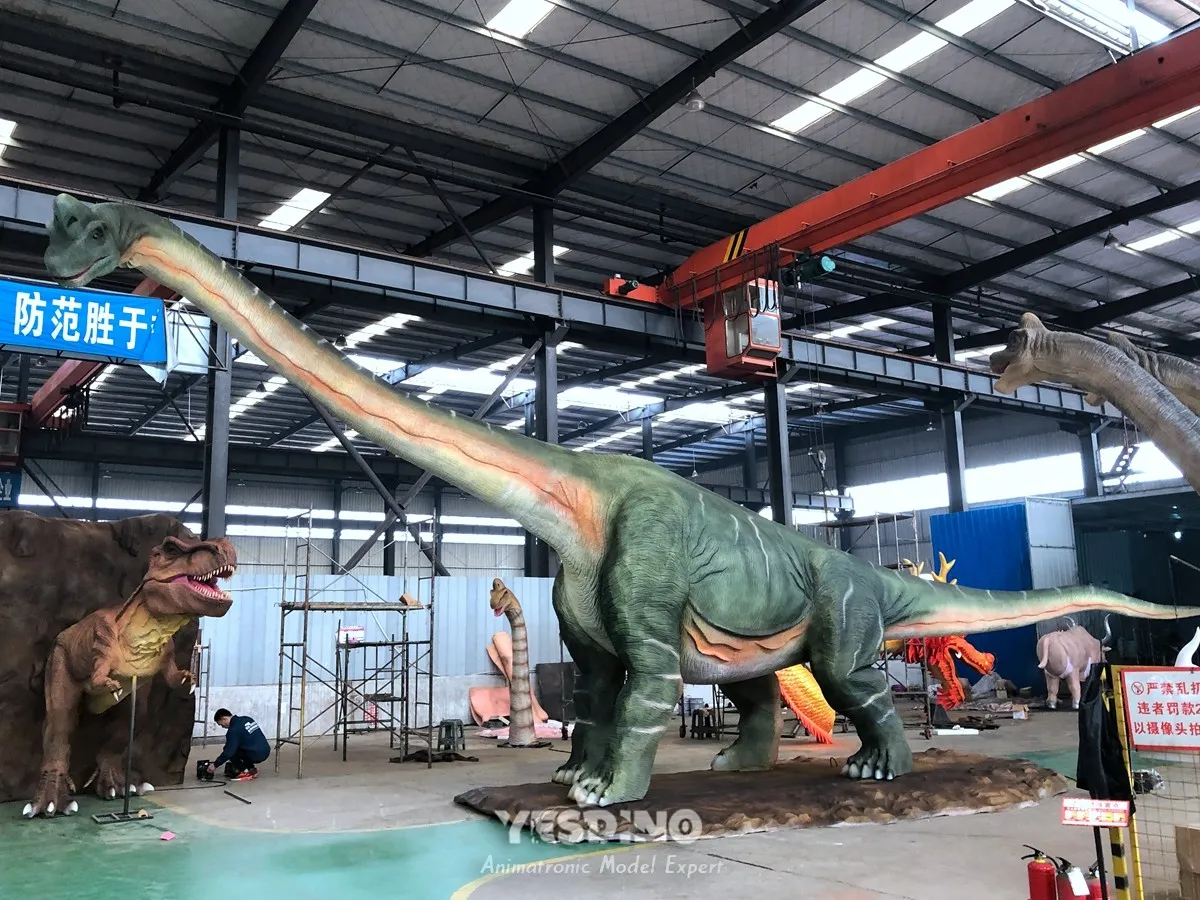
16‑meter‑long animatronic Brachiosaurus When a large dinosaur model goes wrong on site, the model itself is rarely the problem. The foundation was not built, the crane cannot reach the position, or the biggest single section will not fit through the gate. We have dealt with all three, and the most expensive one we have had to unpick started with a 16 m Brachiosaurus that reached the park entrance and could not get in. The crane was too small for the approach, so a larger one had to come in from the side. Two extra days, and a bill nobody had budgeted for. That failure was decided months before, when the price was agreed. Nothing in it was a manufacturing fault. It was a site question that nobody asked in time, which is the whole reason this guide exists. Here is the sequence in the order it actually happens on site: site survey, foundation, shipping splits, lifting, reassembly, commissioning, acceptance. Each stage locks in the cost of the ones after it, so the earliest stages are where the money is saved or spent.
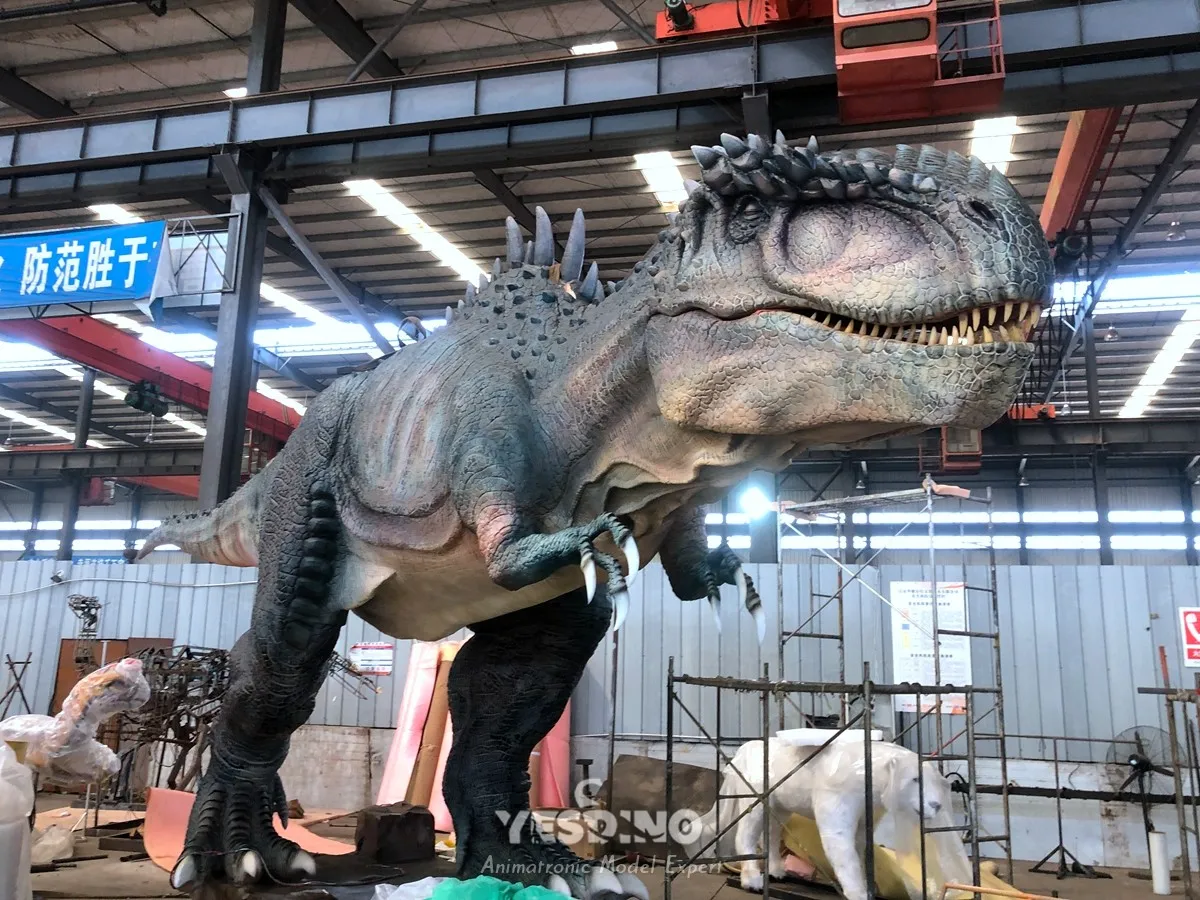
15‑meter‑long animatronic Giganotosaurus The Short VersionIf you read nothing else on this page: answer six questions about the site before you ask for a quotation. Ground bearing capacity, headroom and wind, the access route, the door openings, the power supply, and visitor flow. Two of those six, the access route and the door openings, are the ones that most often turn into an extra line on the invoice, and both cost nothing but a tape measure and an afternoon to check. Everything after that is routine engineering. Large models between roughly 500 kg and two or three tonnes are well understood, they ship in numbered sections, and a team that has done it once can do it again. The unpredictable part is always the site, which is why we collect that information before quoting rather than after the container has sailed. One word on who this is written for. It assumes you are the client, not the contractor: someone with a site, a budget and an opening date, who has to brief a supplier and then brief a local installation crew. If you would rather hand the whole thing over, we do that too, and the closing section covers how it works. Either way, the six questions decide whether the project runs on rails, so they are worth an afternoon of measuring before anything is designed. Video of the assembled 16‑meter animatronic Brachiosaurus Six Things to Settle Before You Ask for a Price
Write those six answers on one sheet and send it with the enquiry. The quotation that comes back will be closer to the final number, and the split and foundation advice will be based on your site rather than on an average. Photographs work better than written description for the access route in particular: stand at the gate, photograph the whole path, and photograph the tightest corner and the lowest overhead obstruction. Three photos usually replace a page of prose.
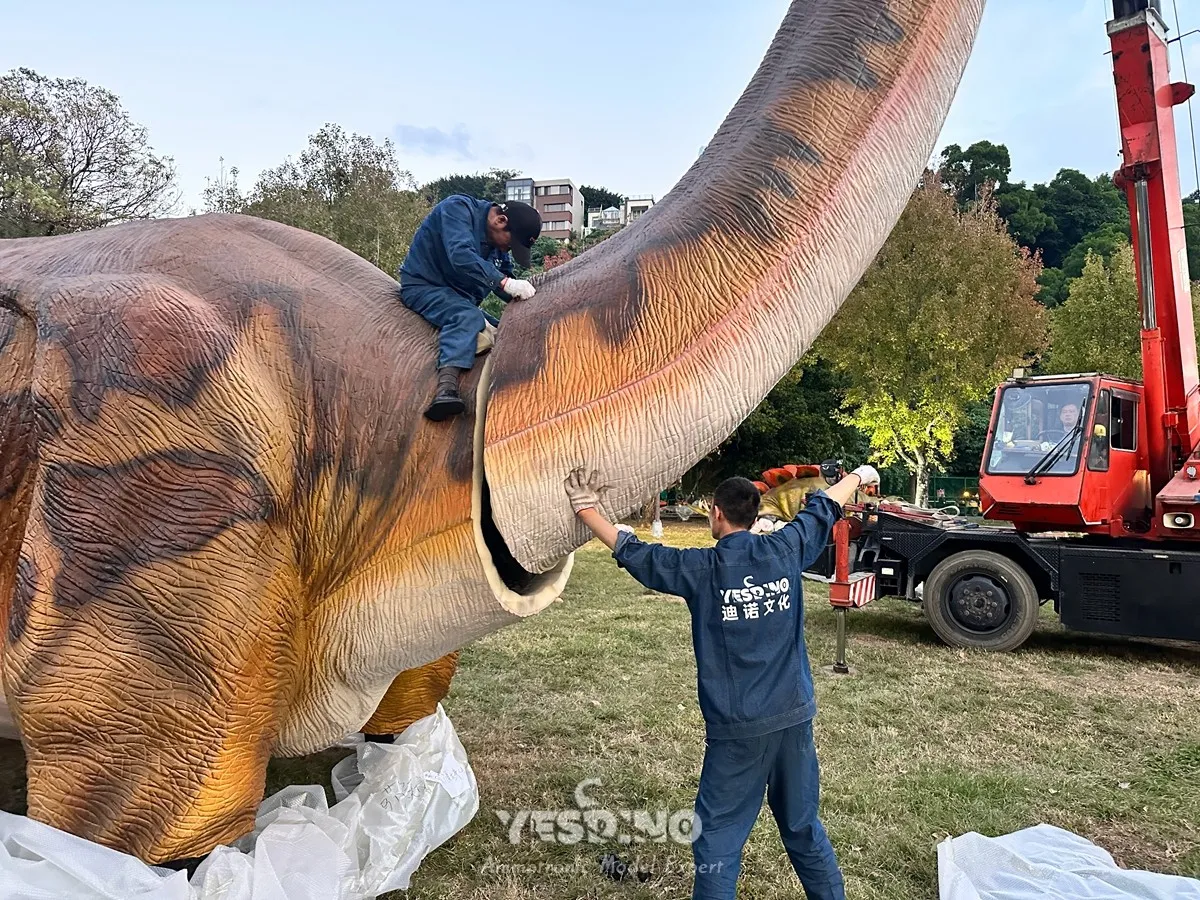
Neck assembly for 20‑meter Mamenchisaurus Foundations: Three Options and How to ChooseThe foundation does two jobs: it carries the weight of the model, and it resists the force the model puts into the ground when it moves. The second one is the one people underestimate, because a head that swings and a tail that sweeps both load the base sideways as well as downwards. There are three practical approaches, and the right one depends on the ground, the site rules and how long the model will stay there. Concrete pad or pier foundationThe most secure option, and what we recommend for models of 10 m and above, especially when they will stand outdoors all year. Excavate, place the reinforcement, cast the concrete and set the anchor bolts in position while it cures. Two scheduling points catch people out. First, curing has to be in the programme: the foundation should not be loaded for around seven days, and it does not reach full design strength for about 28 days. If you are casting in cold weather, allow longer. Second, the anchor bolts have to be in exactly the right place. The base plate layout is fixed, so an anchor that is 30 mm out is a drilling and chemical-anchor problem on a pad you have just finished.
Assembly process of giant dinosaur legs Pre-drilled plate with chemical anchorsFor ground that is already sealed: drill into the existing slab, fix a steel plate with chemical anchors, then bolt or weld the model's base to that plate. It is fast, and it avoids breaking up a finished surface. The catch is that the slab has to be good enough. Chemical anchors transfer the load into the concrete around them, so a thin or poorly reinforced slab will not hold a model that rocks, and the anchor's own cure time still has to be respected before the base is loaded. Test one anchor before you commit to the whole pattern. Ballasted baseFor sites where the ground cannot be touched: a leased plot, a temporary exhibition, a heritage surface. Weighted blocks or a cast ballast collar hold the model down, and stability comes from the weight and the area of the footprint rather than from anything buried. This works, and we build it, but be honest about the limits. It needs a low wind loading, it needs level ground, and it is not the right answer for permanent outdoor installation. If the model is going to stand in a windy place for years, it needs to be anchored into the ground. Drainage, whichever option you choose. Leave a fall away from the base so water does not sit around the feet. Standing water does two things over a season: it accelerates corrosion at the base, and in the wet season it softens the soil around the foundation, which lets the base settle unevenly. A model that starts to lean is almost always a drainage problem that has been running for two years. A small kerb or a shallow channel is enough. One more point, and we would rather state it plainly. We supply the base plate drawing, the anchor positions and the load figures. The foundation itself should be designed and signed off by a structural engineer working to the local code, particularly for a large model in a public place. That is not a disclaimer, it is how it should be done, and any supplier who tells you a foundation drawing is unnecessary for a 16 m installation is telling you something about their approach.
Workers aligning skin textures at cut seams Shipping Splits and Container LimitsA dinosaur that stands 3 m tall cannot travel in one piece, so large models leave the factory in numbered sections. How many sections depends on the size of the model and on the smallest gap it has to get through at your end. For sea freight, the numbers that matter are the container's internal dimensions and, just as importantly, its door aperture:
Note the door. A high cube is 2.69 m tall inside, but the opening through which everything has to pass is about 2.58 m, and on a standard container it is lower still. Design to the door aperture, not to the internal height, and treat these figures as a starting point for discussion rather than as a specification: container types vary by operator. If your largest section is within a few centimetres of the opening, tell us and we will adjust the split.
More splits means better container utilisation and lower freight, which is the argument for splitting early in the design. It is not free. Every additional split is another joint to align on site, another seam to blend and another few hours of labour, so the cheapest freight option is not automatically the cheapest installation. On a model that is going into a park with good road access and a crane, three sections are often the better balance. On a model that has to be carried up a mountain path in pieces, more sections win. When the container is unpacked, two habits save trouble later. Stack by number, not by convenience: the sections are numbered to match the assembly sequence, and mixing them costs more time than the tidier stacking saves. And keep the foam and skin parts off the ground. These are not heavy components, but they are soft, and dragging one across gravel scores the surface you have paid to have finished.
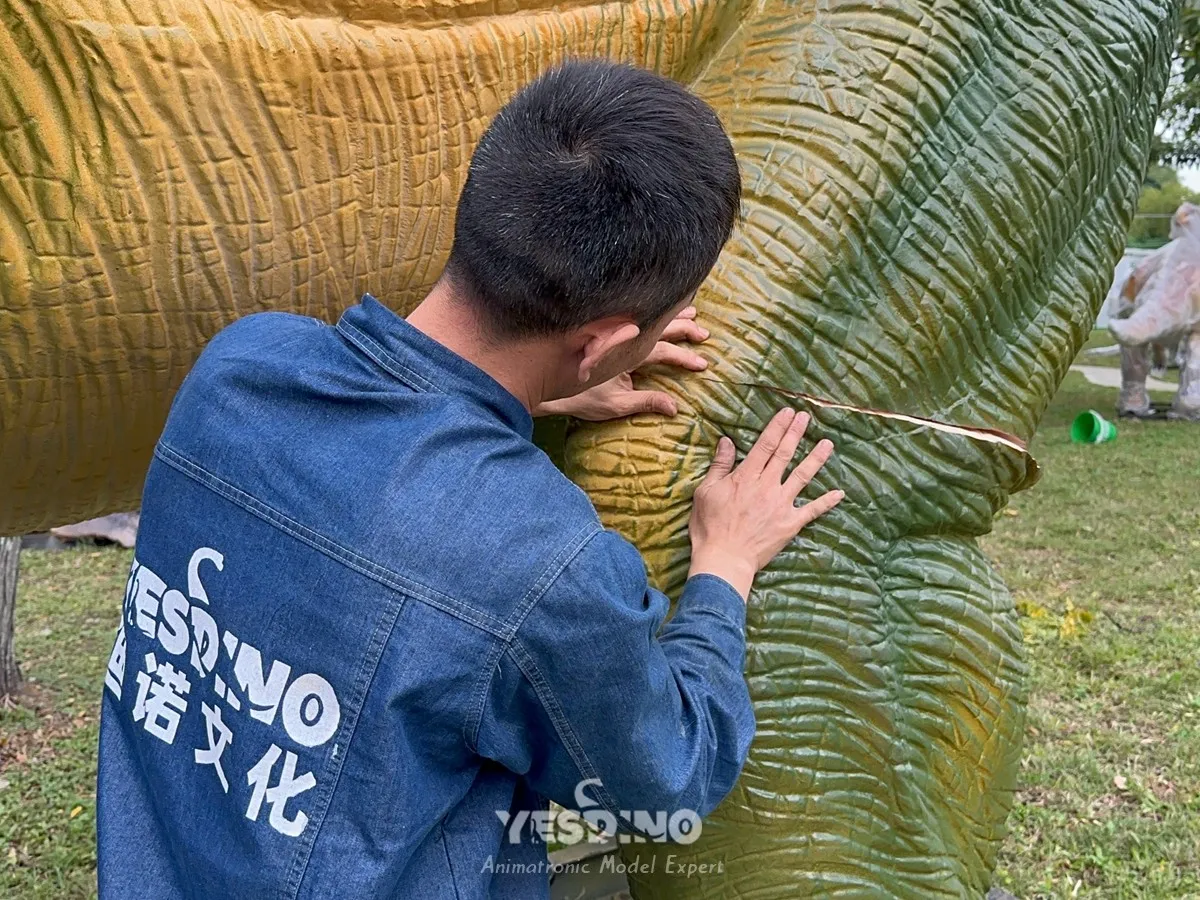
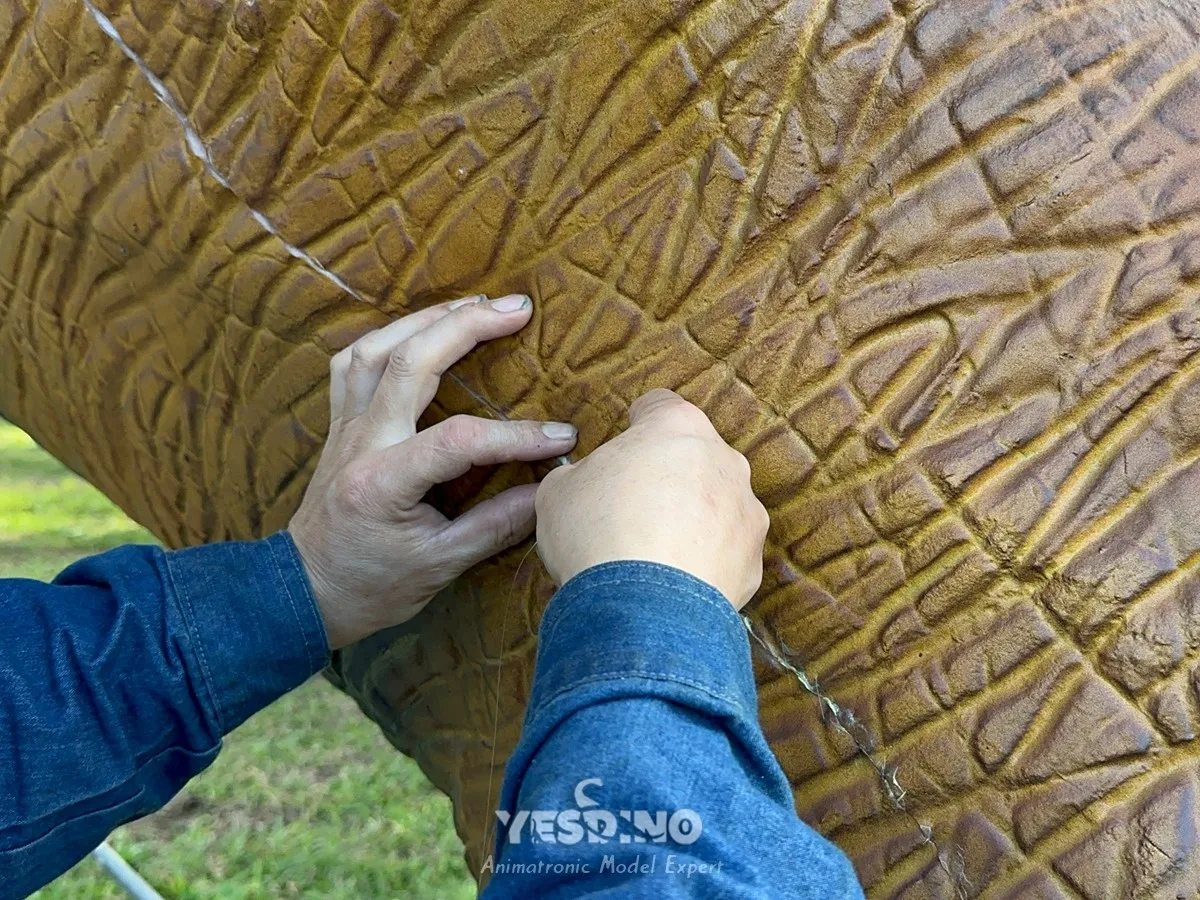
Workers stitching cuts on silicone skin The steel frame inside is sized to the model, not chosen by eye. The local general technical specification for animatronic dinosaurs in our region sets out the frame tube diameters and wall thickness by size class, and the table below is the range we build to. It also explains why a 16 m model cannot be built like a 5 m one, and why we ask about wind exposure before confirming a large installation.
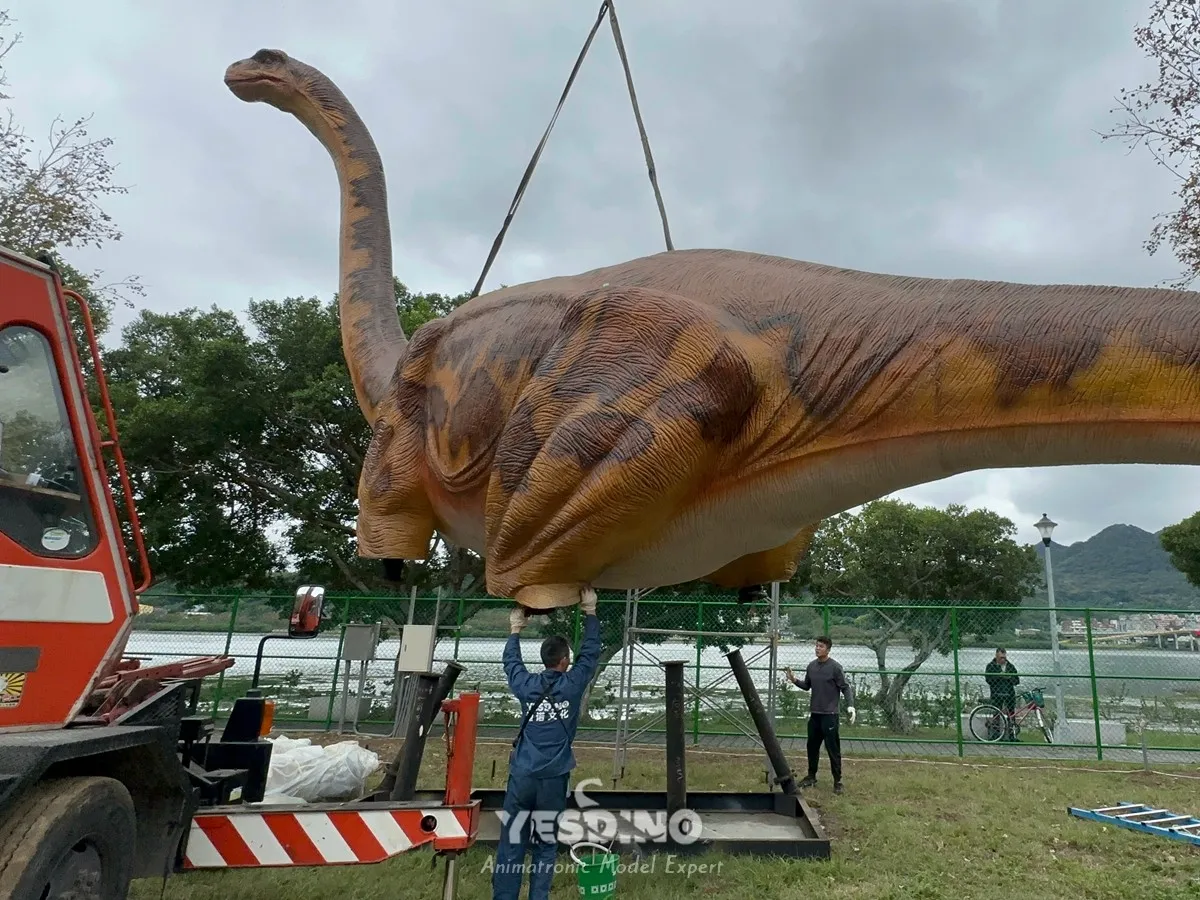
The frame material is Q235 carbon steel, welded, with the profile of the animal formed in shaped wire and treated against rust. The specification also allows wind, snow and seismic loading to be brought into the calculation when the site calls for it, which is the reason a coastal or mountain installation is quoted differently from the same model in a sheltered park. Lifting and PositioningThis is where an installation goes wrong, and it goes wrong quickly. A few rules cover most of it.
On-Site Reassembly: Five StepsThe reassembly sequence is the reverse of how the model was built, and it is the same every time. A team doing it for the first time can follow it directly.
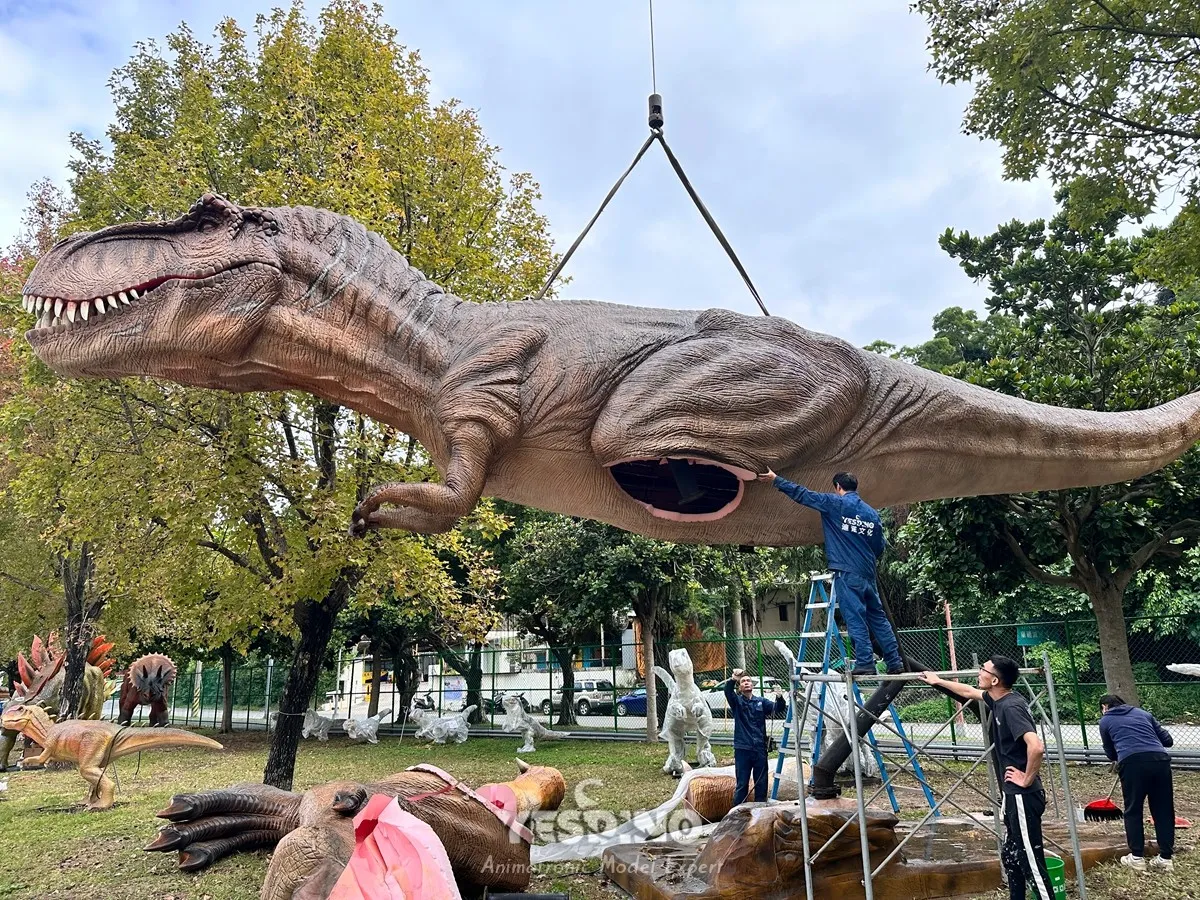
Leg assembly for 15‑meter animatronic Tyrannosaurus Rex Power-Up and CommissioningThree checks before anything is switched on: the supply voltage matches the model, the earth is properly connected, and the control enclosure is sealed with its door closing correctly. Then commission in a fixed order, because it isolates faults instead of mixing them together. Test single movements first: mouth, eyes, head, tail, then limbs. Then combined sequences. Then sound and lighting. At each stage, listen for anything that grinds or knocks, watch for a movement that stutters or stops short, and check the motor housings by hand. Warm is normal after a long run; hot is a load problem, and finding it now costs nothing. In the workshop we test at three points before despatch: once after the frame is finished, once after the sculpting and skin are complete, and once again in full before the crate is closed. Each check looks at movement smoothness and current draw, and the electrical side gets a run-in under load. The purpose is narrow and deliberate: we would rather the fault happened in our workshop than on your opening day. The general technical specification for animatronic dinosaurs in our region takes the same view. It requires that movement timing, cycle and speed match the design and stay in step with the sound, and it puts insulation resistance on the list of items checked before a model leaves the workshop, along with dimensions, electrical connections and appearance. It is a reasonable question to ask any supplier what their pre-despatch inspection actually covers. Acceptance Checklist Before You OpenWalk this list before the park opens, while people are still free to fix things. The first part is about the equipment, the second about the people who will look after it. The second part gets skipped more often, and it is the one that decides how long the model lasts.
Photograph the finished installation from the visitor's eye level, and keep the photos with the handover documents. They are the baseline for every maintenance question later, and they are the fastest way to settle a claim that was never really about the model. For the barrier distance itself, the practical rule and the reasoning behind it are set out in our guide to safety measures for dinosaur displays.
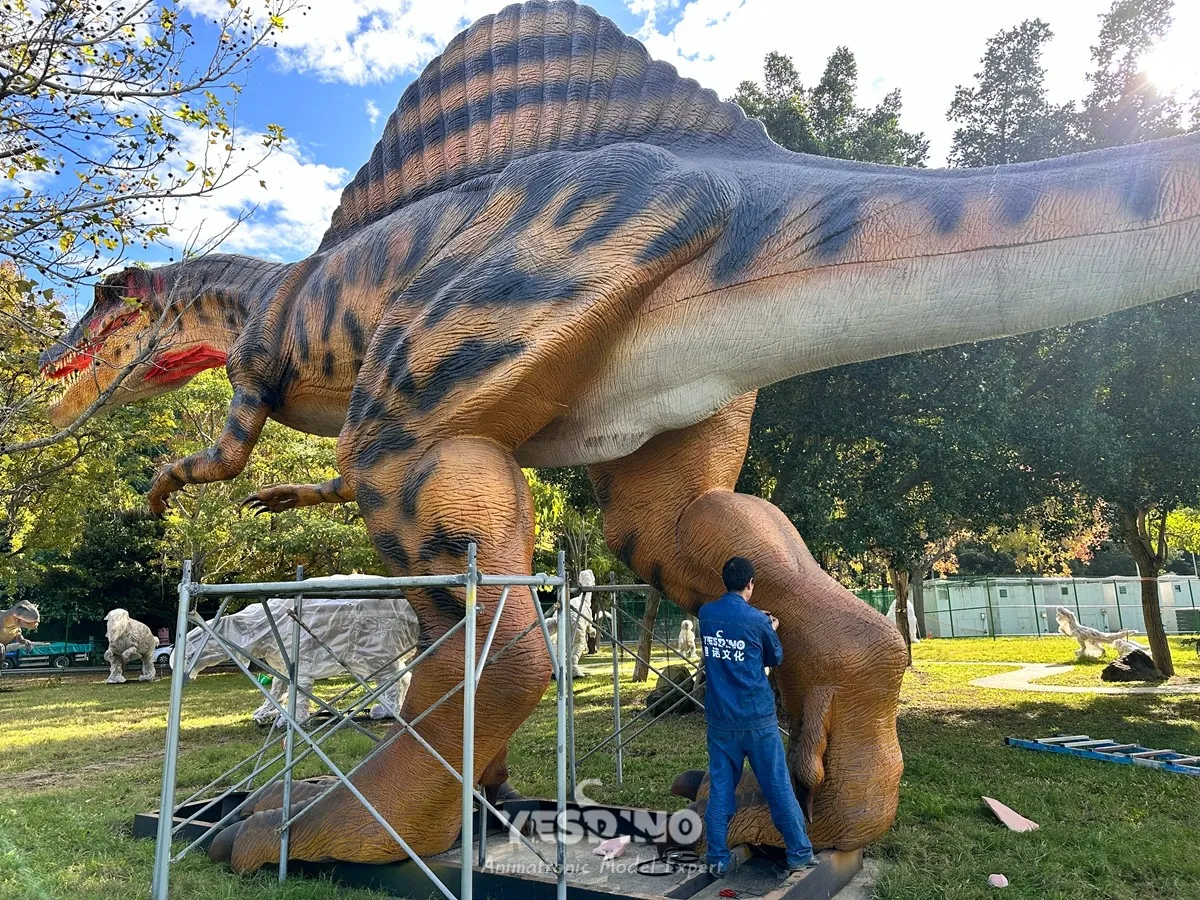
Stitching work on legs of 15‑meter animatronic Spinosaurus Long-Term MaintenanceOne inspection a year, as a minimum. Check the seams, look at how the colour has weathered, tighten the bolts, and check the seals on the electrical enclosures. If the model stands outdoors, add a check before and after the wet season, because that is when water does its damage. Clean with low pressure. A hose on low pressure with a soft cloth or a soft brush is enough. A stiff brush scratches the silicone surface, and the scratches then hold dirt, so an aggressive clean makes the model look worse over a season rather than better. Clean during closed periods so the surface dries before visitors return. Supervision prevents more damage than repair. The most common failure we see is caused by people rather than by the machine: a visitor hanging on the head to hold it still, the motor overloading against the resistance, the current rising, and either a fuse going or, in the worst case, the frame inside taking a set. A barrier, a warning sign and someone watching at busy times prevent nearly all of it, and they cost less than one repair. Switch off when the model stands idle for long periods. In hot or humid climates, powering down lets the electrical components cool and reduces the moisture they absorb while sitting unused. Before restarting after a long break, run the sequence slowly and listen before putting the model back in front of visitors. Frequently Asked QuestionsDoes a large dinosaur model always need a concrete foundation?For models of 10 m and above standing outdoors permanently, yes. Below 8 m, a temporary or seasonal display can work on a ballasted base, provided the ground is level and the wind loading is genuinely low at that position. What we would not do is put a large model on ballast in an exposed location and call it permanent. If you are unsure, send us the position and the local wind conditions and we will tell you which option applies. How long does installation take once the container arrives?A mid-size model of 6 to 10 m is normally one to two days including commissioning, assuming the foundation is ready and the model can be moved straight to its position. A model of 13 m and above, shipped in four sections, is better budgeted at two to three days with commissioning included. Add a day if the access route is slow, because a difficult approach eats time in a way that reassembly itself does not. Can our own team install it without your technician on site?Yes, and plenty of clients do. Every section is numbered to match the assembly sequence, and the wiring follows a diagram supplied with the unit. We run remote training before the container arrives, so your team has seen the process and can ask questions while nothing is at stake. That route saves the travel and accommodation cost of sending someone. If the site is remote, the schedule is tight, or nobody on the team has assembled a large model before, sending a technician is the cheaper decision. Our site is remote and a large crane cannot reach it. What are the options?Tell us before the model is built, because the answer is a design decision rather than a site improvisation. Increasing the number of splits makes every individual section smaller and light enough for small plant and manual handling, and a winch and rail arrangement can move sections along a narrow path. Both work. Both change the drawing, so they are cheap to arrange at design stage and expensive to arrange after the fact. Who designs the foundation?We supply the base plate drawing, the anchor bolt positions, the spacing and the load figures the foundation has to carry. The foundation design itself, including its size, depth and reinforcement, should be prepared and signed off by a structural engineer working to your local code, and that is what we recommend for any large model in a public place. It takes very little time once you have our drawing, and it puts the responsibility for the local ground conditions where it belongs, with someone who can inspect them. What to Send Us Before We Quote
Items three and four in that list are the ones buyers most often leave out, and they are the two that most often come back as extra cost. Photographs of the access route are worth more than any description you can write, so send three or four from the gate to the position rather than a paragraph about it. With those answers we can give you the shipping split, the foundation recommendation, the lifting and assembly sequence, the product and freight quotation, and a delivery commitment. The models themselves are on the animatronic dinosaur pages, including the 15 m lifelike Brachiosaurus and the 16 m Brachiosaurus model. If you have a unit already on site and you are assembling it yourselves, our assembly and wiring checklist covers the component-level detail that this guide does not, and the portfolio shows how these installations look in place. We build these models in our own factory in the Zigong high-tech zone, on more than 6,000 m² of floor space, and they are standing in more than 40 countries. Large installations are routine work here rather than a special project: figures in the 16 m class like the Brachiosaurus at the top of this page, and giant sauropod scenes running well over 18 m along a river valley. Payment can be by T/T, credit card or PayPal, and we quote CIF, FOB or DDU — the term known as DAP under Incoterms 2020. We can send a technician to your site, or train your team remotely and let them do the work themselves. Send us the six answers and we will take it from there. You can also see the factory before you commit. |