Production Process
There are two jobs for a T-Rex on a park site. One is to be the thing in the photograph that ends up on the ticket, the billboard and the phone screen at the gate. The other is to survive a decade outdoors. This build is aimed at the first job and engineered for the second.
Fifteen metres long, 2.1 m across the body, 5.5 m to the top of the head, 1,550 kg. That is a deliberately oversized animal — the largest reasonably complete tyrannosaur specimens sit around twelve metres — and the extra three metres is what makes it read from the car park rather than only from the trail.
Where the fifteen metres goes
Length on a theropod is mostly neck, torso and tail. The tail accounts for roughly half of it, which is why a fifteen-metre animal does not need a fifteen-metre clearing — it needs a fifteen-metre line. Placed at an angle across a path, the tail runs back into planting and the head comes out over the walkway, and the footprint of the exhibit drops to something a normal park can host.
Head height is the other number. At 5.5 m the skull sits above the treeline in most landscaping, which is the whole point: it is visible from outside the boundary, and visibility from outside the boundary is what sells an unbooked visitor at the gate.
What 1,550 kg does to your site
Three site questions come before anything else on a build this size.
The pad. The animal stands on a steel base frame, and the frame has to sit on something that will not settle. A poured concrete pad sized to the frame footprint is the normal answer; compacted hardcore works for temporary installations but will move over a wet season.
Anchoring. The base is bolted down, and the bolt pattern is supplied with the drawings so your contractor can cast them in rather than drill after the fact. On an exposed site, anchoring is also what stops the animal rocking in wind — a five-and-a-half-metre body is a sail.
Service access. The cabinet and the joint panels need to be reachable without scaffolding. If the animal is going into a planted bed, leave a hard path behind it. Every hour spent getting to a joint is an hour the exhibit is down.
Movements, in three tiers
Tier one — what the audience came for. Head left and right, neck up and down, jaw open and close with a synchronised roar. These three carry the whole performance and they are the ones to set carefully: a jaw that opens a fraction before the sound reads as an animal, and a jaw that opens after it reads as a machine.
Tier two — what makes it convincing at three metres. Blinking eyes and a forearm scratch. Neither is expensive and both are noticed mainly by the people closest to the barrier, which on a park trail is most of them.
Tier three — what changes the silhouette. A lateral tail sweep. On a fifteen-metre animal the tail tip travels several metres, so this is the movement visible from the far end of the site.
All groups run on independent drives with end-of-travel protection and can be sequenced from a loop, a proximity sensor or a manual button. Optional additions include motion-sensor triggering, LED glowing eyes, a smoke-spray effect and a ground vibration generator for the walk-up moment.
Frame and skin
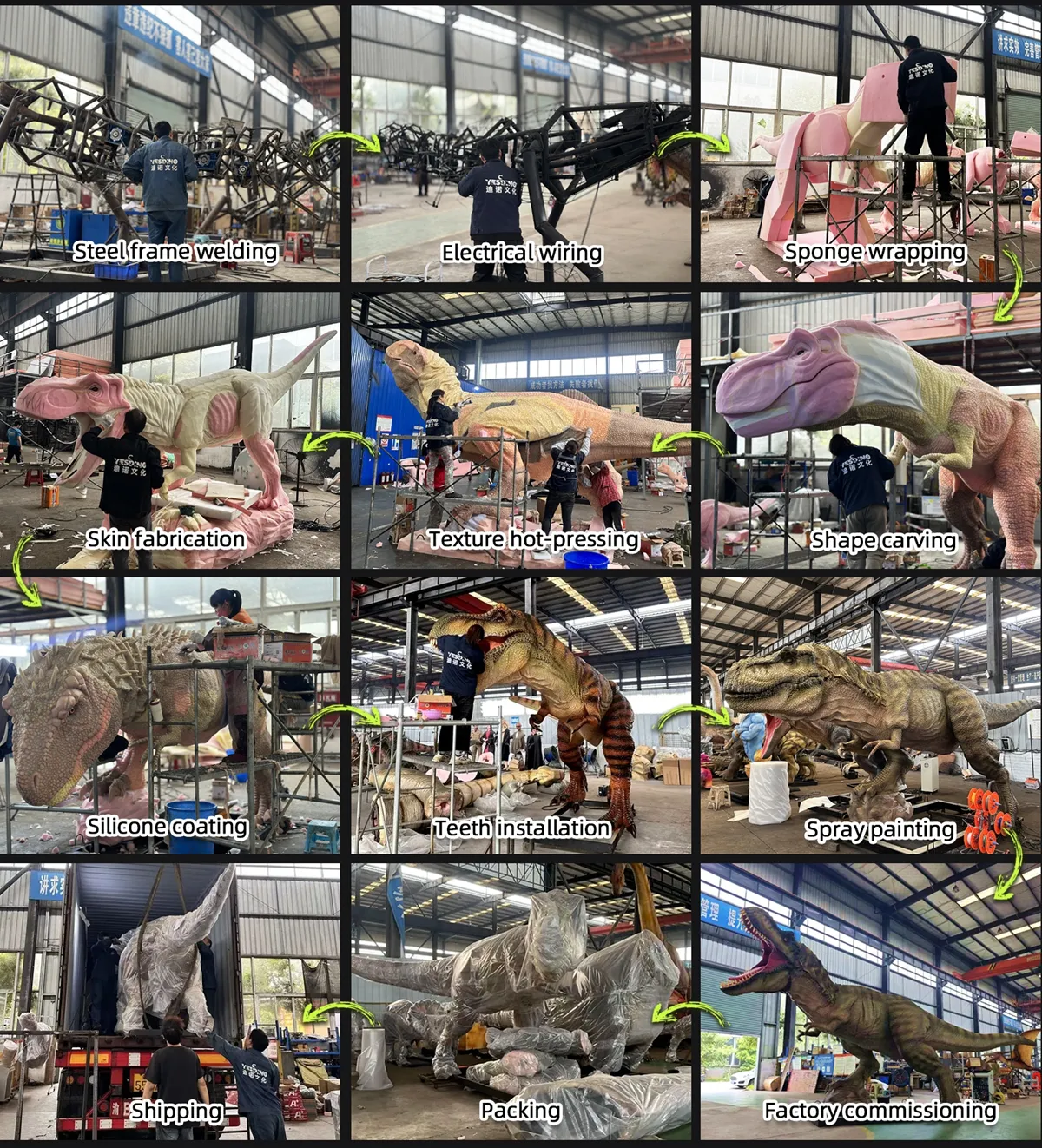
A welded Q235 steel frame with full anti-rust treatment carries the load at the hips and feet, with neck and tail as separate sections bolted on at assembly. High-density foam is carved over that frame to give volume, then coated in silicone five to seven millimetres thick. Colour is translucent silicone airbrushed in layers so the pigment sits inside the skin rather than on top of it.
That choice of finish is what decides how the animal looks in year three. Surface paint on a large outdoor model chalks and fades within a couple of seasons and then needs a full repaint; layered silicone holds depth longer, and damage from a thrown stone or a snagged branch can be touched up locally without repainting a panel.
Working range is −25 °C to 45 °C, with 110 V or 220 V input configured for the destination country at build. The electronics sit in a sealed enclosure inside the body; drives and mechanical stops stay accessible through service panels, and every joint can be moved by hand for inspection.
Getting fifteen metres onto the site
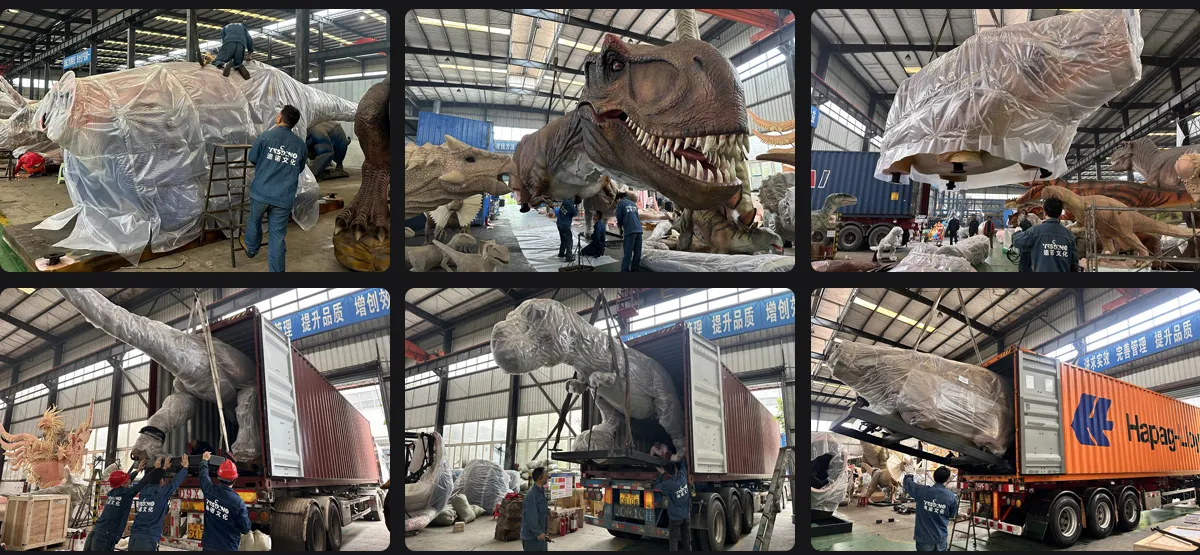
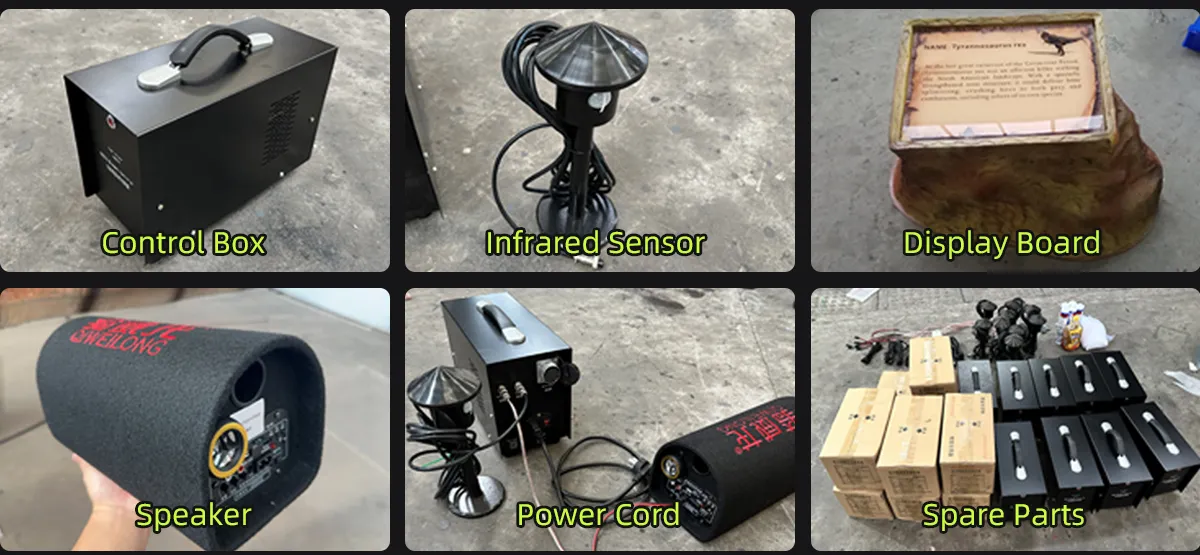
This animal does not ship as one piece and it does not fit a standard container at full length. It travels as legs, body, neck, head and tail with the base frame, control cabinet, sound system, wiring diagram and calibration sheet. Crate dimensions and packed weight are confirmed before booking, and the largest crate decides what kind of vehicle can reach your gate.
Assembly is a crane job for the body section and hand work for the rest. Ask about the access road width, gate height and whether a crane can set down within reach of the pad — those three answers change the installation plan more than anything else.
Freight, duties, certificates and installation are quoted separately and are not included in the product price. Send the delivery city and site photos early and we will price them alongside the animal rather than after.
Before you commit
Tell us the viewing distance from the main path, the ceiling or treeline height at the display point, and whether the site is exposed to wind. With those three we can confirm the fifteen-metre build, or recommend stepping down to a ten-metre animal that will photograph better in a confined space. Watching a hero-size model look cramped is a common and avoidable outcome.
Where to go next
Two things come up in almost every enquiry on this build: how the size compares with the alternatives, and what it takes to get it on site. The rental cost breakdown sets out the length options side by side, and the pneumatic versus hydraulic comparison covers pads, access and assembly. Budget planning sits in the installation guide for pads and access.
For ideas on placing it, see layout strategies for themed trails. The rest of the range is on animatronic dinosaurs, and if this one is the wrong size for the slot, 13m animatronic t-rex for shopping malls is the closest alternative.
Product Accessories
Packaging and Container Loading