


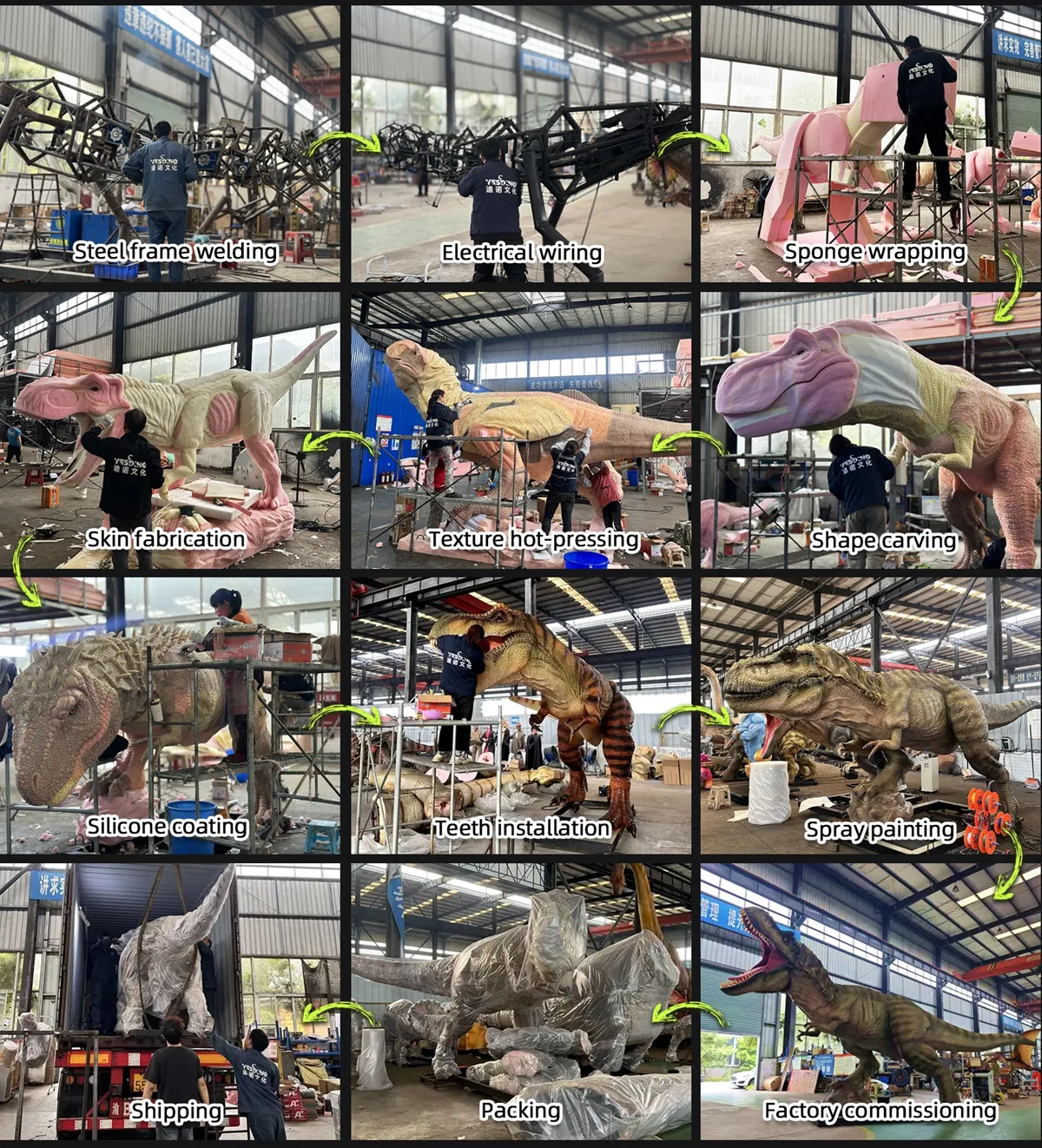
Production Process
Long-neck models are the easiest thing in this industry to get wrong, because size hides error. Length reads as impressive from thirty metres, and the anatomy that makes the animal recognisable is all in the two metres around the shoulder.
SKU YKL-117 is sixteen metres long, 1.8 m across the body, 3.8 m to the top of the back, with the neck carried forward and the head at just under four metres. That is a walking or low-feeding carriage rather than the vertical-neck pose of a museum mount, and the difference is worth understanding before you choose it.
Height is the first decision, not length
A Brachiosaurus with its neck raised stands nine to thirteen metres at the head. In a hall that means a ceiling height most buildings don't have, a shipping problem that never fully goes away, and a structural load at the neck base that grows with every metre. In an open plaza it means the animal is visible from the road, which is usually the reason people want it.
This build takes the other route: sixteen metres of length, four metres of height, neck carried out over the ground. It fits a hall with a normal roof, travels more easily, and places the head at the height where visitors actually walk — which changes the experience from looking up at a monument to walking alongside an animal.
Both are legitimate exhibits. If your site has the clearance and you want the iconic vertical silhouette, ask about a raised-neck build at enquiry; it is a different frame design, not an adjustment to this one.
The detail that identifies the animal
Brachiosaurus had forelimbs longer than its hindlimbs. That single fact produces the sloping back — shoulders high, hips low — and it is the first thing wrong on a generic long-neck model, which is usually built level or tail-high.
The skull is small relative to the body, with a bony arch over the nostrils and spoon-shaped teeth, carried on a neck that rises from the shoulders rather than from the middle of the back. Get those three right and the model survives a knowledgeable visitor; get them wrong and no amount of length compensates.
Five movement groups
Head left and right, neck up and down, jaw open and close with a synchronised roar, blinking eyes, tail sweep. On this animal the neck is the group that carries the performance: a slow rise and fall of four metres of neck is a completely different gesture from a theropod's quick head turn, and it needs its own speed settings.
Set the neck travel so the head never rises into light fittings or signage, and so it never drops below standing eye level where the jaw mechanism becomes visible. Both are commissioning decisions, and both get documented so they can be changed later without a service visit.
Indoor halls and load
A sixteen-metre animal indoors raises three site questions. The floor has to take the load at the feet, which is concentrated rather than spread. The route in has to accept the longest body section, so measure the goods lift and the widest doorway before anything else. And the display line has to allow visitors to walk the length of the animal rather than view it end-on — end-on, a long-neck model reads as a wall with a head.
For outdoor placement, wind is the consideration. The body is long and the profile is low, so the load is smaller than a raised-neck build, but the base still needs anchoring to a pad and the anchor pattern is supplied with the drawings.
Finish and colour
Welded Q235 steel frame with anti-rust treatment, high-density foam carved to volume, silicone five to seven millimetres thick, colour applied as translucent silicone airbrushed in layers so the tone sits inside the skin. Standard schemes run from a warm grey-brown with darker dorsal banding to a cooler slate with a pale underside; mottling along the flanks is what stops a large body reading as a single flat colour.
On an animal this long, large-scale pattern matters more than fine detail. A subtle mottle disappears at ten metres and the body looks like a painted pipe. Send the reference and the viewing distance and we'll scale the pattern to the way it will actually be seen.
Delivery of sixteen metres
The animal ships in sections — legs, body, neck, head, tail — with a steel base frame, control cabinet, sound system, wiring diagram and calibration sheet. Packed crate sizes and weight are confirmed before the container is booked, because the neck and body sections set the freight class. Assembly needs lifting equipment for the body and a crew for the joints.
Freight, duties, certificates and installation are quoted separately and are not included in the product price. Send the delivery city, a photo of the access route and the ceiling height if indoors; those three answers decide more about feasibility than the model does.
Enquiry
Tell us whether you want the low walking carriage or a raised neck, the ceiling or treeline height at the display point, and the viewing distance. We'll come back with a posture recommendation, a program outline and a budget range — and if the space suits a shorter animal better, we'll say that instead of quoting the big one.
Where to go next
Two things come up in almost every enquiry on this build: how the size compares with the alternatives, and what it takes to get it on site. The installation guide for pads and access sets out the length options side by side, and the wiring concealment notes covers pads, access and assembly. Budget planning sits in the park layout and theming strategies.
For ideas on placing it, see museum display guidelines. The rest of the range is on animatronic dinosaurs, and if this one is the wrong size for the slot, animatronic allosaurus for museum displays is the closest alternative.
Product Accessories

Packaging and Container Loading



