


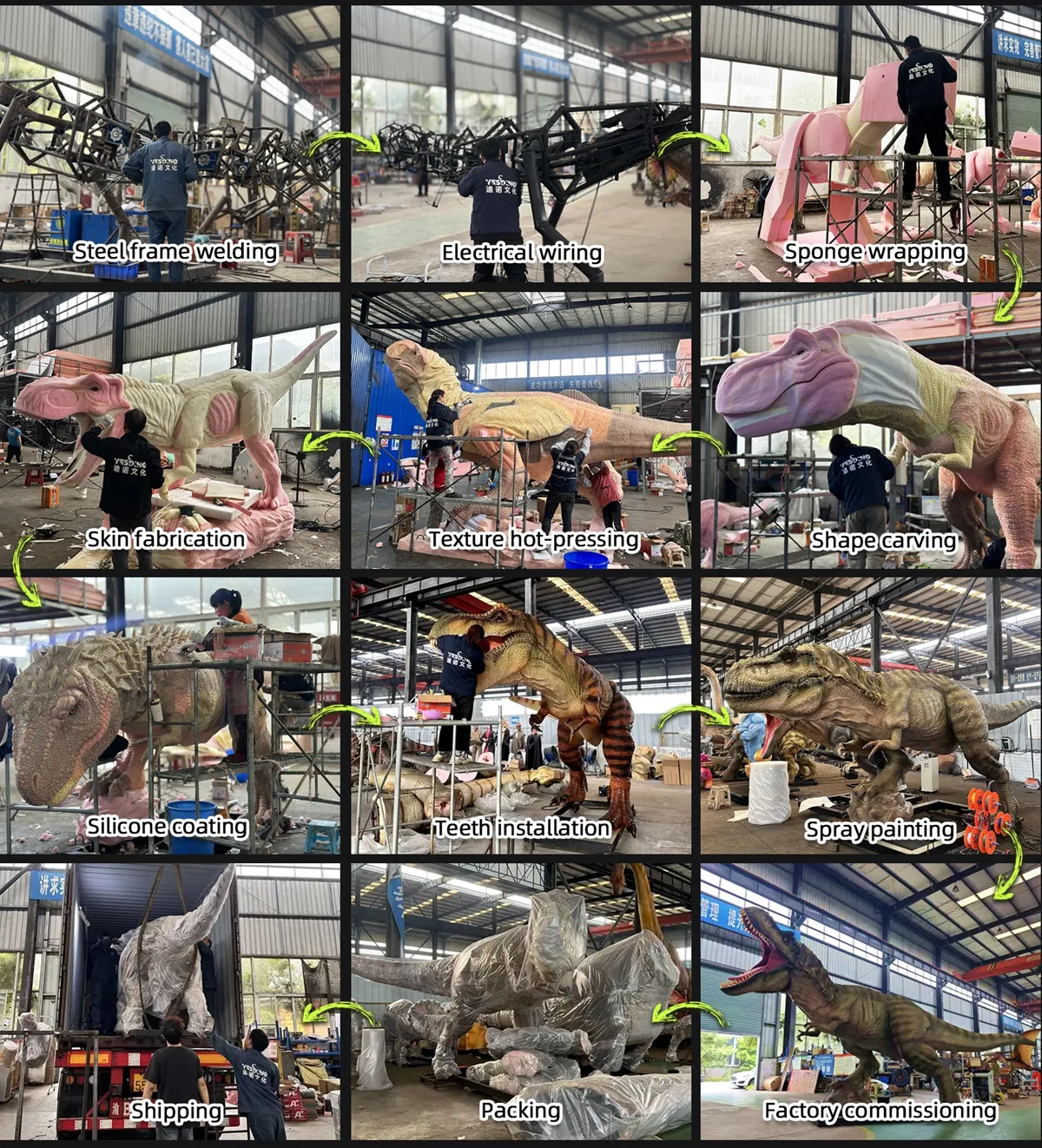
Production Process
In a museum hall, the animal is not competing with music or crowds. It is competing with a two-metre viewing distance and a visitor who has already read the label. That changes what the model has to do: less movement, better timing, and detail that survives being looked at closely.
SKU YKL-110 is built for that setting. Eight metres long, 2.3 m at the shoulders, 0.9 m across the body, with the head carried at roughly the height of a standing adult so the crests and jaw line are visible without looking up.
Detail that only pays off up close
Allosaurus is not a small T-Rex, and visitors who know the difference will judge the model on three things: the pair of bony crests above the eyes, the three-fingered hands with their oversized claws, and a jaw that looks like it was built to shear rather than crush.
The crests sit above the eyes and were probably covered in keratin in life. On the model they are sculpted in, sized from the skull reference, and finished slightly darker than the surrounding skin so they read as structure rather than as paint. The hands are built with three fingers and the inner claw exaggerated — the proportion that makes the silhouette recognisable from ten metres down to arm's length.
Six movement groups
Every group runs independently and can be triggered from a sensor, a floor mat or a button at the barrier. Travel speeds are set at commissioning and are usually slower in a gallery than outdoors.
| Group | Travel | What it's for in a hall |
|---|---|---|
| Head | Left / right | Follows the visitor along the barrier. A slow sweep beats a fast one every time. |
| Neck | Up / down | Lets the head drop to label height for children, then rise back to the display pose. |
| Jaw | Open / close, with roar | Sound level is adjustable downward; the jaw follows the audio track rather than a fixed timer. |
| Eyes | Blink | The one movement that stays convincing at one metre. |
| Tail | Lateral sweep | Balances the animal visually and keeps the far end of the hall from going dead. |
| Forearm | Scratch / lift | Rarely offered, and the reason people stop walking. It is the movement that says this is an animal, not a hinge. |
Silence is part of the specification
A gallery has a different acoustic problem from a park. Roaring every ninety seconds empties the room. The program we ship for indoor use runs a long idle cycle with small movements — a blink, a slight neck shift — and reserves the full roar for a proximity trigger at the barrier. Curators can also run it silent, with movement only, which is the setting most natural history museums settle on within a week.
Frame, skin and finish
Welded Q235 steel frame, load carried at the hips and feet, with neck and tail as separate sections that bolt on during assembly. High-density foam carved over the frame gives the volume; silicone five to seven millimetres thick gives the surface, coloured with translucent silicone airbrushed in layers so the tone sits in the skin instead of on it.
For a hall, the finish question is usually about dust and handling rather than weather. Layered silicone can be wiped down and touched up locally; the matte topcoat we use indoors keeps the highlight from reading as plastic under spotlights. If the display sits in a glazed atrium with direct sun, say so at enquiry — that changes both the coating and the colour choice.
Display planning
Two numbers decide how the animal will read in your hall: the height of the barrier above the floor, and the distance from barrier to head. An eight-metre animal viewed from four metres looks like a wall; the same animal viewed from eight metres looks like a specimen. If the space is tight, a slight turn of the body to three-quarters gives depth without adding length, and we can set the posture that way at build.
The model arrives in sections with a steel base frame, control cabinet, sound system, wiring diagram and a joint calibration sheet. Freight, duties and installation are quoted separately from the product price, and we plan crate sizes before the container is booked.
Common questions
Can the movement be slowed further? Yes. Speed and dwell are parameters in the program, not fixed in hardware. We set them at commissioning and leave the values documented so your technician can adjust them later.
Is a glass barrier a problem? No, but a reflective floor is. If the hall has polished stone, tell us — we may lower the tail sweep and add a matte base skirt so the reflection doesn't double the movement.
Can it be built to a specific mounted specimen? Yes, working from your skull or skeletal reference. We produce CAD drawings for approval; we don't produce 3D models or animations.
Where to go next
If you are still comparing options, start with the size guide covering 3 m to 12 m builds — it lines up the builds by length and reach. Site work is covered in the rental cost breakdown, and the pneumatic versus hydraulic comparison lists the factors that move the price.
For ideas on placing it, see museum display guidelines. The rest of the range is on animatronic dinosaurs, and if this one is the wrong size for the slot, animatronic pachycephalosaurus for dinosaur parks is the closest alternative.
Product Accessories

Packaging and Container Loading



