


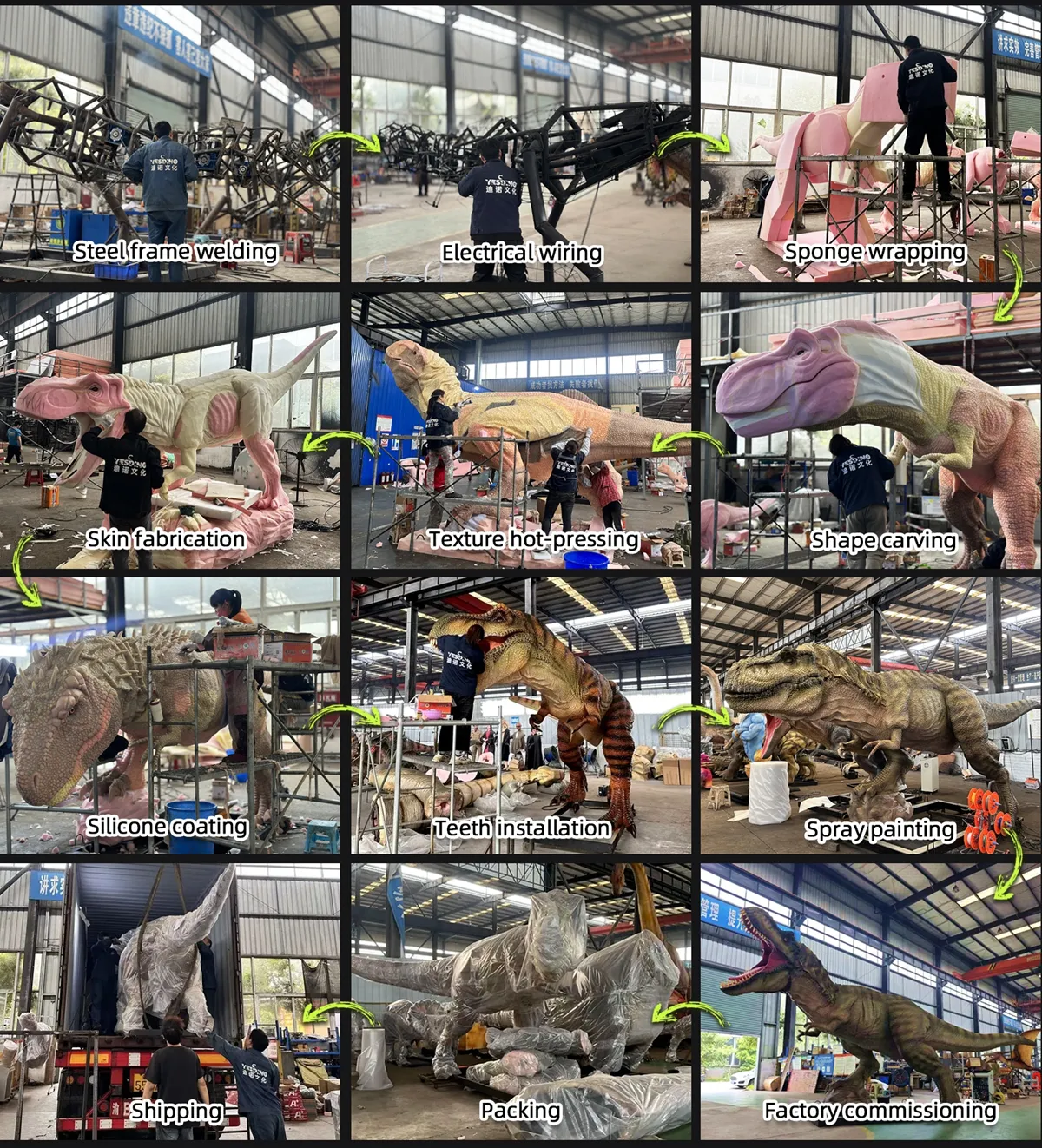
Production Process
The smallest ride in a range is usually the one that earns the most per square metre. It loads in seconds, it turns over a queue quickly, and it fits in a space that a five-metre animal cannot use. This one is three metres long with a 1.6 m back height, which is exactly the height a parent can lift a child onto without steps.
SKU YDR-010. Three metres long, 0.7 m wide, 1.6 m to the top of the back. Narrow enough to sit against a wall in a mall and still leave a walkway.
Why 1.6 m is the useful number
A child can be lifted onto a 1.6 m back by one adult standing on the floor. That removes the platform, the step, and the fall hazard that comes with both. It also means the attendant can hold the child steady while the harness goes on, which is what keeps a loading cycle under a minute.
At 0.7 m wide the animal fits a standard mall walkway with room for a queue on one side. If you need two units side by side, plan on about 2.5 m between saddles so that attendants can pass.
Throughput, honestly
The ride itself is the short part. Loading, harness, a supervised run of a couple of minutes, then unloading: the cycle is dominated by the handling, not the animation. That is why the layout matters more than the movement set — a loading position that lets one attendant work both sides of the animal is worth more than an extra movement group.
Plan the queue so that waiting families stand where they can watch the animal perform. The sway and the head turn are what sell the next ride, and they only work if the queue can see them.
Movement on a small frame
Body sway, head turn, jaw with roar, blinking eyes, front claw wave and tail swing. On a three-metre animal these read at close range, which is where children actually are. A slow sway is more effective than a fast one: it looks like breathing, and it does not unsettle a small rider.
The front claws are at child eye level when they are on the animal's back, so they are programmed to wave outward rather than toward the saddle.
Mall or park
Indoors, the constraint is the floor. A ride is a point load in four places, so a spreader plate and a conversation with the building manager come before installation. The 3 m length means it can usually be taken in through a service lift in two sections.
Outdoors, the constraint is weather and supervision. A three-metre animal is light enough to move, which means it is also light enough to be moved by wind if it is left unanchored overnight. Anchor points are part of the build.
One detail that decides whether the ride feels safe: the harness anchor point. On a small animal the anchor is often behind the saddle, which lets a child slide forward under braking. We put the anchor forward of the saddle so the load pulls back into the seat, and we specify the harness length with the animal rather than leaving it to the operator.
Wear and upkeep
The wear points on a kids' ride are the saddle, the step area and the tail tip, because children grab all three. Those areas get reinforced skin and a thicker top coat. The rest of the animal sees far less handling than a trail exhibit of the same size.
A touch-up kit in the base colour covers the daily scuffs. Weekly, check the harness anchors and the tail joint — the two things that take the most unintended load.
Power and control
110 V or 220 V to destination standard, control cabinet with a stored programme and a trigger, working range −25 °C to 45 °C. For a supervised ride we set the programme to a fixed loop with an attendant stop, rather than a sensor trigger: on a ride, the attendant decides when it moves.
The stop is a physical button at the loading point, not a menu item. Anyone working the ride should be able to stop it without looking.
Enquiry
Tell us the floor or ground, the age range, and whether the ride is permanent or seasonal. We will send a layout with the loading position marked, because that is the part that decides how many children ride in an hour.
Where to go next
Worth reading before you commit: the wiring concealment notes for how the sizes compare, the park layout and theming strategies for what the ground has to carry, and the size guide covering 3 m to 12 m builds for where the money actually goes.
For ideas on placing it, see playground prop selection. The rest of the range is on dinosaur rides, and if this one is the wrong size for the slot, animatronic toothless ride for amusement parks is the closest alternative.
Product Accessories

Packaging and Container Loading



