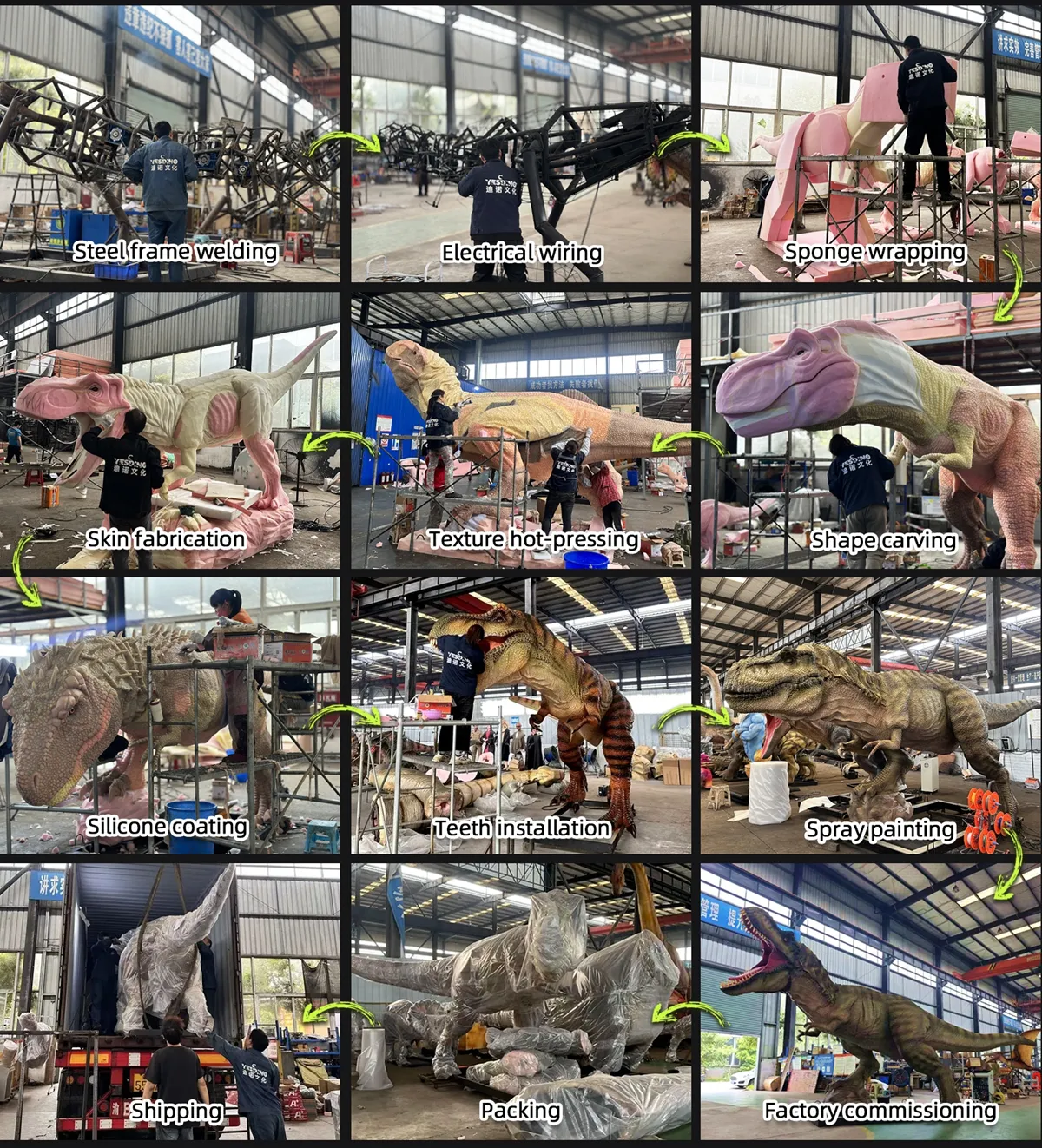
Production Process
A dark-ride queue hall, a ceiling grid overhead, and a creature that has to look like it is about to leave the building. Where a banshee hangs decides almost everything else about it, including how it moves.
SKU YDZ-010: 5 m along the curve of the body, 2 m tall including the wings. Where the design follows a film, the name and the likeness need clearing on your side before the piece goes into any promotion.
Flown or standing, two different animals
A flying creature can be flown from a truss or stood on a frame, and that choice changes the movement set more than the skin does. Flown, the body is free to pitch and roll and the beat can be quick, because nothing has to stay level. Standing, the feet carry the mass and the head does the acting.
Flown, you need structure overhead, a rigging plan, and service access that does not involve a ladder in front of visitors. Standing, you need floor area, a base, and a barrier around the footprint.
The trade-off runs both ways: a flown unit reads as airborne and costs more in structure, a standing unit reads as a creature landing or perched and costs less to install.
Queue halls and the angle from below
Queue halls, pre-show rooms, ride facades, themed corridors, a tall atrium. The 5 m curve needs a room where the body hangs clear of heads, and 2 m of height including the wings means the lowest point of a flown unit sits above the crowd rather than beside it.
Sightlines decide the angle. Seen from below, a banshee is a silhouette with wings; seen from the side, it is a body with a wing. We ask which view visitors get first, because the wing structure is drawn to flatter that one.
A dark, warm queue hall is kinder to silicone than a sunny plaza, and the build runs from −25 °C to 45 °C either way. Outdoors, the position matters more than the height: a sheltered courtyard holds a flown unit better than an exposed roof.
What moves: a short arc, a fast beat
Wing flapping at this scale is a short, fast arc rather than a slow, wide one. With 2 m of height including the wings, the travel is limited by the room and by the frame, so a quick beat with a pause at the top reads as hovering from underneath.
Head and jaw carry the close-up, and the tail trails the body when the wings drop. Legs tuck on a flown unit and barely move, which is exactly where a budget should not go.
The fold is worth programming properly. A creature that folds its wings on approach and opens them at the trigger gives you two shows out of one mechanism, and the fold is also what makes the wing span manageable in a low room.
Membrane, spars and tip wear
Q235 steel frame with rust treatment, body volume carved in high-density foam, skin in silicone at 5–7 mm, colour sprayed in translucent layers so the tone sits in the surface. The wing membrane is a thin skin over spars, kept light because every gram at the tip is load at the shoulder.
Wing tips and the trailing edge take the wear on a flown unit. They are built as replaceable sections, and the pigment record ships with the animal so a repair on a translucent membrane does not show as a patch.
Rigging, isolators and the ladder
Sections: body, wings, head, tail, and a rigging frame or a standing base, in foam-lined crates. A flown unit goes up on a lift or a small crane depending on the height; the rigging points above are yours to certify; we supply the load figures.
The cabinet sits off the visitor route, with an isolator within reach of a technician. Power is 110 V or 220 V, configured at build for the destination, and core electronics carry a two-year warranty. Freight, duties, certificates and installation are quoted separately.
Height, trigger, and when to go smaller
Send the ceiling drawing with the points you can use, the clear height, the viewing angle, the door and lift sizes, and whether the piece flies or stands. Tell us what triggers it: proximity, floor mat, or a cue from the ride's show control.
Where this size does not work: a hall low enough that a flown 2 m unit leaves no clearance over heads, and a space with no rigging points and no floor for a base frame. A smaller flying build suits both.
Enquiry
Send the ceiling drawing and a photo taken from the visitor's eye line. Tell us flown or standing, what should trigger it, and how often it should move in an hour. You get a rigging sketch, a skin card and a price.
Where to go next
If you are still comparing options, start with the spare parts and repair kit list. Site work is covered in the installation guide for pads and access, and the rental cost breakdown lists the factors that move the price.
For ideas on placing it, see layout strategies for themed trails. The rest of the range is on custom animatronic builds, and if this one is the wrong size for the slot, animatronic avatar dragon with flapping wings is the closest alternative.
Product Accessories

Packaging and Container Loading