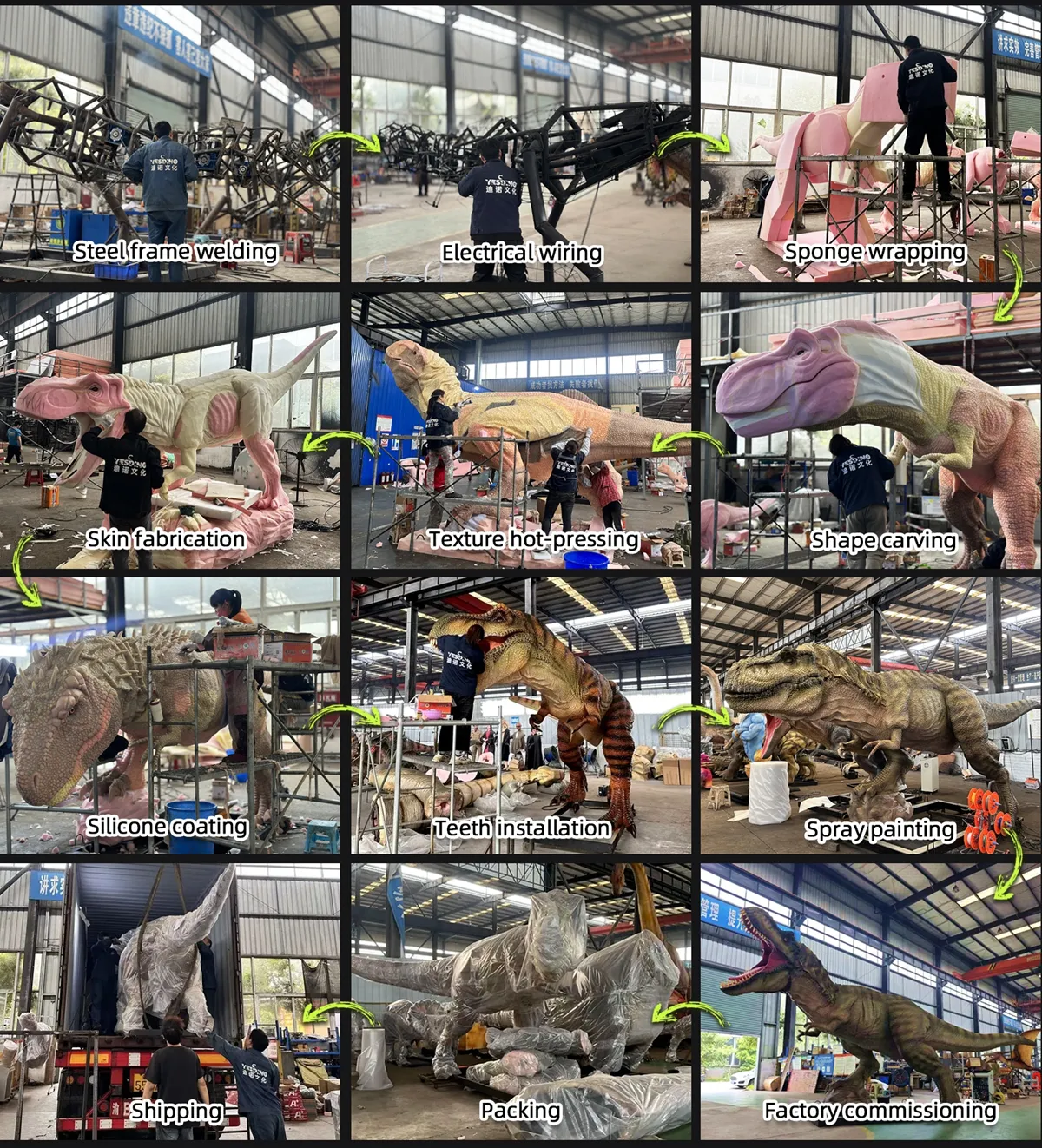
Production Process
A ride queue is a bad place to be bored. The band goes where visitors have stopped walking and started waiting: three dinosaurs at 1.8 m, on a footprint 2.5 m long and 1.5 m wide, playing a set that lasts about as long as the wait does.
SKU YDZ-007: three independent units, each 1.8 m tall, grouped into 2.5 m by 1.5 m.
Three animals, one clock
A band is a show-control problem before it is an animation problem. Three units on three controllers start together and drift apart by the end of the set, and the drift is audible before it is visible at the rail. One controller, with the units addressed separately, keeps them in time.
The trade-off is real. One controller means one place to stand while the show is tuned, and one cabinet to reach. Three remotes give you flexibility unit by unit, and cost you the thing the band exists for.
The footprint is the other constraint before you draw the queue. Two and a half metres by one and a half is smaller than a market stall, so the group fits a corridor that was not built to hold a stage.
Queue lines and the sightline at the rail
Queue lines, mostly, at the point where the wait gets long: outside a coaster, inside a dark-ride pre-show. Visitors are standing still, so the sightline matters more here than it does at a passing exhibit.
At 1.8 m the heads sit below adult eye level and above a child's, which works for a mixed crowd and badly across a wide open plaza where three small figures read as lost. This group wants a back wall, a rail, or a corner to play into.
Sound decides position as much as sight does. In the open, a plaza swallows a small speaker; against a wall or under a canopy the same system carries twice as far. Outdoors the build runs from −25 °C to 45 °C, and indoors the audio needs less level.
What moves: the arm on the beat
The instrument arm is the group worth the tuning time. Strike timing on a drum or a string hand is what makes the set read as playing rather than swaying, and it has to land on the beat the audio plays, not near it.
Head and torso follow a fraction behind the arm. When all three move on the same beat the band looks choreographed, which is not the same as looking alive; a slight lag in the heads is what makes three machines look like three players listening to each other.
Jaws and eyelids cost little and do most of the work between numbers, when the arms are still and the audio is changing. Those seconds are where a queue stops noticing it is in a queue.
Skins, instruments and the hands
Q235 steel frame with rust treatment, body volume carved in high-density foam, skin in silicone at 5–7 mm, colour sprayed in translucent layers so the tone sits in the surface. Instruments are props on the same frame logic, because an arm hitting a drum shell pushes load into the shoulder on every beat.
Wear collects at the hands, the instrument edges and the feet. Those parts are built to be replaced, and the pigment record travels with each unit so a repair matches the other two.
Three crates, one cabinet
Three crates, one per unit, plus instruments, controller, audio. The footprint goes onto a flat surface: a stage, a paved bay, a concrete pad. Uneven ground shows up as a limp within a week, read as a fault in the animal rather than the slab.
One cabinet feeds all three, with cable runs along the back of the set rather than across the visitor side. Power is 110 V or 220 V, configured at build for the destination, and core electronics carry a two-year warranty. Freight, duties, certificates and installation are quoted separately.
The set list decides the programme
Send the floor plan with the queue route, the sightline from the waiting area, and the wall or rail behind. Tell us the set length, any spoken lines and their language, and the music you plan to use — clearing that music is your side of the job, and it decides what we programme against.
Two places this group does not work: a corridor with less than 1.5 m of clear width, and a very large open plaza where three 1.8 m units cannot hold a sightline from more than a few metres away. A single larger animal serves both cases better.
Enquiry
Send the queue layout, a photo taken from where visitors stand, and the show length you have in mind. If the instruments are still open, we quote two line-ups. You get a layout drawing, a programme sheet and a price.
Where to go next
If you are still comparing options, start with the size guide covering 3 m to 12 m builds. Site work is covered in the spare parts and repair kit list, and the installation guide for pads and access lists the factors that move the price.
For ideas on placing it, see layout strategies for themed trails. The rest of the range is on custom animatronic builds, and if this one is the wrong size for the slot, 13m animatronic talking tree with gift boxes is the closest alternative.
Product Accessories

Packaging and Container Loading