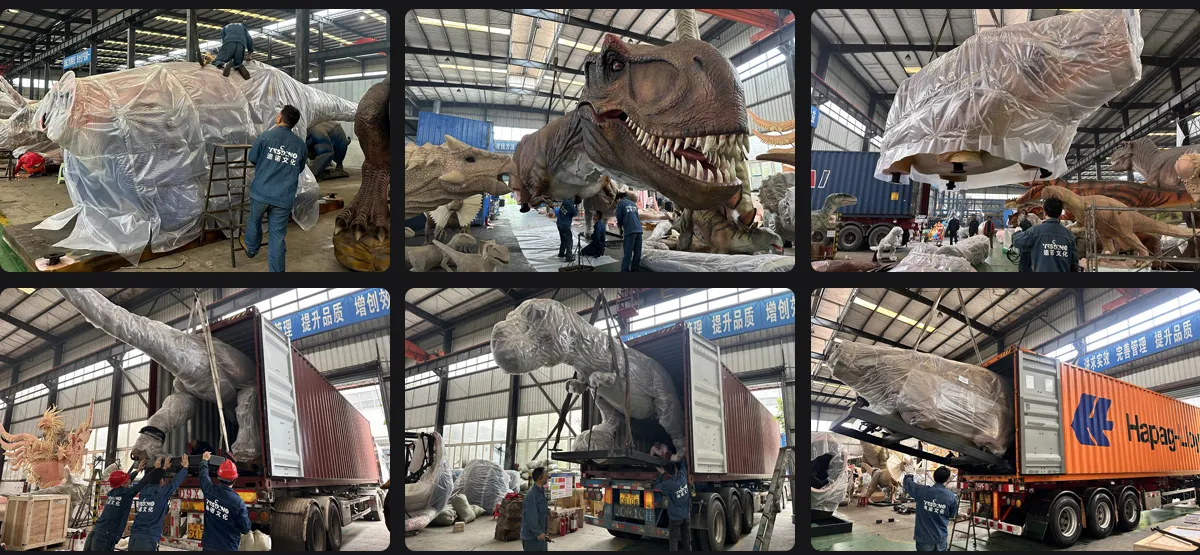


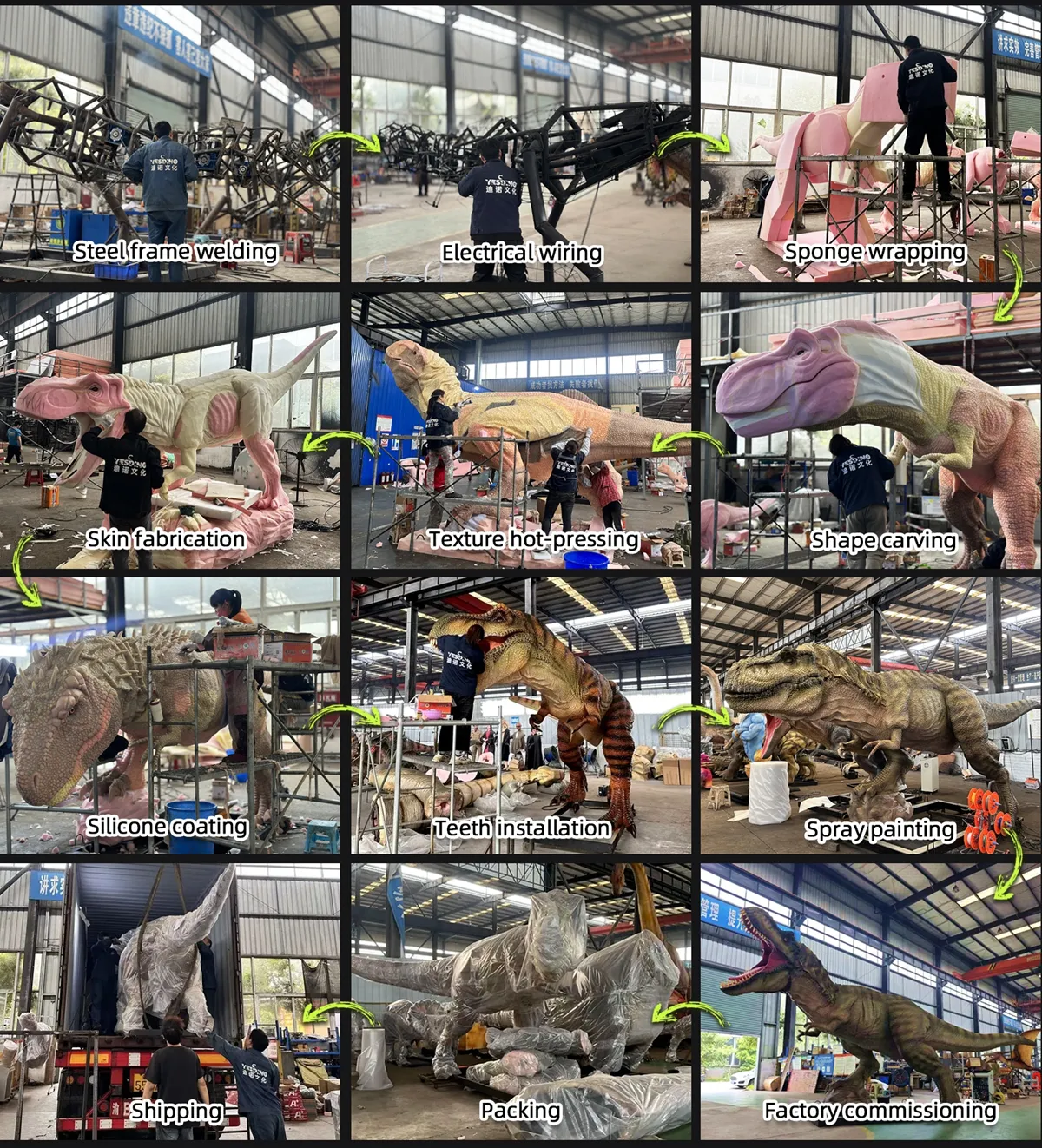
Production Process
A two-metre and a thirty-metre dragon are not the same product at different sizes. One hangs above a doorway; the other needs a footing, a crane and a wind calculation. We build both, but they are quoted from two different starting points, and the first job is working out which one your site can actually take.
SKU YDM-002 covers the range. Length runs from 2 m to 30 m and height from 1 m to 15 m, with nothing fixed until the site is described. That is not a marketing line — it is the reason this page has no dimensions table with a single row.
What changes as the animal gets bigger
Below roughly four metres, a dragon is a prop. It travels assembled, two people move it, and the frame is a single welded box. Between four and twelve metres it becomes a sectioned animal: the body breaks into three or four parts for crating, and the wings usually ship separately because their span sets the crate width. Past twelve metres it behaves like a structure — the frame has to carry its own weight plus wind load, and it needs its own pad rather than a shared walkway.
The practical consequence is that the same silhouette appears three times on this page's range and behaves completely differently in freight. We size the crate before we size the animal, because a build that cannot reach your gate is not a build.
Wings are the deciding part
On a dragon the wing is both the signature and the liability. A flapping wing multiplies the animal's effective footprint by three or four times, including the sweep behind and above it. Under a canopy that sweep hits structure; on a lawn it hits visitors who walk too close.
We set the wing movement in one of three ways depending on where the animal stands: a slow open-and-hold for display pieces that are photographed, a fuller flap for animals that perform on a timer, and a folded rest position for animals that have to sit through weather. All three are programmed, not manual, and the rest position doubles as the storm setting.
Specifying size against a real site
Send four things and the size question usually answers itself: the footprint you can give up, the nearest overhead obstruction, the access route from the gate (width, height, turning radius), and whether the ground is slab, paving or soil. A twenty-metre dragon on soil is a different quote from the same animal on a slab, because the footing changes.
If the site is tight, the useful move is rarely a smaller animal — it is a different posture. A rearing dragon at eight metres occupies less ground than a walking one at twelve, and reads bigger from the entrance. We quote both when the site is ambiguous.
The movement set
Head rotation, neck up and down, jaw open with sound, wing flap, tail sway and blinking eyes form the standard set. Each runs on its own drive with end-of-travel protection, and the whole set runs either as a loop or from a trigger.
Two additions are worth considering on a dragon specifically. A slow eye-glow ramp reads better than a hard on-off at dusk, and a neck lift timed to the sound makes the roar look like it comes from the animal rather than a speaker. Both are programming changes rather than hardware.
Skin, colour and finish
The skin is carved foam over a Q235 steel frame with a silicone shell and a UV-stable top coat. Colour is mixed to a reference — a photo, a paint chip, a costume — and we send a painted sample panel before the full skin goes on. Scales are sculpted, not printed, so the pattern holds up at two metres and at twenty.
If the animal is going to be photographed at night, tell us at quote stage. Metallic and pearlescent finishes behave differently under floodlight, and the sample panel is the place to settle that rather than the finished animal.
Control, power and operation
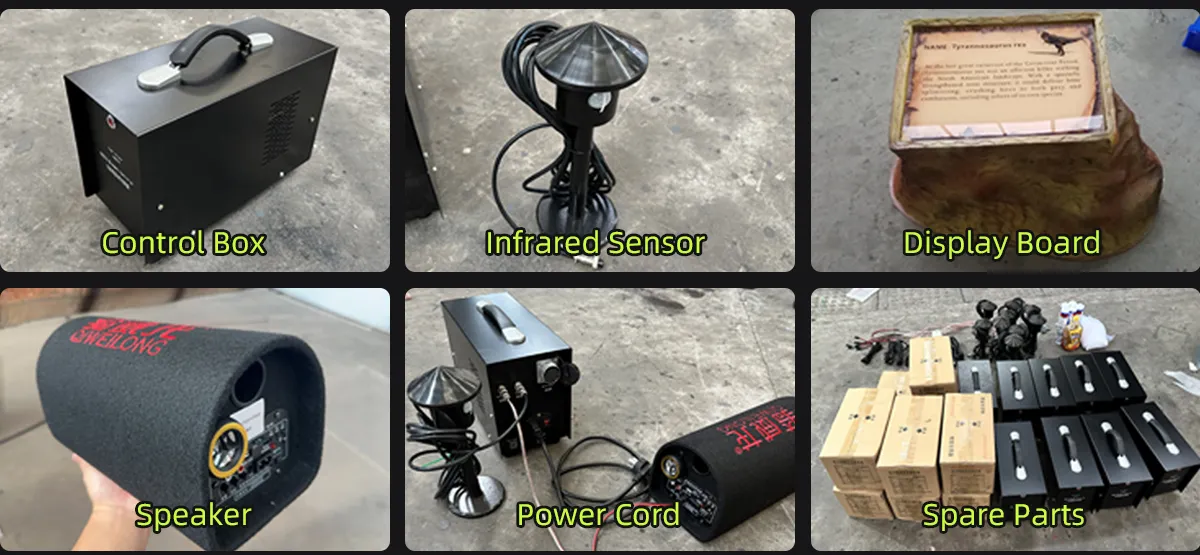
Control is a cabinet with a stored programme, triggered by a sensor, a button or a timer. Power is 110 V or 220 V to the destination standard, and the working range is −25 °C to 45 °C. Larger builds are usually split across two cabinets so that a wing fault does not take the head down with it.
Operating a thirty-metre animal is a daily routine rather than a switch: a walk-round before opening, a check on the wing rest position, and a note of anything that sounds different. We supply the checklist with the animal and walk your team through it at commissioning.
Enquiry
Send the site photo, the access route and the height you want the animal to read at from the entrance. We will come back with one or two size and posture options rather than a single number, because on a range this wide the first answer is usually the wrong one.
Where to go next
If you are still comparing options, start with the installation guide for pads and access. Site work is covered in the rental cost breakdown, and the pneumatic versus hydraulic comparison lists the factors that move the price.
For ideas on placing it, see layout strategies for themed trails. The rest of the range is on animatronic dragons, and if this one is the wrong size for the slot, custom animatronic fire dragon for halloween is the closest alternative.
Product Accessories
Packaging and Container Loading