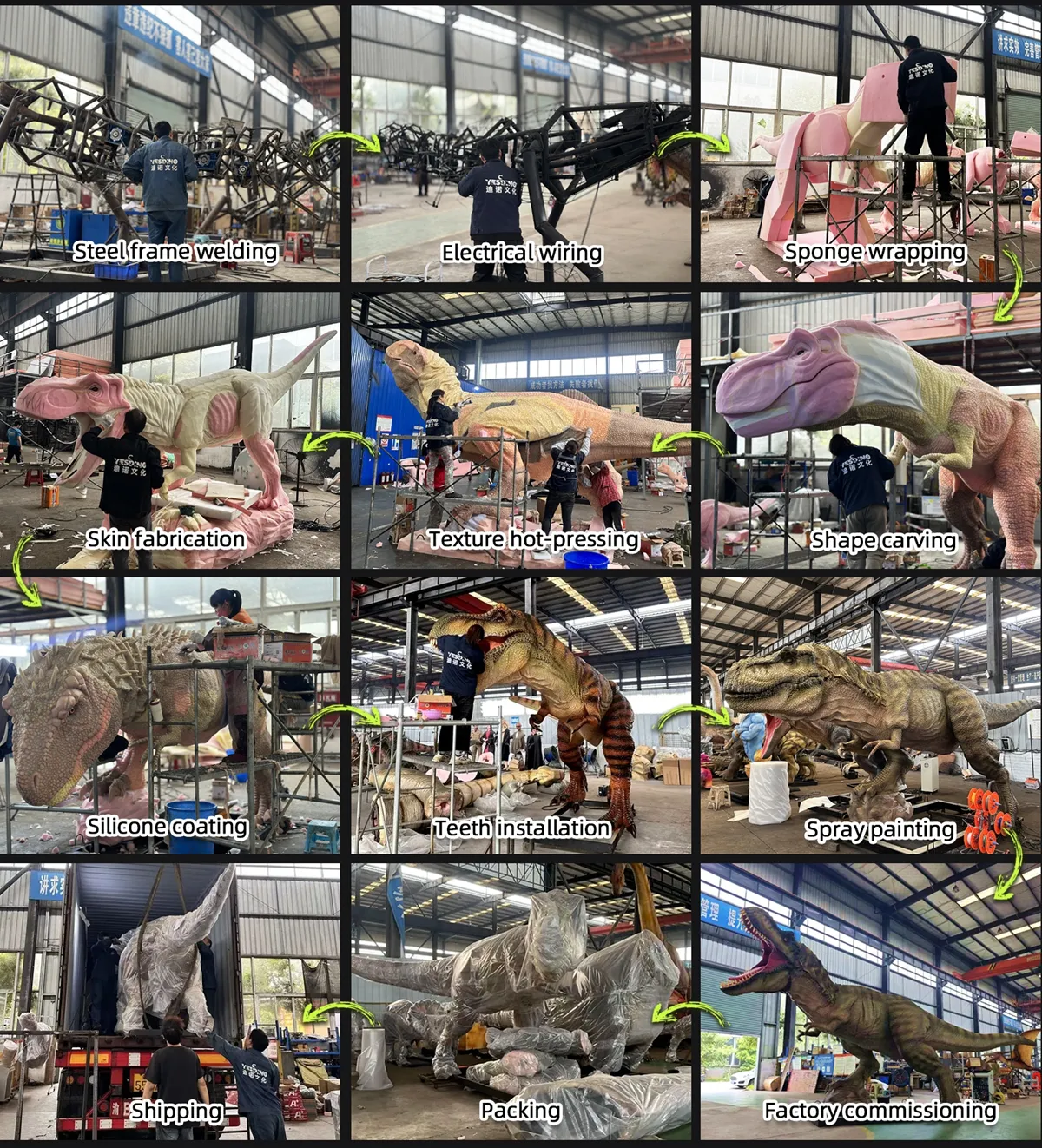
Production Process
Most Halloween dragons do not breathe real fire, and the ones that do are a different kind of project. At eight metres, this animal is sized to stand at the end of a walkway or in a courtyard where people approach from one side, and the effect that sells it is timing: the jaw opens, the sound hits, and something bright happens in the mouth a beat later.
SKU YDM-003 is the build: 8 m long, 2.5 m across, 3 m tall. Wide enough to read as heavy, short enough to fit a courtyard that cannot take a twelve-metre animal.
Simulated fire versus a real flame unit
A real flame needs a fuel supply, a permit, a fire watch and a clearance zone that usually rules out close visitor contact. It also needs the animal to be outdoors, away from canopies and decoration, and it needs someone trained to shut it down. In practice most event sites cannot carry that, so the flame becomes a lighting and mist effect triggered from the same programme as the jaw.
The simulated version reads well at night because the eye is drawn to contrast, not to heat: a warm LED burst inside the mouth, a short mist pulse, and a low-frequency sound that arrives with the light. It also repeats every ninety seconds without refuelling, which matters when the animal is the photo point for a queue.
Built for one season or five
Halloween builds get treated differently from park animals: they go up fast, stand in weather for four to six weeks, and come down in a hurry. That pattern is hard on connectors and on the wing hinges. Two changes make a seasonal animal last: plug-in harnesses instead of terminal blocks, so the sections separate without tools, and hinge covers that survive being handled by a crew in gloves.
If the animal is stored outdoors between seasons, ask for the frame to be galvanised rather than painted. It costs more at build and less every year after.
Movement and effect timing
Wing flap, head left and right, neck up and down, tail sway, blinking eyes and the jaw with sound form the set. The effect channel is separate, so the light and mist can be tuned without touching the movement programme.
The one timing rule worth keeping: never fire the effect at the same instant the jaw opens. A short delay — a fraction of a second — is what makes the mouth look like the source. It is also the difference between an effect that startles people and one that reads as a machine.
Siting it for a night event
Put the animal where visitors see it lit from one side and approach from the front. Side-on lighting flattens the wings; front lighting with a low angle exaggerates the head. The 2.5 m width means a two-metre gap either side is enough for a walkway, but the wing sweep needs another metre on each side while it moves.
Sound is the other siting decision. An eight-metre animal with a full roar will carry across a site, so the speaker level is usually set lower than the build can deliver, and raised only for scheduled shows.
Skin and finish for outdoor weather
Carved foam, silicone shell, UV-stable top coat over a Q235 steel frame. For a seasonal outdoor animal the top coat matters more than the sculpt: it is what stops the colour going chalky after two Octobers. Dark reds and near-blacks are the hardest to hold, so if the design depends on a deep colour, plan on a recoat rather than expecting it to last indefinitely.
We send a painted sample panel before the skin is finished. On a Halloween build that panel is also the place to check how the colour looks under your own lighting, which is usually harsher and warmer than a workshop.
Power, control and crew
110 V or 220 V to destination standard, −25 °C to 45 °C working range, control cabinet with stored programmes and a trigger input. For seasonal use we supply a laminated setup sheet: where the sections join, which harness goes where, and the two checks to run before opening.
Your crew will assemble this in the dark at least once. The setup sheet is written for that, not for a workshop with good light.
Enquiry
Tell us the event dates, whether the site can support a permitted flame unit or needs the simulated effect, and where visitors approach from. Those three answers set the build, the effect package and the price.
Where to go next
Worth reading before you commit: the cost breakdown with the seven price factors for how the sizes compare, the wiring concealment notes for what the ground has to carry, and the park layout and theming strategies for where the money actually goes.
For ideas on placing it, see seasonal display ideas. The rest of the range is on animatronic dragons, and if this one is the wrong size for the slot, custom animatronic dragon, 2m to 30m is the closest alternative.
Product Accessories

Packaging and Container Loading