


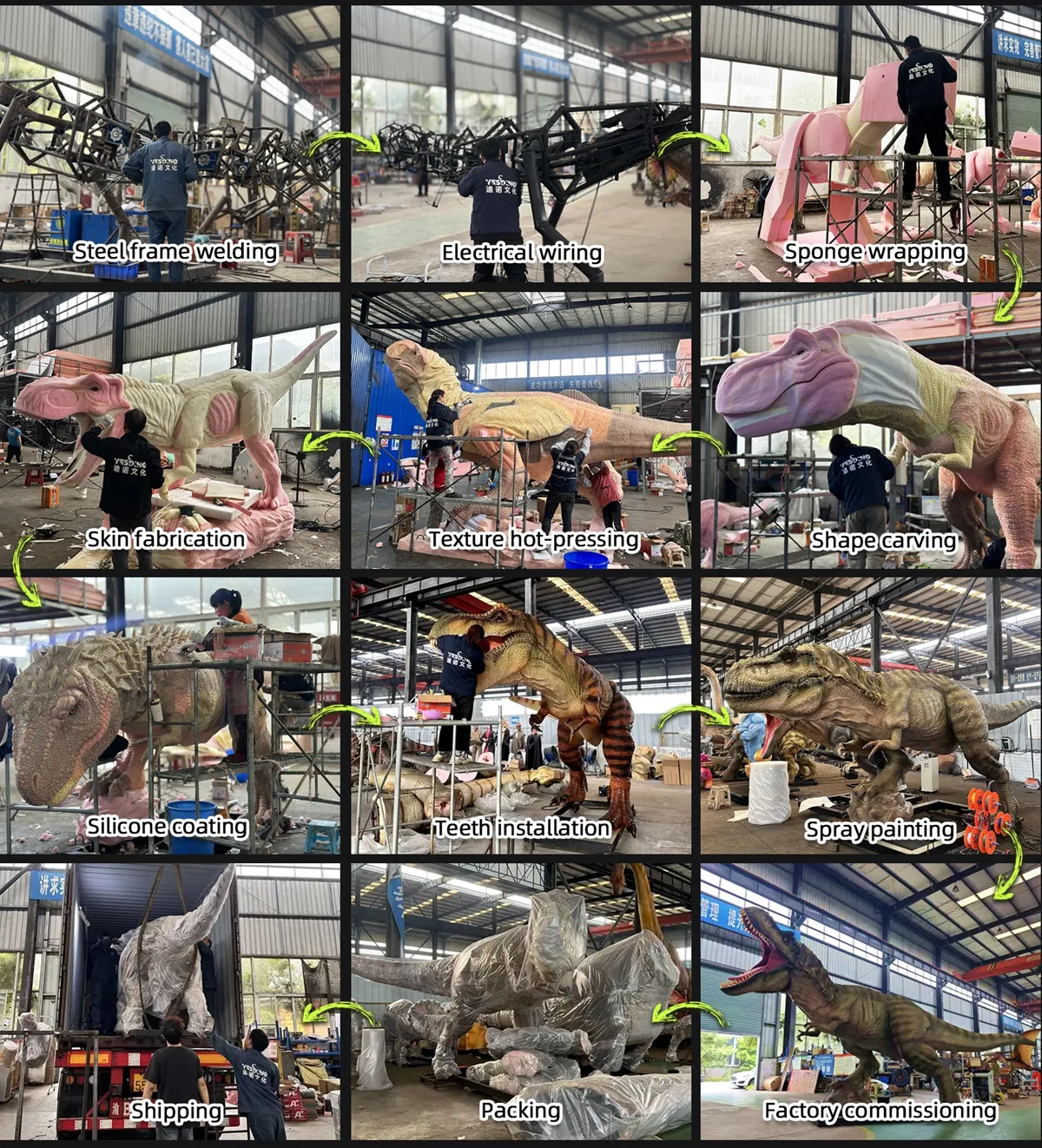
Production Process
Almost everyone who asks for a Dilophosaurus is thinking of the same scene: the frill opening, the high-pitched spit, the folding chair. None of that is in the fossil record. The real animal is stranger in its own way — a lightly built predator from the Early Jurassic with a pair of thin rounded crests running along the top of its snout.
SKU YKL-063 is built from the animal: six metres long, one metre across the body, 2.4 m to the top of the head, standing higher on the legs than most people expect from the film version.
Two crests, no frill
The crests sit on the snout, one either side of the midline, thin enough to see daylight through in a mounted skeleton. On the model they are sculpted as raised arches with a slight sheen so they read as structure rather than painted stripes, and the snout notch behind them is kept — the upper jaw dips where the crests end, which is the detail that makes the profile correct.
There is no frill, no neck flap, and no venom apparatus. If your brief calls for the film creature anyway — a Jurassic Park-themed zone, a photo op that trades on recognition — we build that variant too, with a deployable neck frill on its own drive. What we won't do is hand you the film version and label it accurate.
A light animal, which changes the build
At six metres this is a slender animal by the standards of the other models on this site. The frame is lighter in section, the legs are longer relative to the body, and the whole animal is carried higher off the ground. That has two consequences worth knowing.
It moves faster convincingly. A lightly built theropod animated at Triceratops speed looks sedated, so the program on this build runs quicker cycles with shorter dwells — closer to a bird's movement than a large reptile's.
It also anchors differently. Less mass means a higher centre of gravity relative to footprint, so the base frame needs a wider stance than the body width suggests, and the anchor pattern is wider than buyers expect. Send the pad dimensions and we'll confirm before fabrication.
Six movement groups
Head left and right, neck up and down, jaw open and close synchronized with the roar, blinking eyes, tail sweep, and a forearm scratch. The jaw travel is shorter than a tyrannosaur's — a long, narrow snout with a wide gape looks like a puppet instantly — and the forearm group reads well on this animal because the arms are long for a theropod.
Each group runs on an independent drive with end-of-travel protection, triggered from a loop, a proximity sensor or a floor mat. The proximity trigger is worth specifying for this species: the whole point of a Dilophosaurus in a trail is the moment it notices you, and a head that turns as a visitor arrives does that better than any sound effect.
Placement
This animal works best at a corner or a narrowing in a path, at a viewing distance of three to six metres. Closer than three metres and the neck joint becomes the most interesting thing on the animal; further than six and the crests stop registering.
Because it stands higher than a raptor of the same length, it also works as a background animal behind a lower exhibit — the head line stays visible over a fence or a planting bed while the body is partly screened. That layering is often what makes a trail feel populated rather than assembled.
Finish
Foam volume over a welded Q235 steel frame, silicone five to seven millimetres, translucent silicone airbrushed in layers. Standard scheme is a muted green-grey body with darker banding across the back and a pale throat, with the crests picked out slightly warmer — a small amount of contrast on the crests is what makes them visible at distance. Posture, pattern, colour, motion programming and sound are all specified per order.
The animal ships in sections with a base frame, control cabinet, sound system, wiring diagram and calibration sheet. Rated for −25 °C to 45 °C outdoors, 110 V or 220 V configured at build. Freight, duties, certificates and installation are quoted separately and sit outside the product price.
Before you order
Two questions decide the build: accuracy or recognition, and how close visitors get. Answer those and we can confirm whether this is the right animal for the spot, or whether a smaller Dilophosaurus or a different species would carry the scene better.
Where to go next
Worth reading before you commit: the wiring concealment notes for how the sizes compare, the park layout and theming strategies for what the ground has to carry, and the cost breakdown with the seven price factors for where the money actually goes.
For ideas on placing it, see photo zones and crowd flow. The rest of the range is on animatronic dinosaurs, and if this one is the wrong size for the slot, animatronic stegosaurus for theme parks is the closest alternative.
Product Accessories

Packaging and Container Loading



