Production Process
Half the visitors who stop at a dilophosaur arrive with a picture already in their heads, and it usually has a frill. This animal does not. Worth saying early, on the page and on the sign beside the display: the two versions ask for different builds, and only one of them is this one.
Six metres long, 0.65 m across the body, 2 m at the top of the skull.
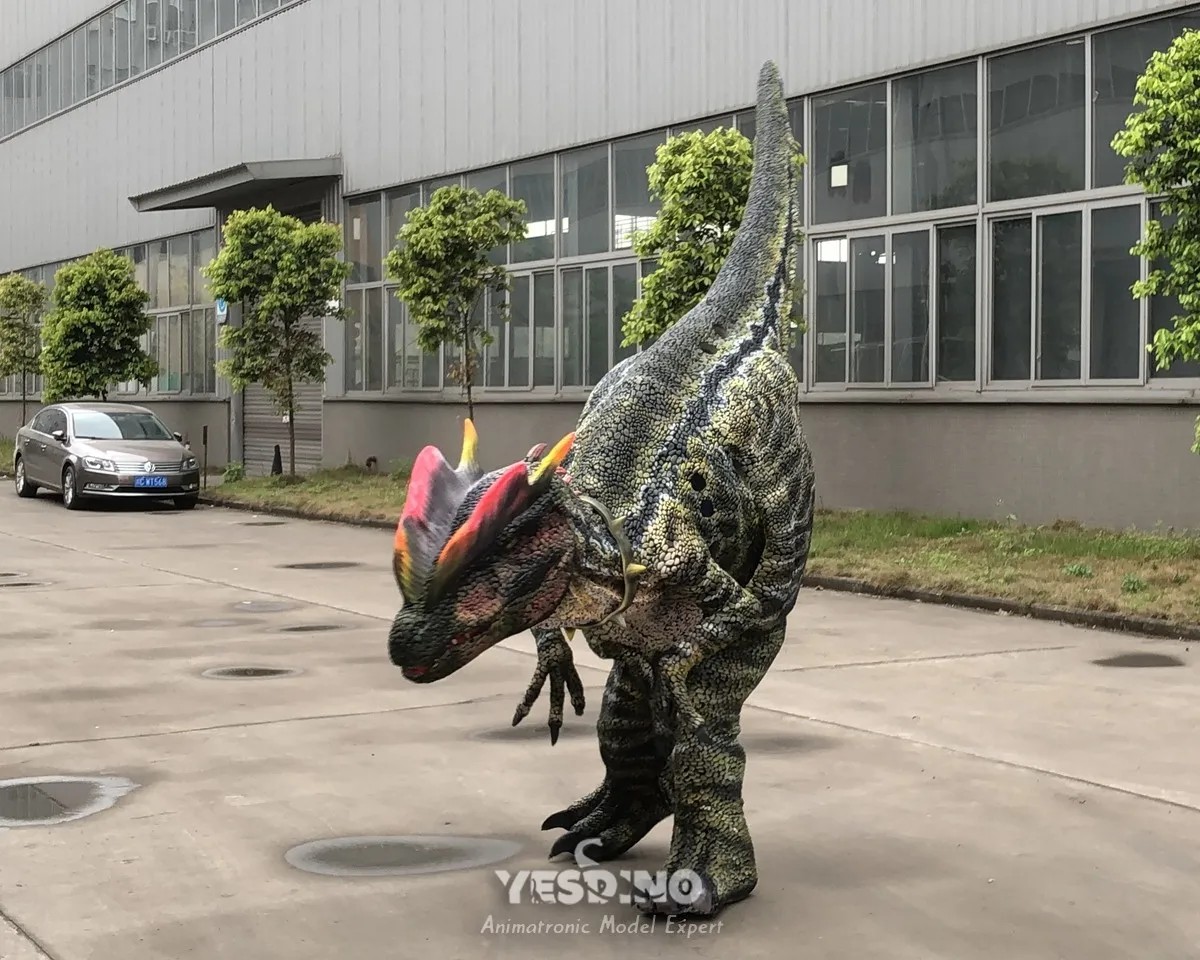
Two thin crests, no frill
The animal carries two thin rounded crests along the snout, set close together and low to the bone. The neck frill most people expect belongs to the film, not the animal, and this model does not have one. What you get is a narrow, crested head, lighter than a tyrannosaur's and shorter in the jaw.
Those crests are also the hardest part to make convincing: thin, catching side light, the first thing a visitor's eye finds. They are moulded with a supporting core and a soft edge, so the profile stays crisp instead of sitting on the snout like a stuck-on fin.
Beside a path, at two metres
At 2 m the head sits just under most adults' eyeline and well above a child's, which suits an animal people walk past rather than gather around. Six metres of length and 0.65 m of width takes the strip between path edge and fence without eating into the walking surface.
The viewing band that works runs from about two metres to six; beyond that the crests stop separating and the animal reads as a plain theropod. A trail bend is a better home than a long lawn, and setting the animal at an angle to the path lets the head face the approach without the body blocking the route.
Neck first, jaw second
The neck carries this animal's character. A slow head turn with a small pause at the end, then the jaw, reads as curiosity; a fast turn reads as a jump scare and wears off by the third pass. Jaw travel stays short, since a wide gape on a narrow skull looks like a hinge rather than a mouth.
The approach sensor matters more than the movement list here. Mount it at about 0.9 m and aim it across the path rather than along it, so a group walking past triggers once instead of stuttering. A delay of about 1.2 seconds before the cycle starts keeps the animal from reacting to every passer-by at a busy junction.
Thin parts, soft skin
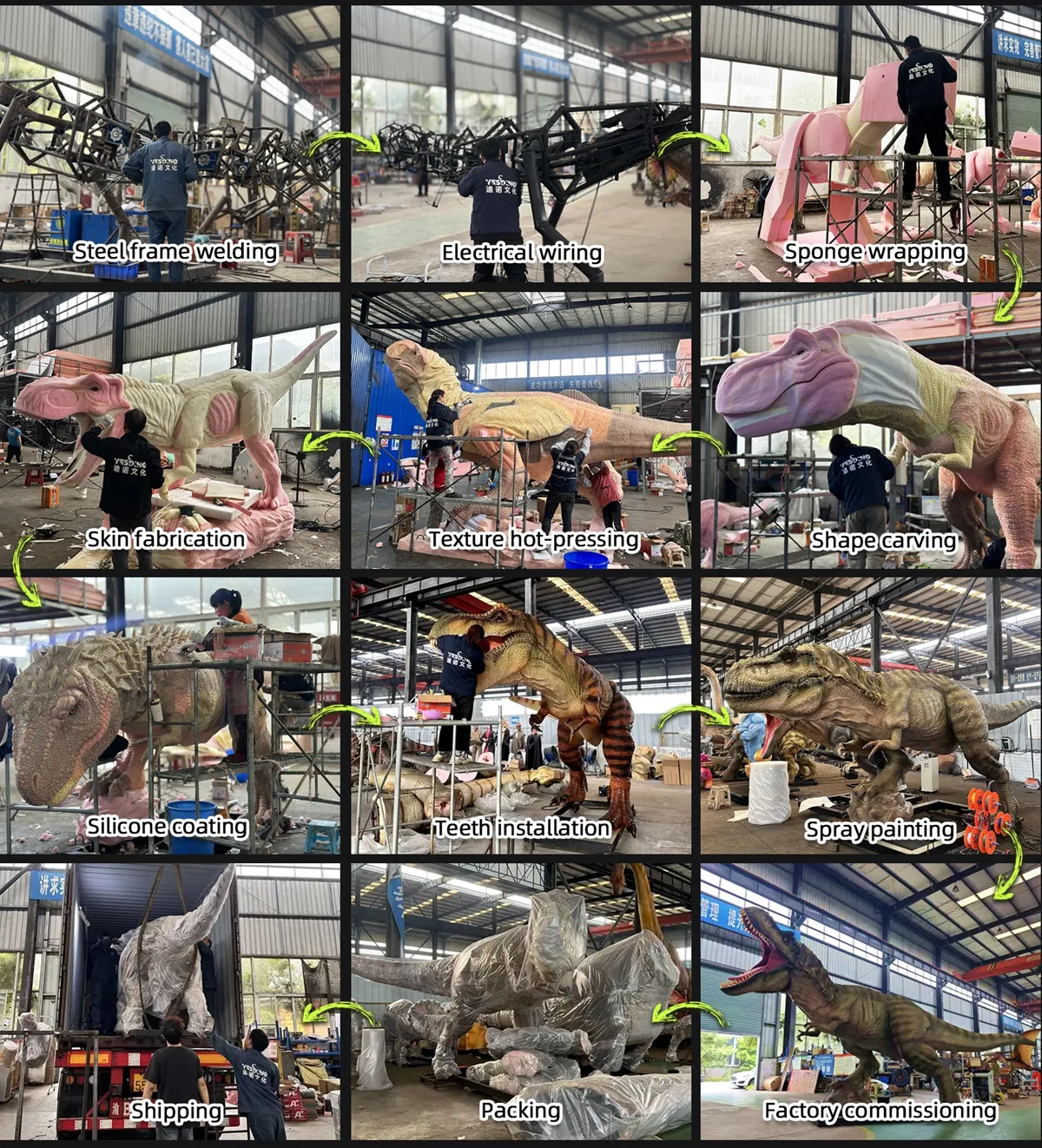
Q235 steel frame with rust treatment, high-density foam carved to volume, silicone skin at 5–7 mm, colour sprayed in translucent silicone layers so tone sits in the surface. Trail animals take branches, bags and the occasional hand; a patch with matching pigment blends in better than a repainted panel.
Light decides how the crests read. Under 4000K neutral lamps the edge stays visible and the head looks sharp; heavy warm light softens the crest into the skull behind it. If the trail opens in the evening, test the head under the actual fitting rather than in the workshop.
Down a gap 0.65 m wide
The build splits into body, neck-and-head and tail, which keeps the widest crate close to the body width. That matters where access is a gravel path, a boardwalk or a gap between trees rather than a road. Two people with a hand cart move the sections; no crane at this size.
Assembly on a trail: base plates on a level pad, body onto the plates, neck and head onto the shoulder coupling, tail last, skin closed at the two joints. The cabinet goes behind the animal, off the path, its door swinging away from visitors. On soft ground, ground screws or a concrete curb instead of a slab keeps the footprint small enough to tuck behind planting.
Before you order
Send the path width, the surface, the walking direction, and a photo of the strip the animal will stand on. Tell us about evening hours and whether a sign will explain the crests; that affects how much goes into the head finish.
Two situations where a six-metre animal does not fit. An open plaza with a thirty-metre approach, where a 6 m animal at 2 m tall reads small. And a brief that wants the frilled film creature, which is a different product — if the marketing leans on that image, a build without the frill gets read as a mistake rather than an accurate animal.
Enquiry
Send the trail plan, the path width and the walking direction. Tell us where the power comes from and whether the site takes 110V or 220V.
Shipping, duties, certificates and installation are quoted on top of the animal price. The movement list travels with the drawing so your team can see what the build actually does.
Where to go next
Worth reading before you commit: the rental cost breakdown for how the sizes compare, the pneumatic versus hydraulic comparison for what the ground has to carry, and the installation guide for pads and access for where the money actually goes.
For ideas on placing it, see exhibit planning walkthrough. The rest of the range is on animatronic dinosaurs, and if this one is the wrong size for the slot, animatronic velociraptor for jurassic theme parks is the closest alternative.
Product Accessories

Packaging and Container Loading