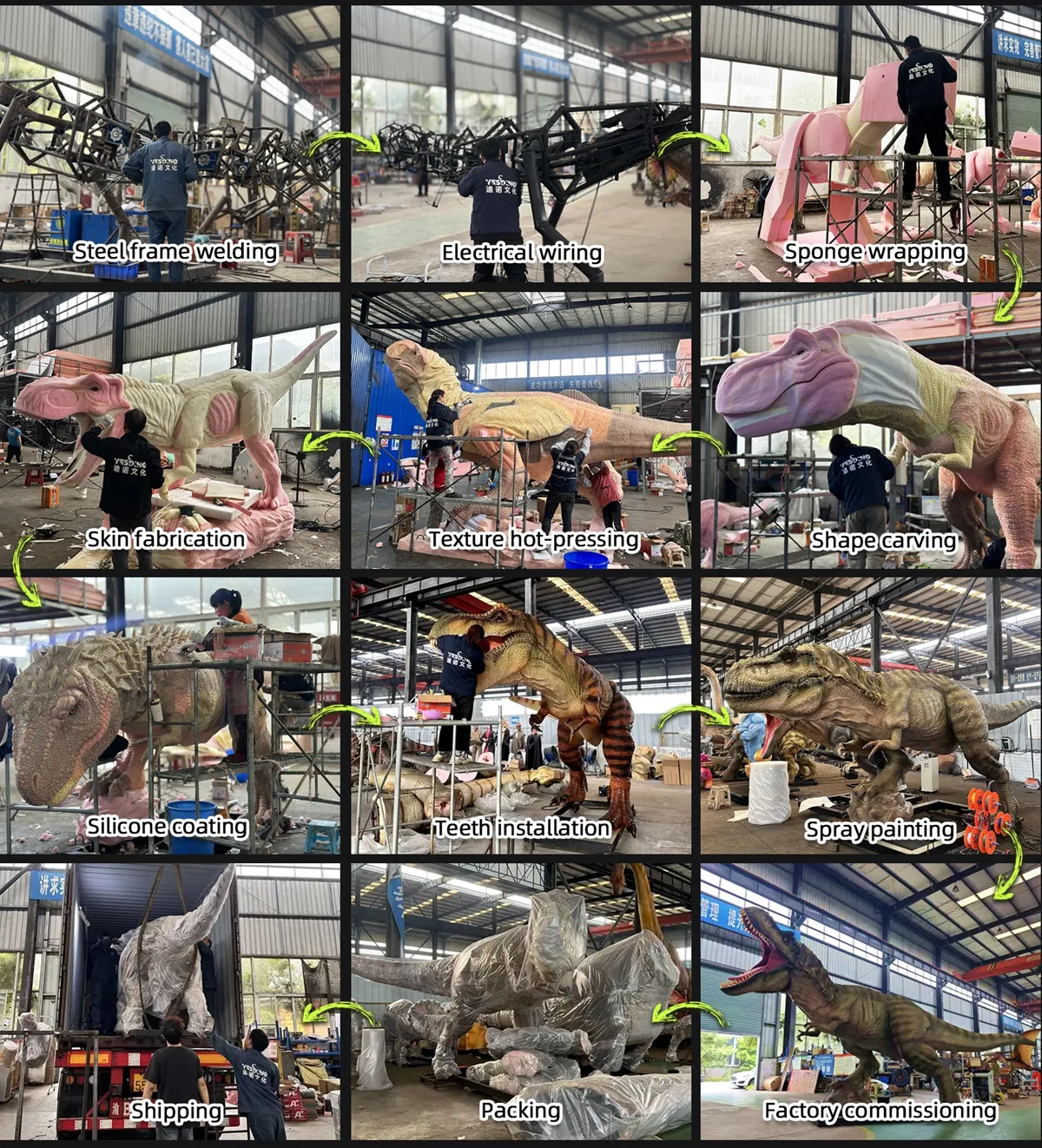
Production Process
A path-side animal is passed on both sides of its body over a day. Visitors come up one way in the morning and back the other after lunch, seeing it from behind at 1 m. That is a different design brief from an animal posed at the end of a clearing.
This one is 5 m long, 1.2 m across the body, 2 m tall. Broad for its length, which is what makes it work beside a path rather than across one.
One point two metres across
At 1.2 m across, this animal has a chest and hip that read from the side at walking pace. A narrow build shows a line; a broad one shows a shape, and the shape holds up when someone stands 0.5 m away looking at a section of flank.
The cost is where it can go. A 1.2 m body needs a 1.6 m gate and a path with 2.5 m of clear width if people are to pass without stepping onto planting. On a narrow trail this animal is the wrong pick, and a slimmer five-metre build does the job.
Where a wide animal sits
Placement is beside the path, angled 20 to 30 degrees towards the walking direction, with the flank 0.5 m back from the edge. Straight across the path, the animal blocks the flow and its own best view; angled, the head sits in the line of travel and the body fills the planting behind.
The tail needs a clear 1.2 m arc behind it, and the base plate wants level ground. On a slope, the animal sits on a cut pad with a gravel apron that keeps runoff from under the belly. Path lamps at 2700 K warm the skin and pick out the crests; unlit sections read flatter than the sample suggests.
Two crests, no frill
The animal carries two thin rounded crests running along the snout, moulded into the skull as raised shells rather than glued on. Thin edges are the first thing to suffer on a path where branches and hands get close, so each crest is sealed along its rim and set proud of the skin to catch a side light.
The neck frill is a film invention, and this build does not have one. Some parks ask for one because visitors expect it. We will make it, and we say plainly what it is: film design, not anatomy. That conversation is easier before the artwork is approved.
What moves on a broad body
Neck turn, head tilt, jaw, tail sway, blink and breathing. On a wide animal the neck turn is slower, and the breathing cycle is set deeper so the chest visibly expands — at 1.2 m across, a shallow breath does not show.
Close passes need a short delay. The sensor sits at 900 mm on a path-side post, 0.45 s delay, so the head starts moving as the visitor is level with the shoulder rather than after they have passed. The jaw opens on the second beat and closes slowly, which reads as a breath rather than a bite.
Frame, skin, and the width problem
Q235 steel frame with rust treatment, foam-carved volume, silicone 5–7 mm in translucent layers, matte topcoat. A wider body means a wider frame, so the base is built as a ladder with feet at four points instead of two. That keeps a 1.2 m body from rocking when the neck swings to one side.
A broad flank also means a long unsupported skin panel. Ribs run every 300 mm behind it, and the panel is bonded to the foam rather than stretched over it, so a hand pressed into the flank springs back. Rated −25°C to 45°C, 110 V or 220 V at build, electronics under a two-year warranty.
Getting a wide build in
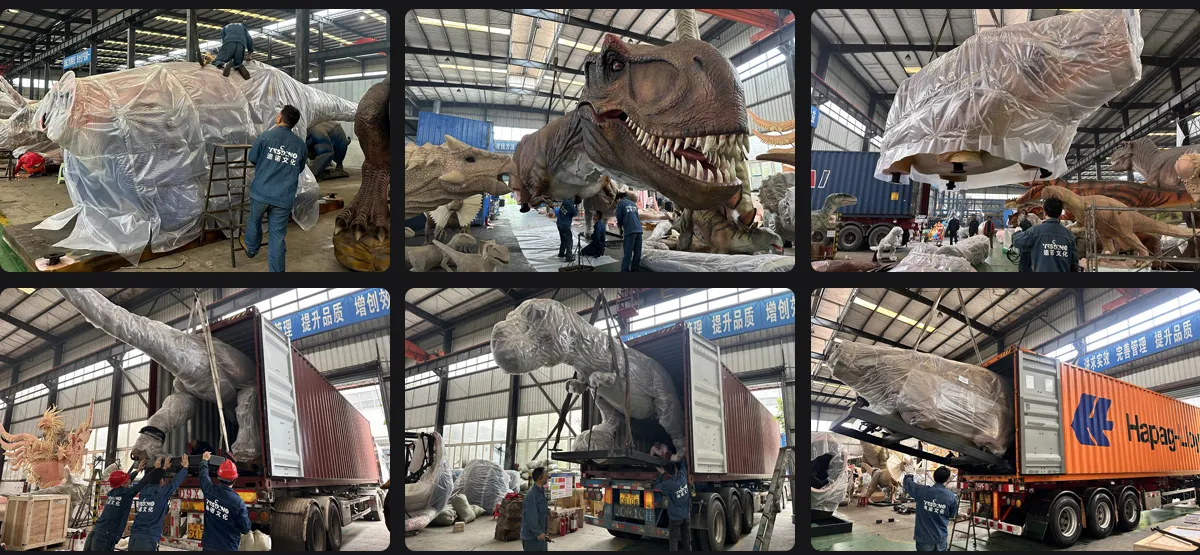
Ships as head, body, tail in two parts, legs, ladder base and cabinet. The widest single piece is the body at 1.2 m, so the gate on the delivery route decides the route before anything else does. Load order on a path: base, legs, tail, body, head, with the head last and kept covered until the neck collar is clean.
The cabinet sits inside the body, reached through a rear hatch under the tail root, with 500 mm of clearance and the door hinged to drop down. It is tighter than a flank panel, and it keeps the electrics out of the weather. Anchoring is four M12 anchors or ballast where drilling is not allowed.
Enquiry
Send the path width, the gate width on the delivery route, which side visitors walk on, and whether a frill is wanted. Those four answers settle the placement, the section split and the artwork brief. Freight, duties, certificates and installation come as a separate line.
Where to go next
If you are still comparing options, start with the park layout and theming strategies — it lines up the builds by length and reach. Site work is covered in the cost breakdown with the seven price factors, and the spare parts and repair kit list lists the factors that move the price.
For ideas on placing it, see layout strategies for themed trails. The rest of the range is on animatronic dinosaurs, and if this one is the wrong size for the slot, 15m t-rex centre piece for exhibition halls is the closest alternative.
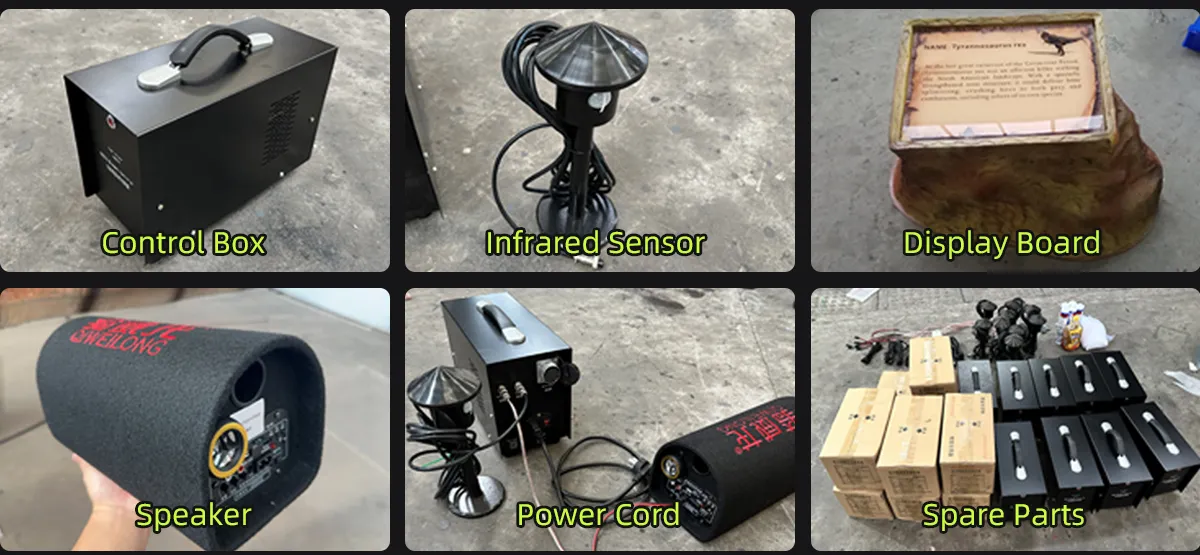
Product Accessories
Packaging and Container Loading