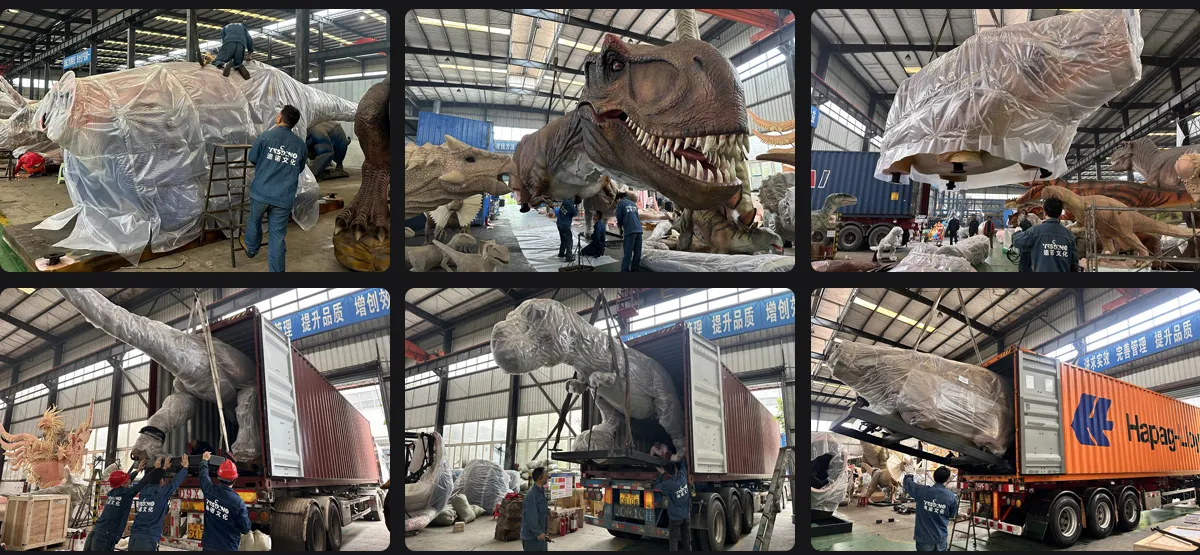
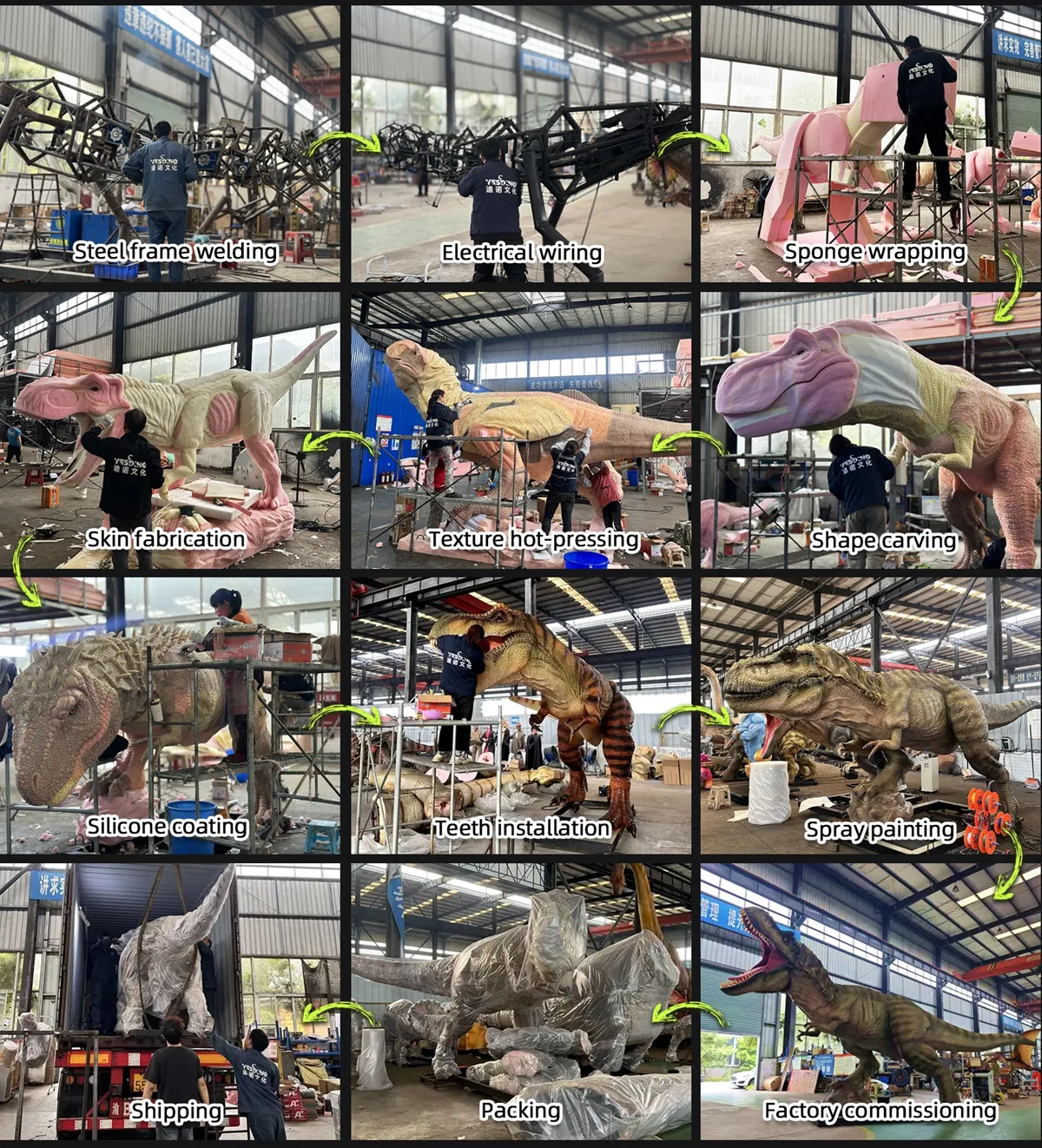
Production Process
The photo line is taped on the floor three metres out, parents stand behind it, and the animal turns its head into the phone camera. Forty times an hour on a Saturday. What makes that work is not the movement set — it is the horns, the height, and the fact that a 0.8 m body leaves the walkway open behind it.
Five metres long, 0.8 m across, 2 m at the head. In a mall those three numbers decide whether the activation is allowed on the floor plate at all.
Why 5 m by 2 m is the mall size
A 2 m head height sits under the soffit in most concourses, above the crowd, and below the fire signage band. The 0.8 m body width means the animal occupies a strip rather than a block: a 5 m strip along a shopfront leaves 4 m of walkway, which is what centre management look at first.
The trade is that a 5 m predator is not a landmark. It anchors a 12 m to 20 m concourse; in a 40 m atrium without a plinth or lighting it reads small.
The spot: glass, glare and the approach
Best position is side-on to the main flow, 2.5 m off a shopfront window, head angled 20 to 30 degrees toward the approach so people meet the horns first. Straight-on gives a photograph of a chest; the quarter angle gives the profile and the head turn.
Against glass, settle the reflection before fixing colour. A dark build in front of a bright window becomes a shape with no detail after dark. Front-top lighting at 3000 K to 3500 K keeps the skin warm; cold white floods turn it grey-green, and that is what most phone photos end up showing.
What moves in a noisy room
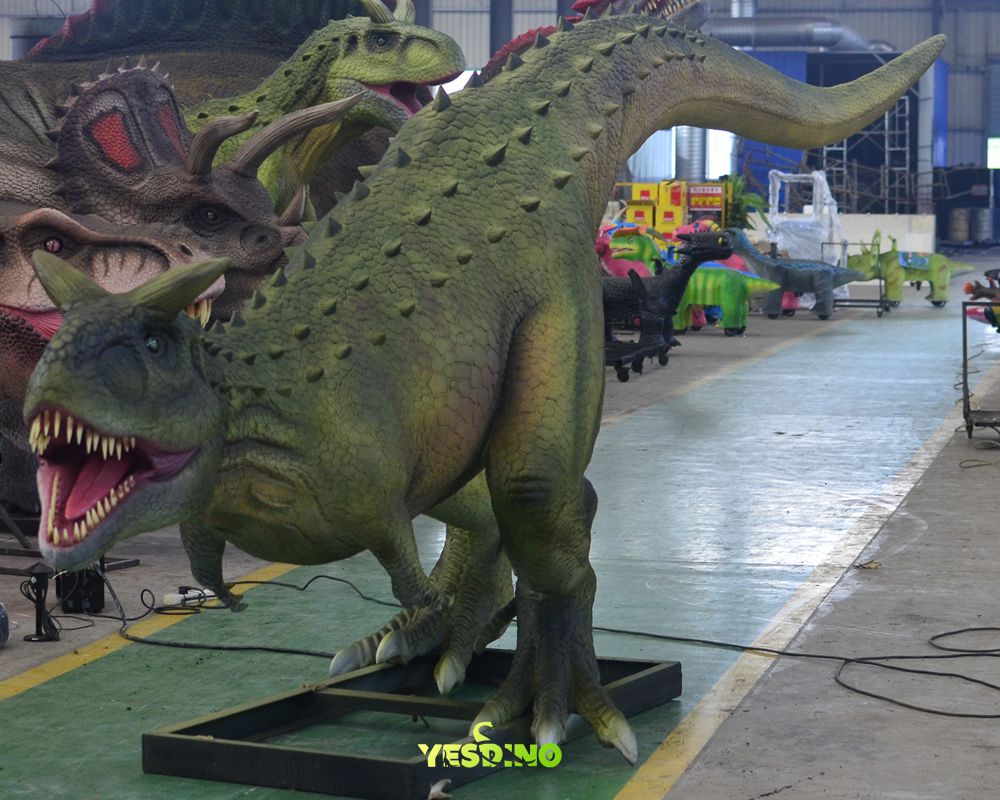
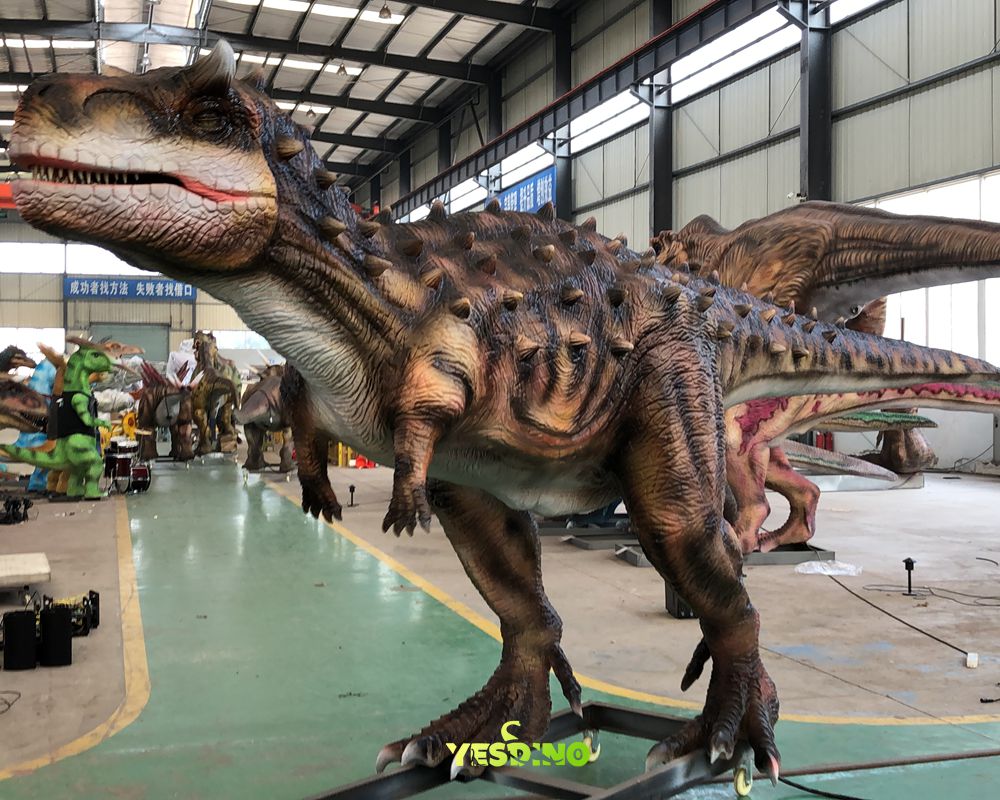
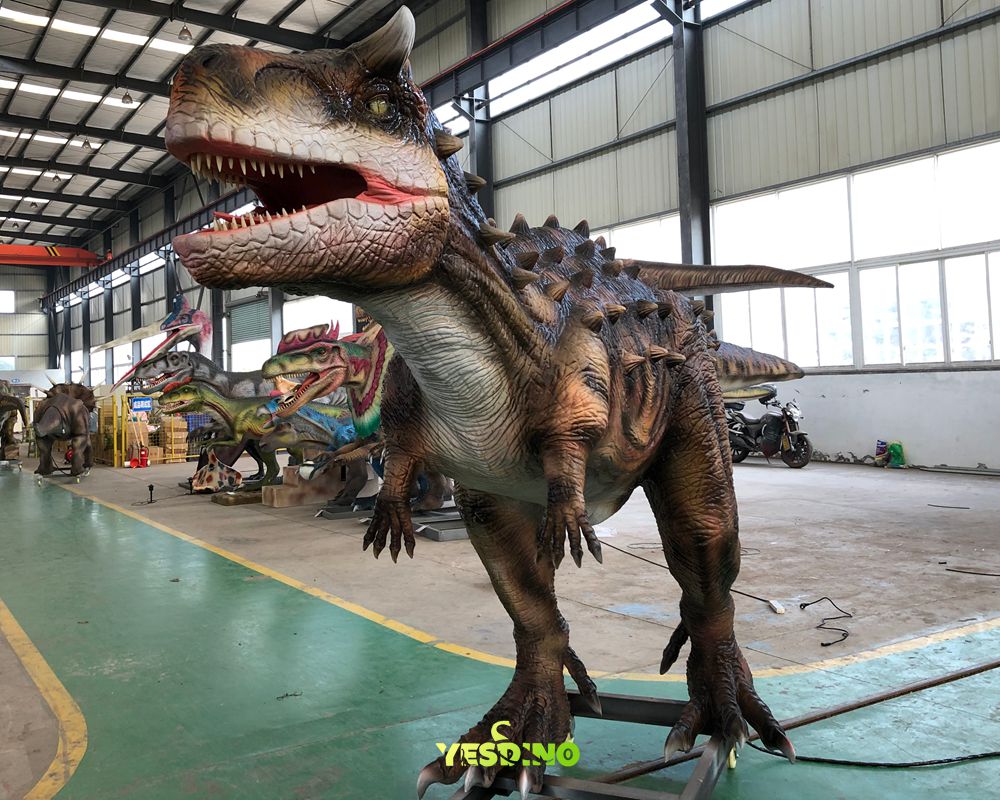
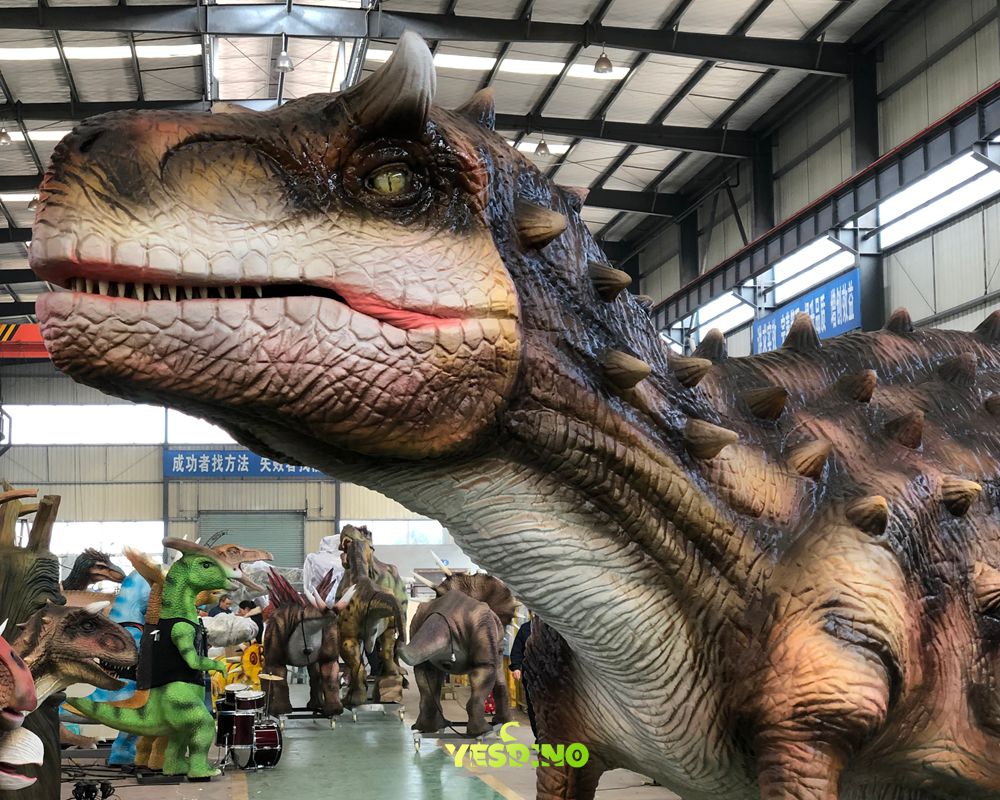
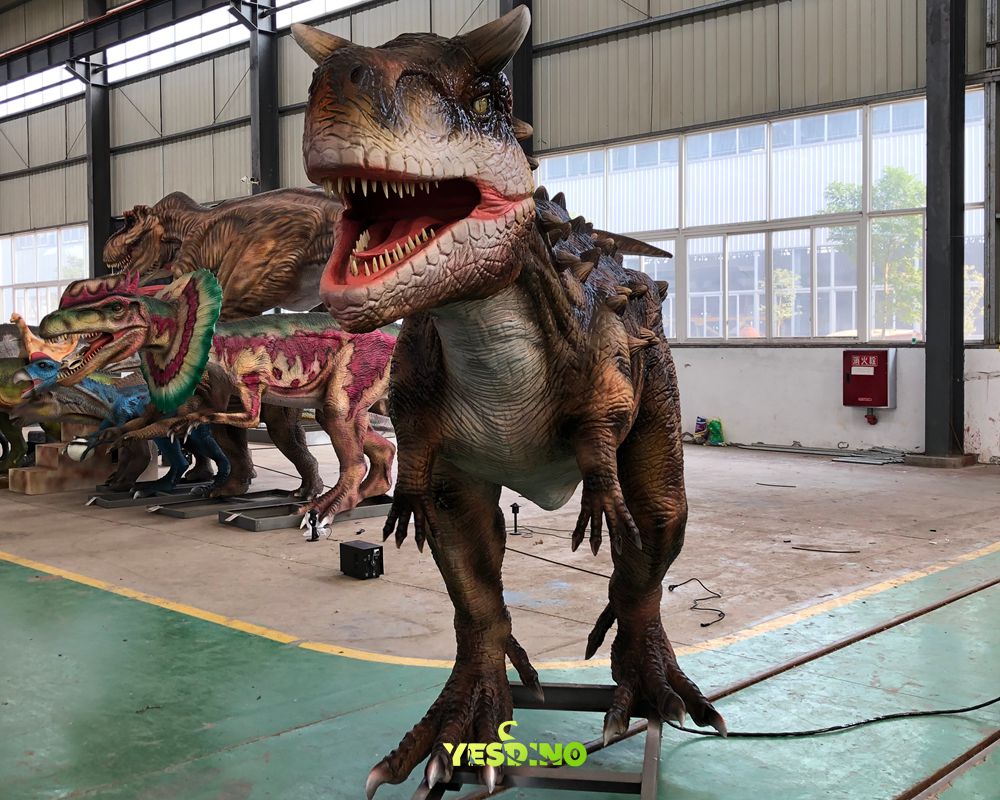
Neck turn, head tilt, jaw, blink, tail sway, and a slight rise in the chest. The head turn is the one to spend time on, because the horns only do their job in profile — the movement that shows them best is the slow turn across the walkway, not the jaw.
Sound is the part that gets negotiated with the centre. Ambient level in a busy concourse sits around 65 dB to 70 dB, so a roar set for a park is inaudible at 5 m and a roar loud enough to carry is a complaint at 20 m. We usually set a short, low call triggered at close range, with the speaker in the chest and the level fixed at the cabinet after a walk test in the actual mall.
Skin, horns and shop lighting
Q235 steel frame with rust treatment, high-density foam carved for volume, silicone skin 5 to 7 mm, colour in translucent layers. The short deep skull and the two brow horns are the reason this animal photographs well: the horns catch a rim light along their length, and the skull stays readable as a shape even in a phone snap.
Mall floors are cleaned daily and children touch everything at hand height, so the snout, jaw edge and lower flank get the heavier colour build. Damage there is patched with pigment on site in an hour, which matters when the dismantle date is fixed.
Getting it in after trading hours
Mall installs happen between 22:00 and 06:00, through a service corridor and a goods lift. The animal splits into head and neck, torso, and two tail sections; the horns are crated separately because they are the part that takes a knock. At 0.8 m body width the sections clear a 1.2 m lift opening with 100 mm each side.
Ceramic tile is not something to drill. We use a ballasted base frame with rubber pads, loaded to hold the animal against a push, and a 5 m build at this weight sits inside what a floor plate takes without a structural note. The cabinet sits in the torso behind a panel on the left flank; that side needs to face away from the public, so tell us which way the animal faces before the base is welded.
Before you order
Send the floor plan with unit numbers, the soffit height, the sprinkler and signage positions, and the goods lift dimensions. Add the centre's noise rule and the install hours — those two documents shape the build more than the animal does.
One case where we would say no. If the concourse is a through-route with no side pocket, a 5 m animal on the centre line becomes an obstruction by the second week, and a 3 m build against a wall serves the same campaign with fewer conversations. The other is a mall with continuous glass on both sides and no lighting position: the silhouette will not hold, whatever the colour.
Enquiry
Send a photo of the exact spot at trading hours, the lift dimensions, and the centre's install window. Tell us the light fittings near the position and the voltage at the service point. We will come back with the footprint, the facing direction, the ballast layout and a lifting plan your contractor can work to.
Where to go next
Two things come up in almost every enquiry on this build: how the size compares with the alternatives, and what it takes to get it on site. The pneumatic versus hydraulic comparison sets out the length options side by side, and the installation guide for pads and access covers pads, access and assembly. Budget planning sits in the wiring concealment notes.
For ideas on placing it, see mall exhibition notes. The rest of the range is on animatronic dinosaurs, and if this one is the wrong size for the slot, 5m t-rex for museum exhibitions is the closest alternative.
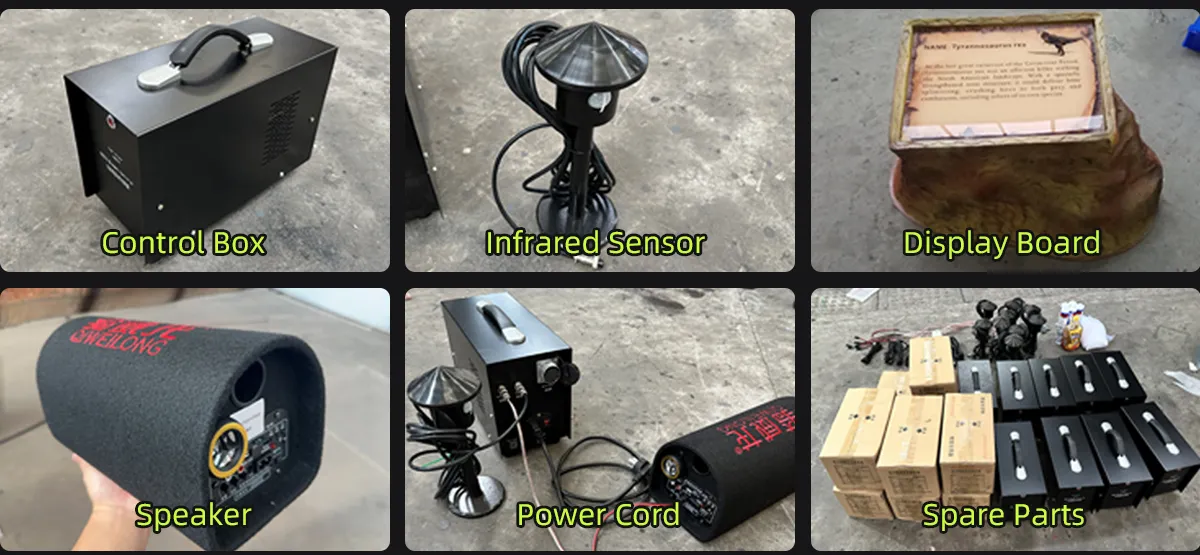
Product Accessories
Packaging and Container Loading