|
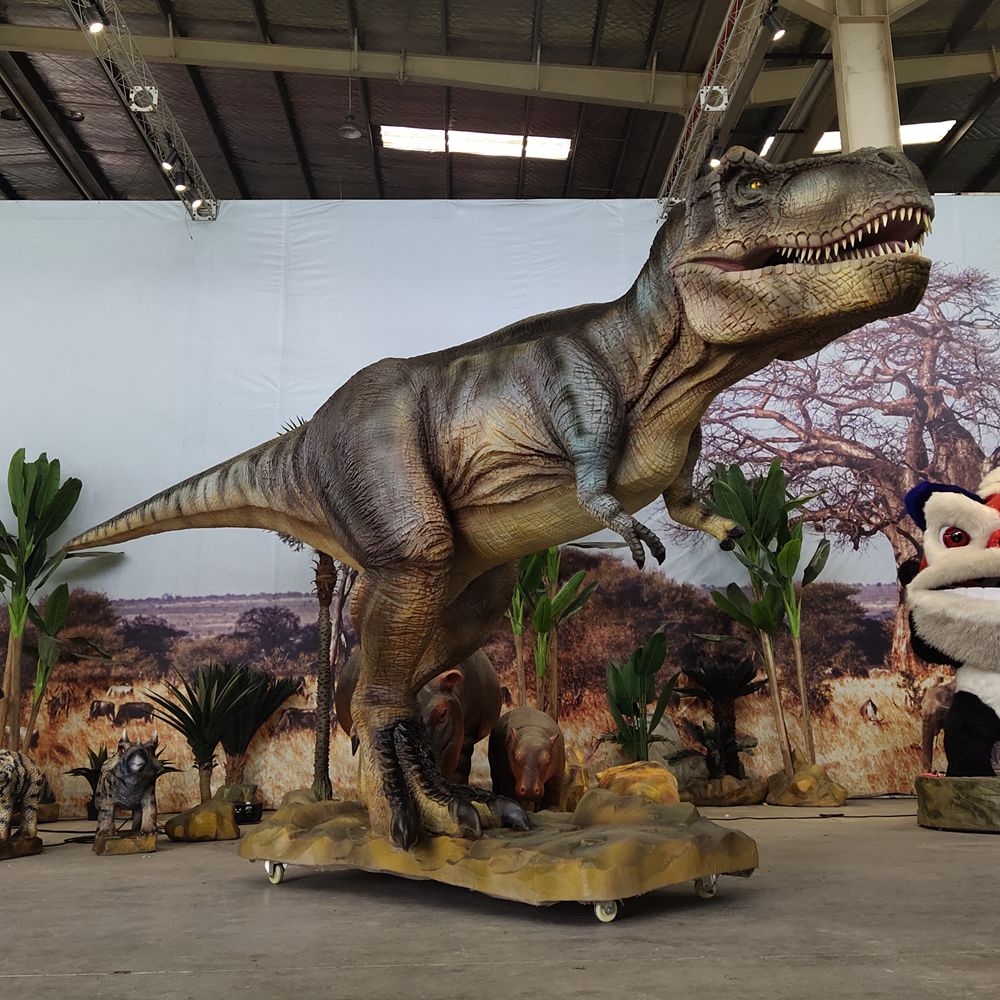
Featuring animatronic dinosaurs in shopping malls has become a highly common and engaging display strategy. Many shopping centers leverage these exhibits to attract family demographics, create photo opportunities, and ultimately boost foot traffic. Lifelike AllosaurusTechnical Specifications & CraftsmanshipOn the welding platforms of our workshop, technicians use MIG welders to spot-weld the Q235 carbon steel framework. At critical load-bearing points of the Allosaurus's lower jaw, the steel tubing features an outer diameter of 15mm and a wall thickness of 2.5mm, with a 0.8mm penetration gap left at the weld joints. This robust structure ensures the metal components resist fatigue and prevent fractures, even after performing over 500 high-frequency open-and-close cycles daily. The neck vertebrae are embedded with three brushless DC motors, each rated at 120W and operating within a safe low-voltage range of 24V. The motor shafts are connected to two 6mm aviation-grade steel cables, which are anchored to tension rods behind the skull model. This pulley-style transmission allows the head to achieve smooth lateral movement within a 45-degree arc. The skeleton is wrapped in industrial-grade polyurethane foam. High-density 60D foam—up to 45cm thick—is used for muscular areas like the thighs. Artisans hand-carve the foam using hot-wire cutters heated to 300°C to simulate realistic biological muscle contours.
In a climate-controlled mixing room kept at a constant 22°C, technicians blend liquid silicone with a curing agent at a precise 100:2 ratio. To prevent premature cross-linking once exposed to air, each batch is limited to 5kg and must be applied within 15 minutes. The initial base coat, approximately 1.5mm thick, is worked into the foam fibers using stiff hog-hair brushes. While the silicone is in a tacky, semi-dry state, a layer of 250D elastic mesh is applied. Workers use scrapers to press this mesh—which features a 2mm pore diameter—fully into the silicone layer. This reinforced composite skin can withstand a tensile force of 30kg per square centimeter, preventing the skin from tearing during prolonged movement. Before the skin fully cures, the texture is detailed using a set of 12 specialized sculpting knives with varying curvatures. Scale textures are pressed into the silicone surface using custom embossing molds. The lacrimal horns on either side of the Allosaurus's head are the most rigid parts, covered in high-hardness silicone up to 8mm thick.
Coloring is achieved using a blend of acrylic pigments and diluted silicone, applied with an airbrush at a constant pressure of 0.3 MPa. The Allosaurus features a pale grey-white underbelly and dark brown tiger stripes across its back. Every stripe edge is finely atomized for a natural transition, with each unit requiring approximately 300ml of custom-blended pigment. Unlike the soft silicone body, the teeth and claws are cast from AB epoxy resin. After 48 hours of room-temperature curing, 32 serrated resin teeth ranging from 4 to 8cm in length are set into the upper jaw. Each tooth has a Shore hardness of 80D, with roots deeply embedded into the grooves between the foam and steel frame, reinforced further with hot-melt adhesive. The eye sockets house custom 40mm glass prosthetics connected to micro-servo motors. These servos provide a 20-degree horizontal field of vision, and the eyes are backlit by 0.5W warm-yellow LEDs. The iris patterns surrounding the pupils are produced via high-precision printing at a resolution of 1200 DPI. A discreet 30cm x 30cm maintenance hatch is located on the belly. All internal wiring uses 18 AWG multi-strand pure copper wire encased in flame-retardant corrugated tubing. The looms are secured to the steel chassis with nylon ties every 15cm. Signal cables lead to an external microcomputer controller pre-loaded with 20 distinct motion logic sequences. The entire Allosaurus is supported by a chassis welded from No. 10 channel steel, measuring 3.5m long by 1.2m wide. Four lockable swivel casters are installed at the corners, each rated for a 150kg load. The chassis is camouflaged with fiberglass "rockwork" and finished with four layers of wear-resistant, anti-corrosive clear coat.
Prior to shipping, each unit undergoes 72 hours of continuous stress testing. When the sensor detects a pedestrian, the tail motor activates, swinging the tail at a speed of 1.5m/s. Internal mechanical noise is maintained at approximately 35dB. The idle current remains stable at 4.2A, while the forelimb micro-motors respond to 5V pulse signals to lift the arms by 30 degrees. Dimensions & Spatial IntegrationFor delivery, the disassembled Allosaurus arrives in three fumigation-free wooden crates via a 13-meter semi-trailer. The largest crate, containing the main torso, measures 3.8m long, 1.5m wide, and 2.2m high. A 3-ton hydraulic pallet jack is used to lift the crates via the 12cm clearance slots at the base. The combined weight of the torso and its crate is 380kg, manageable by a single adult. The mall's freight corridor provides a net width of 2.8m and a height of 2.5m. While navigating the 3.8m crate through corridor turns, a 45cm clearance remains at both ends. The freight elevator features a door width of 1.8m, an internal depth of 2.6m, and a weight capacity of 2,000kg. The smaller 2.1m crate for the tail occupies only 30% of the elevator floor. However, the large torso crate must be pushed into the elevator cabin diagonally; once positioned, the crate corners sit just 8cm from the elevator’s stainless steel walls. The mall's atrium is floored with 18mm thick natural marble. The fully assembled Allosaurus weighs 250kg and has a footprint of 4.2 square meters, resulting in a static pressure of 60kg per square meter. The architectural blueprints specify a live load limit of 350kg per square meter for the ground floor. To distribute the weight, technicians place a 50cm² rubber vibration pad (8mm thick) under each of the four casters. These pads triple the load-bearing surface area. Even accounting for the weight of surrounding crowds, the marble tile deformation is kept under 0.1mm. Once assembled, the Allosaurus measures 5.2m in a straight line from snout to tail-tip. When standing at full height, the top of the head reaches 2.35m. For an adult standing 1.5m from the safety railing (eye level approximately 1.6m), their line of sight forms a perfect 20-degree angle with the dinosaur’s eyes. The glass railings on the second floor are typically 4.5 to 5m high, meaning this 2.35m tall dinosaur remains fully visible without blind spots for visitors looking down. From above, the display occupies 15 square meters of the atrium floor. A 3.5m wide circular main aisle is maintained around the model. When powered, the head's lateral movement covers a 0.6m radius sector, with the snout sweeping a horizontal distance of 0.85m. The 2.2m tail is the most active component, swinging up to 25 degrees on either side. The tail tip carves an arc 0.95m long. A 0.4m clearance is maintained between the chassis edge and the furthest point of mechanical movement. The decorative perimeter fence is fixed to a metal track 0.8m from the chassis. If a child (1.2m tall) reaches over the fence, there is still a 35cm safety margin between their fingertips and the swinging tail tip. Component Dimensions:
Installation occurs after mall hours, typically between 11:00 PM and 1:00 AM. A team of three technicians performs the assembly using two 18V lithium-ion torque wrenches. Attaching the tail requires two people to support and align the connection interface. The interface between the tail and body features eight 12mm holes. Technicians use the torque wrenches to tighten eight M12 high-strength bolts to a torque of 65 Nm. The internal wiring is connected via 6-pin "fool-proof" (keyed) connectors. The side of the exhibit is 4.8m away from the nearest cosmetics counter. During peak weekend traffic, with a density of roughly 1.2 people per square meter, this 4.8m aisle allows two strollers and three adults to pass one another comfortably. Decorative artificial plants around the base do not exceed 0.6m in height, ensuring they do not obstruct the neon signage of facing shops. Sightline transparency between ground-floor shops is maintained at over 85%. The mall's directory sign is positioned 1.2m directly behind the dinosaur's tail. Its 0.15-square-meter base is offset from the front view of the dinosaur, guiding foot traffic toward the nearby up-escalator. Centrally located 22m above is the mall's glass skylight. At noon, the Allosaurus casts a shadow of approximately 6.5 square meters on the floor, with the shadow edge remaining 2m away from nearby benches. Visitors on the benches have 80cm of legroom and cannot reach the outer transparent barrier. At night, the exhibit is illuminated by six track spotlights mounted on the edge of the third floor. Interaction Modules & ElectronicsA microwave radar sensor is concealed within the rockwork at the front of the chassis. It is set to a frequency of 5.8 GHz, allowing electromagnetic waves to penetrate the fiberglass shell to detect human presence. Engineers have calibrated the detection field to a 120-degree wide angle with a trigger distance of precisely 2.5m. When someone enters this 2.5m semicircular zone, the microwave signal undergoes a 0.2-second Doppler shift. The microcontroller in the control box detects this voltage change and wakes the audio and motion programs from sleep mode. "Anti-shake" code is implemented to enforce an 8-second cooldown between triggers.
Once activated, the decoder reads from an 8GB industrial-grade TF card containing 12 lossless WAV audio tracks synthesized by a paleontology institute. The audio features a 48kHz sampling rate and a 1411kbps bitrate. The speaker is not located in the mouth but is mounted behind a breathable mesh cover in the mid-rear of the chassis. The unit utilizes a 45W all-weather waterproof speaker with a 165mm diameter and a moisture-proof silicone-coated cone.
At a distance of 1 meter, the peak volume is 82dB. By the time the sound reaches shop entrances 4.8m away, it attenuates to approximately 65dB. This complies with daytime mall regulations (under 65dB), ensuring the exhibit does not interfere with sales staff and customers. As the audio triggers, the jaw's servo motor receives a 5V Pulse Width Modulation (PWM) signal. The fluctuations in the audio waveform are converted by the microcomputer into mechanical angles for the jaw’s movement.
The latency between sound and movement is kept under 0.15 seconds, creating a perfect visual "lip-sync." A secondary circuit delivers 5V DC to the LED chips behind the eyes. In standby mode, a "breathing" program causes the 0.5W warm-yellow LEDs to pulse. A full dark-to-light cycle takes 3.5 seconds, mimicking the slow respiratory rhythm of a large animal.
A 900W micro stage fog machine is hidden beneath the rockwork on the left side of the chassis. The machine uses an 18mm nozzle connected to the Allosaurus’s nostrils via a high-temperature corrugated hose. Upon activation, a micro-pump draws 2ml of high-purity vegetable glycerin fog juice. The heating element reaches 230°C within 3 seconds to fully atomize the liquid. The white smoke dissipated from the nostrils lasts only 4 seconds in the air. The jet distance is limited to 0.5m, ensuring it does not touch spectators standing 1.5m away at the railing.
The power management system is housed in a 35cm x 25cm aluminum alloy distribution box. The exterior is covered in 1cm deep cooling fins to dissipate the 45°C heat generated by the transformers. The system plugs into a standard 220V AC mall floor outlet. Internal dual 300W switching power supplies convert the current into regulated 24V and 12V DC for the various modules. The distribution box panel features an emergency stop button with a transparent waterproof cover. In the event of a safety concern, security personnel can hit the red button to cut power to all motors within 0.5 seconds.
Indominus Rex DinosaurMaterials & Control ParametersThe internal skeleton is constructed from 4mm thick seamless steel pipes. To reinforce the load-bearing joints, workers welded three pieces of 8mm thick angle iron at each stress point. Because the dinosaur's neck must withstand the strain of constant twisting, the tubing here was upgraded to Q460 high-strength steel with a yield strength of 460 MPa. After welding, the steel pipes are sanded smooth and coated with two layers of anti-rust primer. The 80-micron-thick paint cures in a climate-controlled room for 12 hours. The machine withstood 48 hours of continuous salt spray testing without blistering, ensuring it won't rust even in humid, air-conditioned malls in the south. The skeleton is wrapped in a layer of high-resilience foam with a density of 40 kg/m³. Craftsmen use hot wire cutters to shape the general outline along the pipes, then meticulously carve out muscle definition using angle grinders. The thickest foam layer around the ribcage reaches up to 15 cm. Once the foam is shaped, it is covered with a layer of tear-resistant mesh fabric.
After the mesh is applied, operators brush liquid silicone onto the dinosaur in a clean room at 25°C. The silicone has a Shore hardness of only 15A, making it very soft to the touch. Workers apply the silicone, pre-mixed with a curing agent, in three distinct layers to maintain a precise thickness of 4 to 6 mm. Before the silicone fully cures, artisans use patterned iron rollers to press 2mm deep scale textures into the surface. The 12 massive bone spikes on the Indominus Rex's back are crafted separately and individually glued into pre-drilled holes along the spine using a specialized adhesive. Standard paints are eschewed in favor of oil-blended, silicone-specific colorants. With the spray gun air pressure set to 0.15 MPa, the paint is applied in seven stages from the back down to the belly, creating a smooth gradient from grayish-white to a translucent pale hue. The neck houses two 200W AC motors paired with speed reducers. These motors generate 120 N·m of torque, easily swinging the 80 kg head 45 degrees to the left in just 1.5 seconds. Jaw movement is controlled by a 100 mm stroke electric linear actuator located behind the skull. This actuator provides 500 Newtons of thrust and moves at 60 mm per second. Upon receiving a signal from the circuit board, the dinosaur can snap its jaws shut or slowly open them in just 0.2 seconds. The eyes are 50 mm diameter hollowed-out transparent acrylic hemispheres fitted with color-changing LED beads.
Concealed within the chest cavity are two 100W waterproof speakers. A dedicated circuit board reads lossless audio files from a memory card, capable of blasting roars at up to 110 decibels at max volume. The rhythmic rise and fall of the belly, simulating breathing, is powered by an internal 12V air pump inflating a bladder. Programmed to complete an inflation and deflation cycle every 4 seconds, it pushes the silicone skin on the stomach out by 10 to 15 cm. The tail consists of five progressively tapering steel pipe sections connected by universal joints. Four 3mm thick wire ropes are anchored underneath, running all the way to a pulley motor at the base of the tail. As the motor rotates forward and backward, it pulls the wire ropes, allowing the tip of the tail to whip back and forth across a 1.5-meter arc. The bearings are packed with grease, dropping the friction coefficient below 0.05 to ensure perfectly smooth, snag-free movement. The main control board inside the belly runs on a 168 MHz microprocessor.
All internal wiring uses 2.5 mm² pure copper flexible cables. These wires are entirely encased in flame-retardant plastic tubing and secured to the inner side of the skeleton, with 15 cm of slack deliberately left at the flexing joints. This batch of wiring endured 10,000 bending cycles in machine testing without a single breach in the outer jacket. The junction box is hidden behind a 30x40 cm maintenance hatch beneath the belly, secured by a zippered cover panel that is stitched seamlessly into the skin. Of the machine's total 1,200 kg weight, 700 kg is concentrated on its two legs and base. Inside both massive feet are welded 10 mm thick iron plates, which are firmly anchored to the exhibition platform's steel plate using six M16 expansion bolts. Commercial Exhibition PerformancePositioning an 8-meter-long Indominus Rex right in the middle of a mall's ground-floor atrium draws in 45,000 visitors in a single weekend day. The once-empty plaza is packed, driving a 32% spike in foot traffic for surrounding stores. Standing behind the iron barriers, visitors linger for an average of 8 minutes and 30 seconds. Compared to looking at static mannequins in glass displays, shoppers spend fully five times longer captivated by this mechanical behemoth. When crowds gather and stay, business naturally follows. A bubble tea shop located just 50 meters from the dinosaur exhibit sold 1,200 drinks in a single day—a huge leap from their usual maximum weekend volume of 800 cups. Over half the onlookers are families with children, making up 68% of the total crowd. To let their kids watch the dinosaur roar with its jaws wide open a bit longer, parents gladly take a number and wait 45 minutes at a nearby family-friendly restaurant. That specific restaurant sold out of its kids' meal three times in one day. The infrared sensor on the dinosaur's snout triggered 1,450 low growls over a 12-hour period, and every time it sounded, over a dozen smartphones shot up to record. People immediately post their footage online. Searching the mall's name along with "dinosaur" on Xiaohongshu yields over 2,800 location-tagged posts over a two-day weekend. An 8-second video of the dinosaur swinging its tail uploaded to Douyin racked up 500,000 views in just three hours. The mall's planning department ran the numbers after the 14-day exhibition, showing massive surges across key metrics:
The mall printed 50,000 paper adventure maps to accompany the 1.2-ton attraction. Kids use the map to hunt down staff on five designated floors to collect stamps, a complete circuit that takes about an hour and a half to finish. The stamping stations were strategically placed right outside toy stores and children's clothing boutiques. By directing traffic along this route, the maternity and baby section on the third floor hit 280,000 RMB in daily sales, compared to a typical weekend average of 170,000 RMB before the dinosaur arrived. A 2-square-meter red carpet was rolled out outside the barricades as a photo op area, requiring replacement twice a day. From the 10 AM opening to the 10 PM closing, roughly 8,500 people stood on it to snap photos with the dinosaur, completely flattening the carpet fibers. Peak crowds hit at 8:30 PM. When the Indominus Rex's eyes flash with 7000K LED red lights and the massive speakers blare a 110-decibel roar, more than 300 people can be seen leaning over the glass railings on the second and third floors to get a look. Organizers set up a 20-square-meter pop-up shop nearby. Shelves were packed with dinosaur egg blind boxes and plush toys uniformly priced at 69 RMB, generating 35,000 RMB in daily revenue across two cash registers. Customers who presented a same-day shopping receipt of at least 199 RMB could redeem a paper voucher for a "feed the dinosaur" experience. Over the two-day weekend, customer service desks scanned and validated 4,200 barcode-printed vouchers. Kids with tickets step onto an iron pedal just half a meter away from the dinosaur. The moment they step on the floor's pressure sensor, the Indominus Rex immediately lowers its head and shoots plumes of white dry ice smoke from its nostrils. The dry ice machine consumes 30 kg of solid carbon dioxide a day. Though the smoke effect lasts a mere 5 seconds, 70% of parents hold down their smartphone shutters for burst mode, filling the atrium with a chorus of camera clicks. Shoppers who didn't hit the 199 RMB threshold could exchange 800 loyalty points for a single turn. Within three days, 2.5 million points that usually sat dormant in the mall's backend system were completely cleared out. With their points depleted, shoppers are motivated to buy more to replenish their balance. That week, 45% of Platinum members swiped their cards at cosmetics counters to buy skincare products, spending an average of around 1,800 RMB each. The massive basement-level supermarket also enjoyed the halo effect. Families swinging by to grab rice and milk on their way home after seeing the dinosaur caused checkout lines at 9 PM to stretch 15 meters longer than usual. Janitorial staff had to double their sweeping and trash collection runs. The floor tiles within a 10-meter radius of the dinosaur had to be cleaned with a dust cart every 40 minutes to handle the thick layers of dirt and dust tracked in by visitors' shoes. Venue & Safety RegulationsHauling an 8-meter-long Indominus Rex into a ground-floor mall requires first making absolutely sure the floor tiles can handle the weight. The animatronic itself weighs a full 1,200 kg; factoring in the heavily welded anti-rollover steel frame at the base, the entire rig pushes almost 1.8 tons. The static load-bearing capacity of the ground floor atrium must meet a strict minimum of 400 kg/m². Before setup begins, the site manager must get the property management to officially sign off on the calculated load-bearing spec sheets.
The iron blocks pin the base down securely, ensuring the chassis remains dead still no matter how wildly the dinosaur thrashes its long tail. The engineering test logs explicitly note that the sweeping motion of the tail generates 300 kg of lateral force, entirely offset by the bite of the floor bolts.
While the machine's skin might look like standard plastic, there's much more to it. The manufacturer's quality inspection sheet bears the official red stamp of the fire department. Both the exterior platinum silicone and the interior high-density foam have passed certification as B1 fire-retardant materials. When firefighters subjected a silicone scrap to a windproof lighter flame for 10 continuous seconds, the surface only emitted a wisp of white smoke and charred into a hard scab at the edge. The moment the flame was removed, the sparks on the skin self-extinguished, without dropping a single bead of flaming molten plastic. Electrical regulations at the venue are fiercely strict. Going full tilt with its roars and movements, this behemoth can draw up to 2,500 watts. The chief electrician ran a heavy 4 mm² national-standard pure copper flexible cable, plugging one end into the control box and wiring the other directly to the main power distribution cabinet. The grey iron junction box is packed with leak-proof components.
A perimeter of iron fencing, over a meter high, circles the machine. When swinging, the dinosaur's tail sweeps out a 1.5-meter semi-circle on both sides. The fence is stationed a full 1.2 meters beyond the tail's absolute maximum reach. Welders cut the fencing to a uniform 1.2 meters tall, and the gap between any two iron bars was carefully measured with tape—maxing out at just 11 cm. This ensures a kindergartener can't wedge their head through, and even with arms fully outstretched, they couldn't possibly touch the electrified machine. A 50 cm wide ring of thick black anti-slip matting wraps around the outside of the barrier, concealing wired pressure sensors beneath. If a mischievous kid hops the fence, the second their toe touches the ground, an alarm in the security booth blares out an 85-decibel shriek. That terrifying row of long teeth inside the dinosaur's mouth is actually molded from soft silicone, without even a single piece of stiffening wire inside. If a child touches them, it simply feels like being rubbed hard by a large eraser, leaving a red mark on the back of the hand at worst. Roving patrols monitor the exhibit area continuously, specifically to catch anyone tossing unextinguished cigarette butts inside.
When the mall closes and lights dim at 10 PM, maintenance crews unplug the power and ethernet cables. Balancing on two folding aluminum stepladders, four workers heave a 40 kg heavy-coated canvas tarp over the dinosaur, shrouding it completely from head to tail. Midnight load-ins and installations are routed entirely through the B2 loading dock. Because delivery trucks must clear a 3.2-meter height limit, the dinosaur's thick legs, tail, and ribcage are completely disassembled by the crew and packed into five massive wooden crates to be wheeled inside. The largest crate, holding the main body, measures 4.5 meters long and fits diagonally into the mall's largest double-door freight elevator with barely an inch to spare. The elevator's metal plaque rates it for 2 tons; even with the crate and three movers squeezed inside, the load gauge still shows 400 kg of clearance.
Reassembling this pile of parts into a dinosaur takes a grueling 14 hours. Wearing dark-glass welding goggles, three welders fire up their torches to fuse the disassembled skeleton back to its original state. The silicone seams on the outer shell are then smoothed out and sealed tight with color-matched adhesive.
ParasaurolophusTubular Crest StructureThe interior of the crest is supported by a 2.5 mm thick polycarbonate tube. This plastic tube is custom-molded to keep the total weight of the entire crest strictly under 4.2 kg. The neck motor has a maximum pulling torque of 35 kg·cm. Because the tubing is so lightweight, the machine can operate with its head lowered for extended periods without risking metal fatigue or snapping. The exterior of the tube is wrapped in medical-grade liquid silicone with a 45% light transmittance. This layer of soft silicone tapers from 8 mm thick at the base to 3 mm at the tip. The silicone is mixed with 7g/L of mica pearlescent powder, and a ring of 12V RGB LED flexible strips is adhered inside. When the mall's ambient lighting dims, the crest illuminates with a 520nm fluorescent green, which smoothly transitions into a 610nm amber orange.
The vocalization principle mimics a wind instrument perfectly. Inside the crest is a 3D-printed S-shaped resin sound chamber. The sound resonates through a 2.4-meter folded acoustic pipe, paired with two full-range waterproof speakers located at the jaw. The motherboard automatically filters out any electronic noise above 800Hz. Low-frequency audio reverberates within the resin tube, emitting a steady 350Hz low hum. Measured from 5 meters away, the sound registers at 62 decibels, resembling the deep resonance of a cello's C string. For context, normal mall background noise hovers between 55 and 60 decibels. This 350Hz sound penetrates the human ear clearly without feeling loud or disruptive. The joint where the crest meets the skull is packed with high-density memory foam, and the seams are sealed with 4 mm of waterproof caulk. The neck motor allows the dinosaur to turn its head 20 degrees left and right, with the foam absorbing 80% of the mechanical vibration. Even if left running continuously for 90 days, light degradation is less than 3%. The very top of the crest features two 1.5 cm diameter holes housing ultra-quiet micro fans. The extraction rate is locked at 1.2 CFM (cubic feet per minute).
The exhaust fans aggressively cap the temperature in the enclosed space below 38°C, ensuring the outer silicone skin won't bake, crack, or peel. The protective polyurethane clear coat is applied via CNC spray guns to an exacting thickness of 0.15 mm. The exterior features scale textures pressed to varying depths of 1.2 mm. There are 15 to 20 bionic micro-bumps clustered into every square centimeter. The measured friction coefficient of the silicone is 0.65. Even if a child touches it with sweaty hands, it never feels sticky or slippery. All internal wiring uses Teflon-coated, silver-plated high-temperature cables. The wire cores are 0.75 mm² thick, sheathed in anti-wear fiberglass tubing. Construction protocols mandate that audio lines must be separated from power lines by at least 5 cm. The base of the crest ends in a 5-pin plug that survives 5,000 insertion/extraction cycles in lab testing without failing. Workers can assemble and disassemble this 1.8-meter-long crest effortlessly. Once removed, it slides easily into mall freight elevators with standard 2.2-meter height limits. Two workers armed with a #6 Allen wrench can completely detach the crest following the blueprints in under 15 minutes. For transit, the crest is packed into a custom pearl cotton flight case with 80 mm thick buffer pads. Even if dropped from 1.5 meters, it can withstand 7G of gravitational acceleration completely intact.
Once assembled and powered up on-site, a technician connects via Bluetooth using a smartphone to fine-tune the flash frequency. A full light-to-dark cycle is timed to 3.5 seconds. The breathing motor in the belly matches this, taking 3.5 seconds per rise and fall. For every three 350Hz calls emitted, the eyelids contract exactly 2 mm in sync. Together, these synchronized actions form a High-Fidelity Live-Action Control Program. The maintenance hatch is hidden beneath a fold of skin at the base of the skull, sealed by a 15 cm YKK waterproof zipper. Unzipping it and applying a multimeter to the drive board will show the voltage fluctuating cleanly between 11.8V and 12.2V. The back of the drive board is fitted with a 2 mm thermal pad pressed tightly against the internal galvanized steel frame. After a 12-hour mall shift, the chip's surface temperature rises no more than 15°C above room temperature. The high-resilience foam surrounding the steel frame is calibrated to a 20A Shore hardness. When pressed, the foam rebounds in exactly 0.2 seconds. The bond between the foam and silicone skin is sealed with eco-friendly neoprene adhesive, boasting a peel strength over 3.5 kg/cm—making it incredibly difficult to blister or detach. Cleaning staff only need a damp rag and 5% neutral soap water to maintain it. Cleaning 10 square meters of dinosaur skin requires just 50 ml of soap water. A hydrophobic surface coating causes liquids to bead up at angles greater than 110 degrees, meaning it dries instantly after wiping. The factory provides a 200 ml bottle of dimethicone spray; a light monthly application maintains a natural 50% reflectivity. Hidden inside the crest is a small airbag hooked to a micro air pump pushing 0.1 MPa of compressed air. The pump powers up in just 0.8 seconds. At the peak of every roar, the pump inflates the airbag, causing the crest to exhibit a micro-expansion barely visible to the naked eye. Motion ParametersThe internal skeletal frame in the dinosaur's belly is welded entirely from Q235B galvanized steel square tubing. Measured with calipers, the tube walls are 3.5 mm thick. The entire body is driven by 6 DC motors. The main load-bearing motor in the hips runs on 24V, peaking at 15 amps during max exertion. The two front claws are welded permanently into a 45-degree bent posture. The tips of the claws remain suspended precisely 15 cm off the ground at all times. Weighing 450 kg, the machine relies heavily on its thick hind legs to bear the brunt of the weight. Installers drive four massive M16 expansion bolts into the mall floor to anchor the base plates. A dual-pivot linkage system inside the neck allows the head to swing a maximum of 15 degrees left and right, while vertical pitch is physically capped at 25 degrees. Timed with a stopwatch, raising the head from the lowest point to the highest takes precisely 4.2 seconds. Blinking is controlled entirely by a tiny 5V servo motor. The eyelid only travels 12 mm, completing a full open-and-close cycle in just 300 milliseconds. A randomized algorithm in the motherboard triggers an automatic blink every 8 to 12 seconds.
The simulated breathing—the rhythmic rise and fall of the belly—is driven by a steel actuator rod capable of pushing with 800 Newtons of force. The stroke length is exactly 50 mm. Pushing the belly out and pulling it back takes 4.8 seconds per breath. The mechanical noise of this rod pushing and pulling is dampened to below 25 decibels. The jaw's maximum opening angle is 22 degrees. The jaw motor outputs a torque of 12 kg·cm. The motherboard deliberately delays the jaw movement by 0.2 seconds, perfectly lip-syncing the physical motion with the 350Hz roar blasting from the speakers. The tail measures 3.2 meters long and is segmented into three interconnected joints. Only the middle 1.5-meter section houses the motor responsible for swaying. The maximum sweep of the tail tip is strictly mechanically limited to 40 cm side-to-side. A shopper walking half a meter away will never be struck by the tail. Concealed inside the left nostril is an infrared sensor. If a child enters a 1.5-meter fan-shaped detection zone in front of the machine, the motherboard reacts in just 150 milliseconds, immediately triggering the dinosaur to lower its head and lean in closer. Every moving joint is packed with micro-sensors. If a child pulls forcefully on the dinosaur's claw and the tension exceeds 3.5 kg, it triggers an alarm. The motherboard cuts power in 50 milliseconds, causing the entire mechanical arm to go instantly limp, ensuring little fingers cannot be pinched or caught. The control box is locked to the underbelly steel frame with four screws. It houses a chip running at 168 MHz, capable of reading 400 lines of motion code per second. Any sudden, frightening "forward lunge" commands have been permanently deleted from the action library. Plugged into a standard 220V mall wall outlet, the power supply steps the voltage down to 24V, 12V, and 5V outputs. The cables running to the four claws are 16AWG silicone wires, capable of withstanding temperatures up to 200°C without melting. All control boards are flashed with an S-Curve Acceleration Profile. The neck motor spins up to 12 RPM, forcing a 0.5-second buffer mid-motion. When the dinosaur halts, the movement slows down fluidly, completely eliminating the jerky, robotic stutter typical of cheaper animatronics. Strapped to the belly frame are two 80 mm exhaust fans, pulling 45 cubic feet of hot air out per minute. Even after running non-stop for 10 hours in a busy mall, the internal thermometer dial won't creep past 42°C. The highest-stress joints in the thighs are packed with high-carbon steel ball bearings. Specs show they can withstand 12.5 kN of pressure. Before leaving the factory, the machine endures 2.5 million continuous motion cycles on a test rig. Checked with calipers, the total wear on the metal components is a mere 0.5 mm. For repairs, a technician simply plugs a USB cable into the motherboard. A screen instantly populates with the real-time power draw for every motor. The 24V motors behave predictably, hovering between 3 and 5 amps. If any motor spikes past 8 amps, the system instantly logs an error file. The pushrod in the belly is fitted with PTFE (Teflon) silent ball joints at both ends, dropping the friction coefficient down to an incredible 0.04. Pushing and pulling 5,000 times a day for a solid month, the rod won't require a single drop of lubricating oil. The skin around the mouth is tethered to the jaw motor by 3 transparent nylon lines. Even if you hung a 45 kg weight from them, they wouldn't snap. Every time the motor completes a rotation, the lines pull the skin at the corners of the mouth back by 8 mm, simulating the realistic chew of stretching facial muscles. Dimensions & Material ParametersAnimatronics built specifically for indoor malls must fit within a strict length window of 6.5 to 8.2 meters. Running a tape measure along the spine from the tip of the snout to the end of the tail yields a margin of error of less than 5 cm. The highest point of the crest sits 3.2 meters off the ground, and the body spans just 1.1 meters wide. The total weight is rigorously engineered to fall between 450 kg and 520 kg. The dinosaur stands on a 12 mm thick Q235 steel base plate, measuring 1.5 meters long by 0.8 meters wide. Workers bolt it into the mall floor using four heavy-duty M16 expansion screws. If a vehicle hit it from the side with 3,000 Newtons of force, the dinosaur wouldn't budge an inch.
The outer skin is cast from eco-friendly soft silicone with a Shore hardness of 25A. Baked to form in a 180°C oven, the skin's thickness undulates organically between 3 and 5 mm. Its tensile strength tests at 2.0 MPa. Even if an adult pulls on it with all their might, the skin snaps back to 99% of its original shape the moment they let go.
Beneath the skin lies a thick layer of high-resilience foam with a density of 40 kg/m³. This foam is heavily aerated; even when compressed to half its thickness, it deforms less than 5% after release. The foam padding on the flanks is a full 15 cm thick. Poking it hard with a finger provides the soft, bouncy resistance of a thick layer of flesh. Embedded within the foam is an anti-explosion mesh rated for 1,200 Newtons of pull force. The mesh is woven tight, with 16 holes per square centimeter, ensuring the internal steel frame can never pierce the skin. Facing 50,000 visitors a day, this synthetic flesh won't sag or flatten even after 3 years on the floor.
The internal skeleton trades standard iron for 3.5 mm thick galvanized square tubing. Workers painstakingly spray every single weld joint with anti-rust paint containing 90% zinc. The mechanical bearings are pre-packed with lithium-based grease, rated for smooth operation anywhere between -20°C and 120°C.
The eyes are 60 mm diameter acrylic hemispheres printed with hyper-realistic pupil patterns. A 4 mm light-transmission hole is drilled in the center of the pupil, hiding a 200-lumen warm-white bulb behind it. When the mall goes dark at night, the glowing eyes make it look like a living creature keeping watch. The steel base plate is camouflaged beneath 15 mm thick artificial turf. The grass blades are 25 mm long, with 16,800 stitches per square meter. If kids step onto the base, the dense turf absorbs half the impact of any stumbles.
The mouth is lined with teeth cast from epoxy resin, hitting a 4 on the Mohs hardness scale. The root of each tooth features a 3 cm long threaded rod. The 2.5 cm exposed crown is screwed directly into the gum line—you could hang an 80 kg weight from a tooth and it wouldn't pull free.
The factory sprays a final 0.15 mm waterproof membrane over the dinosaur's skin. Spilled coffee or milk tea is completely repelled. Janitors can wipe 5 square meters completely clean using just a microfiber cloth dampened with 50 ml of water. The power supply box located near the feet carries an IP54 waterproof and dustproof rating. Inside is a 10-amp leakage protector. If it detects even a tiny 30-milliamp leak, the breaker severs the 220V main power in exactly 0.1 seconds, ensuring absolute safety for anyone walking nearby.
The dinosaur's toes are capped with 20 mm thick heavy-duty rubber. Grinding this rubber directly against machinery wears down less than 0.5 cubic centimeters. Against hard mall marble floors, these thick rubber pads absorb 90% of the motor vibration noise. The skin textures are stamped using molds with varying depths up to 1.2 mm, crowding 15 to 20 bumps into every square centimeter. Instruments measure the silicone's surface friction coefficient at 0.65. Running a hand along it yields an anti-slip, warm, and authentic biological touch. The main chip processes at 168 MHz. Every component on the board is secured using lead-free solder paste, with a failure rate of less than 1 in 1,000 joints. The 24V wiring jackets endure 200°C heat, meaning even if two exposed wires touch and short, they will never spark a flame.
|