


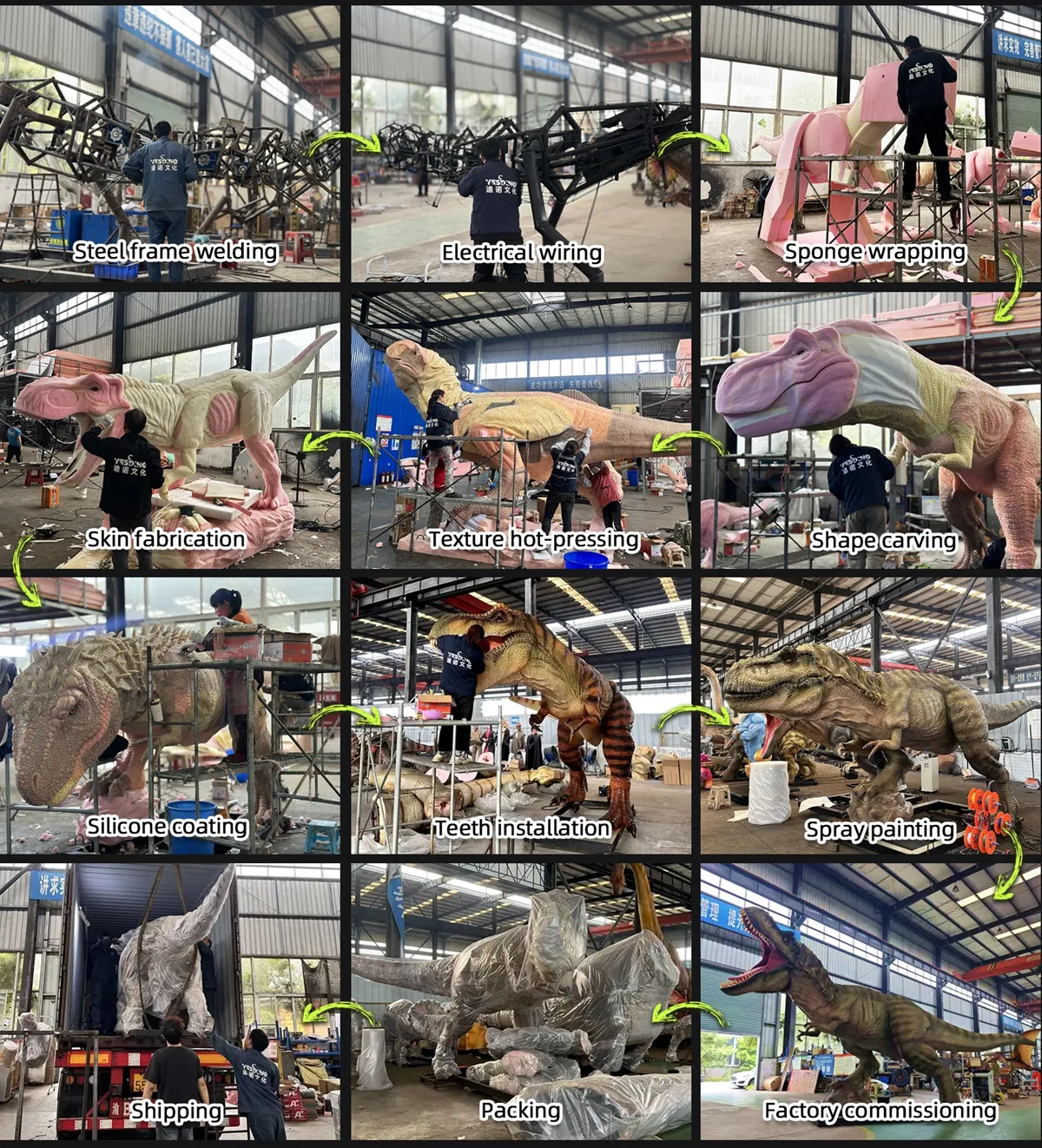
Production Process
The path bends around a rock outcrop, and the animal stands where the bend opens up. Visitors catch the silhouette from about thirty metres, then the horns as they come round, and by the time they reach the rail they are looking up at a jaw. That sequence is the reason a themed walk buys an animal at all.
This build is 6 m long, 0.65 m wide across the body, 2 m to the top of the skull. Narrow enough to stand between two planting beds without eating the path, low enough to see over from the queue behind it.
Why six metres is the middle that works
Six metres is the size where a predator still has body behind the head. A three or four-metre build reads as a juvenile when an adult stands next to it; eight metres needs a telehandler, a bigger pad and a longer tail clearance. This one carries the front half at full weight and lands on ground screws.
Where the horns actually read
Placement decides whether the horns do anything. Straight-on profile flattens them into the skull line. At a three-quarter angle, approached from the left, they break the outline of the head and the silhouette becomes unmistakable at forty metres, which is further than most people assume for an animal this length.
On a straight path that means turning the animal ten or fifteen degrees off the axis, with the head toward the approach and the tail toward whatever hide the set uses. The 0.65 m body sits in the border rather than on the tarmac with 1.2 m clear either side. Leave 1.5 m behind the tail, since the swing clips shrubs and a clipped shrub is the first thing a guest notices.
The jaw carries the performance
The skull is short, deep and blunt, so the movement that pays here is the jaw rather than the tail. A slow open, a hold of about a second, then a close reads as breathing; a fast snap at 2 m looks like a mechanism because the visitor is level with the teeth and sees the whole travel.
Two horns sit above the eyes and project outward, and they are the part that takes knocks. That is why this animal usually stands back from the rail line rather than beside it. Neck, head turn, blink, tail sway and breathing fill out the set, and the reduced forelimbs get a twitch and nothing more.
Paint that sits in the set
Send a sample of the rockwork or the fence, or a daylight photo of the section, and the pigment gets mixed to sit inside that palette rather than beside it. Q235 steel frame, rust-proofed, high-density foam body, silicone skin 5-7 mm, colour sprayed in translucent layers so a scuff shows a shade rather than a patch. Mist nozzles above the head leave mineral marks within a season, so the head goes to the dry side of the spray line and the nozzles point away from it.
No crane, four people
The build ships in four sections with the base frame separate. Four people, a pallet truck and a barrow of tools get it off the truck and onto the pad; the frame lands on ground screws in soil or resin anchors in concrete. The control cabinet goes behind a rockwork panel with the door facing away from the path.
Assembly runs a day for two of our people and a day for your ground crew, mostly carrying. Cable goes in conduit under the mulch and comes up behind the rock instead of crossing the path, where a stroller wheel finds it. The proximity sensor mounts on the approach side at about 3 m, angled down, so a person walking past at the edge of the path still triggers it.
Before you commit to the pad
Send the path width, the ground under the animal, where the theming contractor's rockwork will sit, and the distance to power. Sequence matters more than people expect: rockwork built before the animal arrives hides the base in a day, while rockwork built after means someone is cutting foam around a finished skin with a knife in their hand.
Two cases where this size is the wrong buy. A clearing where the animal is meant to dominate twenty metres of open ground, where 2 m of height disappears. And a site with no power within thirty metres and no appetite for trenching, where the run costs more than the difference between sizes.
Enquiry
Send a photo of the bend and the direction visitors arrive from, plus the colour you are matching. Tell us the ground surface and whether the mist line is already in. Price excludes freight, duty, certificates and installation, and the two-year cover on the core electronics starts at commissioning rather than at shipping.
Where to go next
Worth reading before you commit: the pneumatic versus hydraulic comparison for how the sizes compare, the installation guide for pads and access for what the ground has to carry, and the wiring concealment notes for where the money actually goes.
For ideas on placing it, see layout strategies for themed trails. The rest of the range is on animatronic dinosaurs, and if this one is the wrong size for the slot, animatronic dilophosaurus for sale is the closest alternative.
Product Accessories

Packaging and Container Loading



