

Production Process
Watch a family on a dinosaur trail and you can see where the queue forms. It forms at the animal a child can run up to, touch and circle without an adult calling them back. That is usually not the biggest animal on the path.
This build is 4 m long, 0.8 m across the body, and 2 m at the top of the domed skull — roughly a tall adult's eye line.
A thirty-second stop, at two metres
Trail capacity is arithmetic. A fifteen-metre predator holds a family for two or three minutes: photographs, a slow walk around, a panel read aloud. A four-metre animal holds them for about thirty seconds, because there is nothing to wait for.
At 2 m the animal sits below most adults' sightline and above most four-year-olds', and both matter. An adult two metres back sees the whole trail over the dome, so supervision keeps working. The child looks up at the snout, which is the angle that makes an animal feel large.
What you give up is presence. Four metres does not stop anyone from forty metres away, and one of these alone at the end of a path looks like a prop waiting to be positioned. It works in a sequence, between larger animals. It does not work as the reason people came.
Where it belongs on the plan
A 4 m by 0.8 m footprint turns inside a two-metre path, which is why this animal suits tight trails: woodland walks, boardwalk sections, the inner loop of a small park. Place it on the outside of a bend. On the inside, visitors see the tail first and are past it before the head comes round.
A junction works too. Four metres sets across a corner without blocking either route, and the delay is short enough that neither path backs up. On gravel the frame sits on a prepared base; on a timber deck the feet want to be over joists, so the joist spacing is worth asking for early.
Movement at child height
Head turn, neck dip, jaw, blink, tail sway and a slight body rock. The neck dip is the group worth tuning, because at 2 m the head is close to a child's face. Keep it shallow: a full downward swing puts the snout at chest height and children step back.
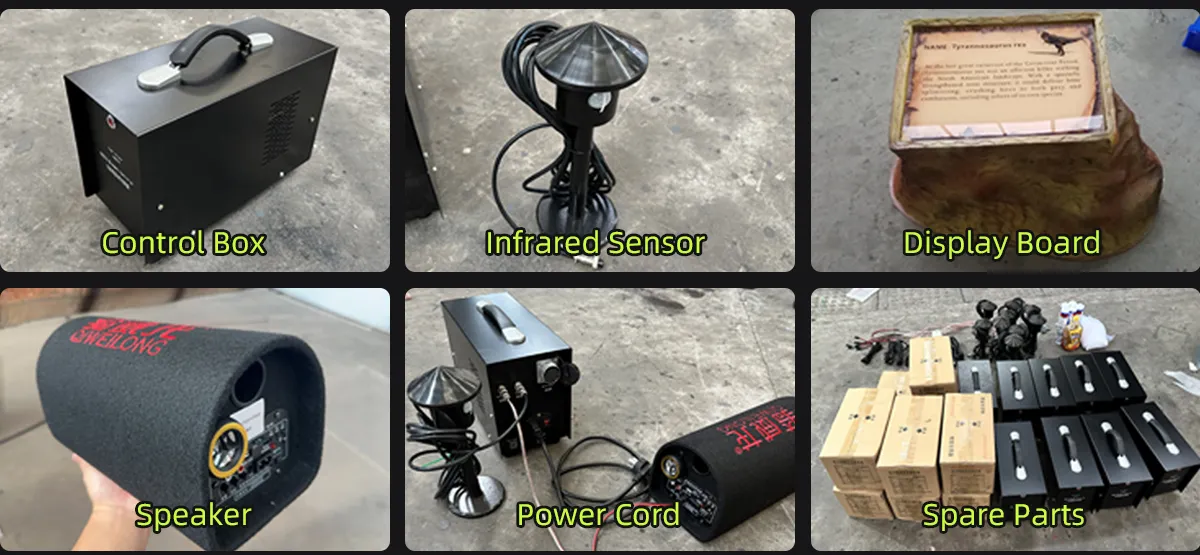
Sensor position matters more on a small animal. We mount the infrared sensor at 0.9 m on the approach side, angled down, with a 0.6 s delay, since children arrive fast and a longer delay fires after they have passed. Where the path runs close on both sides, a second sensor on the far flank keeps the animal from turning its back.
Built to be touched
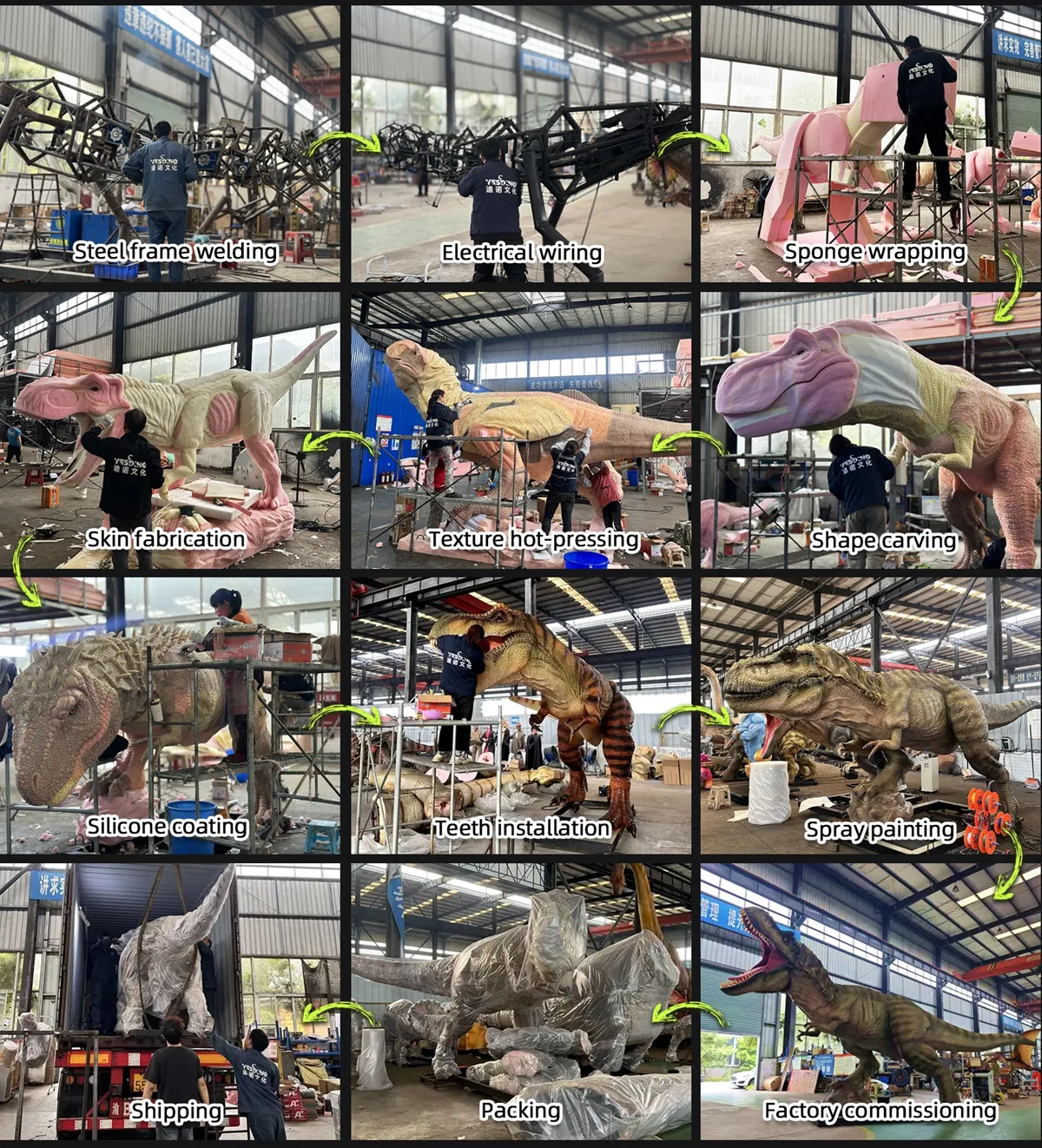
Q235 steel frame with rust treatment, high-density foam carved to shape, 5–7 mm silicone skin, colour layered in translucent coats. At this height hands land on the dome, the bony knobs along the snout and the shoulder, so those areas get a thicker skin build and a matt top coat.
Working range is −25°C to 45°C. Under the 3000K lamps common on woodland trails a grey-green base coat turns olive; under 4000K LED it stays grey. If the lamps are not chosen yet, a mid-tone base holds its colour under both. Damage is patched with pigmented silicone rather than a panel repaint.
Delivery without a crane
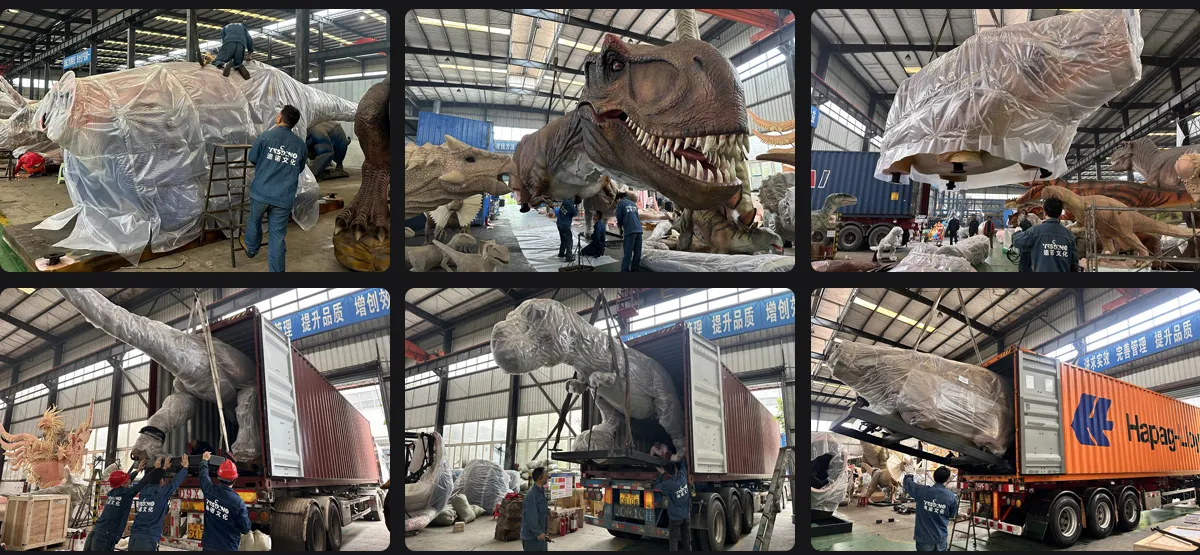
It ships in three sections and a base frame, on one pallet plus a crate. The body is 0.8 m wide and clears a standard 1 m gate; the crate is wider than the animal, so the gate is the measurement that counts. Two people set it on a prepared base in about three hours.
No crane, and that is the second reason parks buy this size: it moves between seasons with a pallet truck and a flatbed. The cabinet sits at the rear of the base frame, door opening away from the path, with 500 mm clear behind. On a narrow trail that decides whether servicing happens from the path or the planting bed.
Before you order
Send the trail plan with the position marked, the path width there, the surface, and where the nearest power is. A photograph from a child's eye height tells us more than the plan does, and so does what the animal will stand next to.
Two cases where this is the wrong buy. A park that needs one animal to justify the ticket price, because four metres will not carry a poster. And a wide trail with long sightlines, where visitors see it from thirty metres and do not slow down.
Enquiry
Tell us the trail layout and where the bottleneck sits. If the animal goes before a larger exhibit, send the distance between the two and we can set the delay so visitors are still moving when they reach it. Posture, skin texture and colour are made to order.
Where to go next
Worth reading before you commit: the park layout and theming strategies for how the sizes compare, the cost breakdown with the seven price factors for what the ground has to carry, and the spare parts and repair kit list for where the money actually goes.
For ideas on placing it, see photo zones and crowd flow. The rest of the range is on animatronic dinosaurs, and if this one is the wrong size for the slot, animatronic carnotaurus for shopping malls is the closest alternative.
Product Accessories
Packaging and Container Loading