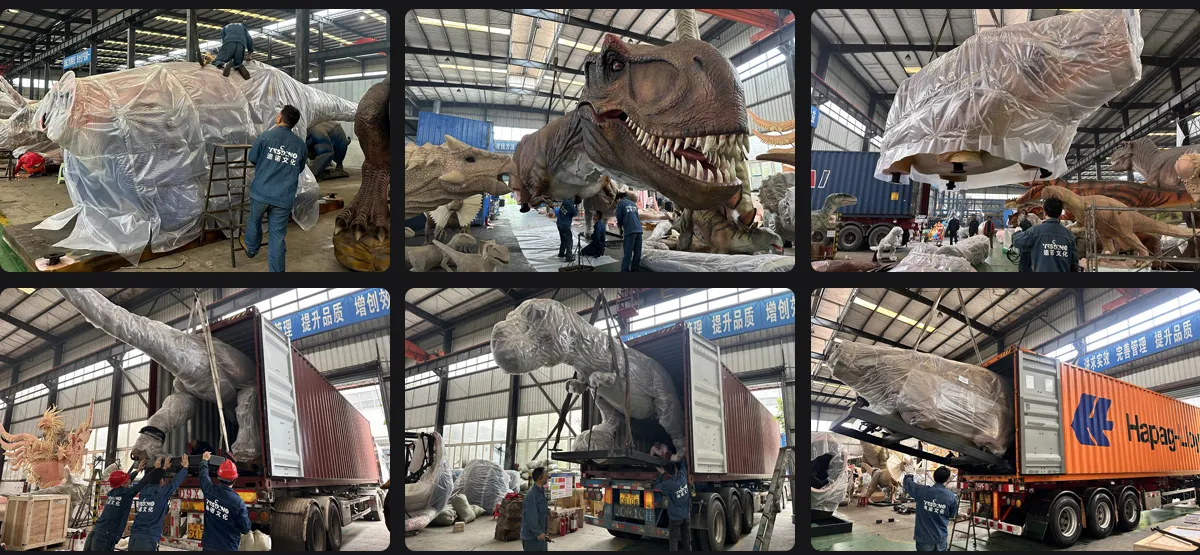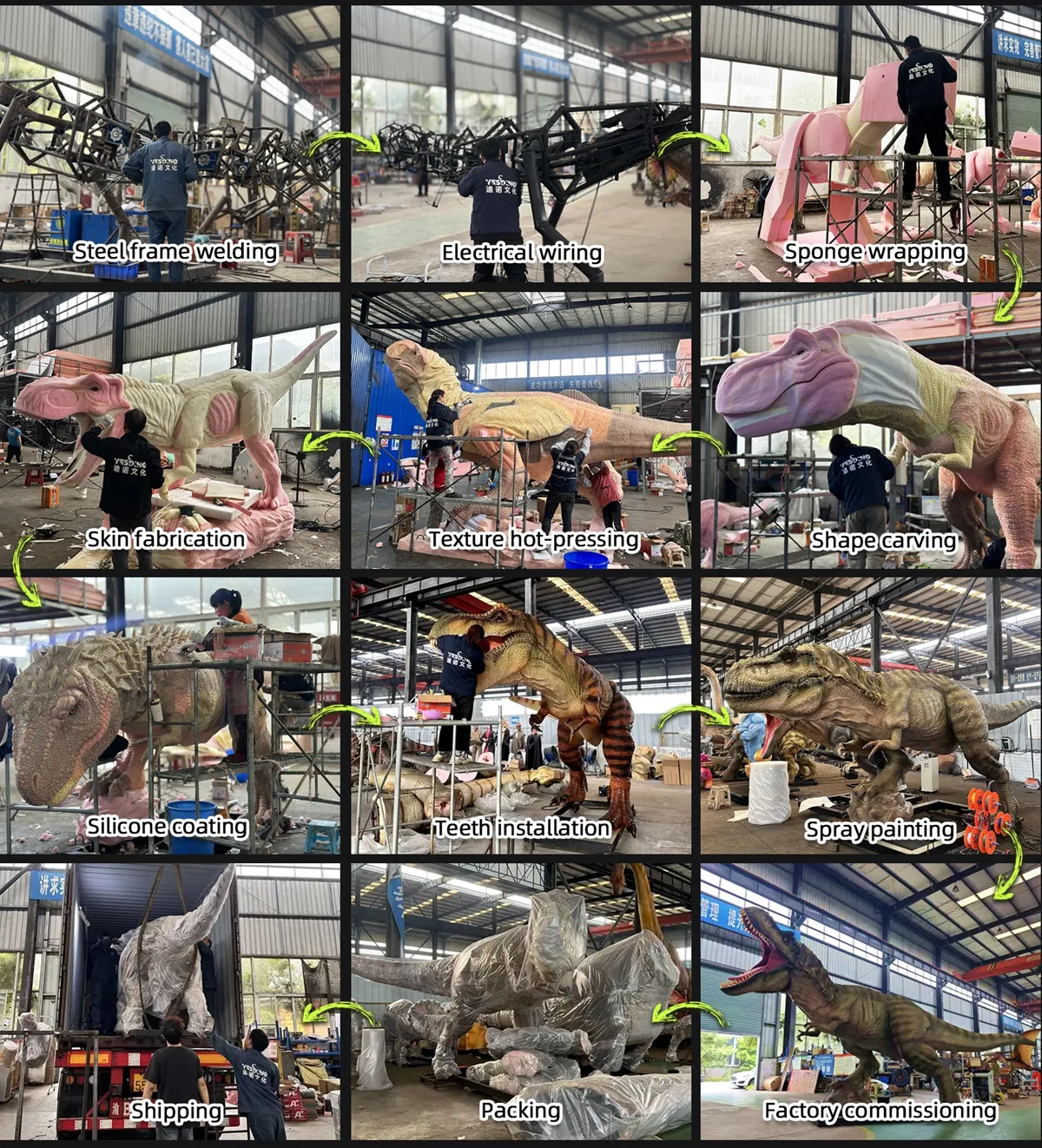
Production Process
Eight metres is the length where a tyrannosaur stops being a decoration and starts doing a job. One truck, one telehandler, two people on site for a day and a half, and a pad you can pour in an afternoon.
The animal is 8 m long, 0.9 m wide across the ribs, 2.1 m to the top of the skull. Stand at the barrier and your eye line sits just under the jaw. That is the trick of this size: the head is close enough to look down at you.
Why eight metres and not fifteen
A fifteen-metre build is the one that ends up on the poster, and it is priced like it: two trucks, a crane, engineered anchors, six metres of clear ground behind the tail. The eight-metre animal keeps the heavy skull, the two-fingered hands and the absurdly small forelimbs, then drops body length that no visitor measures.
What you give up is scale at close range. Beside fifteen metres an adult feels small; at eight, the feeling has to come from the pose, skull turned slightly down and toward the path. Posed level, it reads as a large model rather than a predator.
Where it goes
Six to ten metres of viewing distance suits it. Closer and visitors stand under the jaw, which makes a good photo and a bad queue. From forty metres down a path both sizes read the same, because the silhouette is the skull and the hips.
The pad runs about 9 m by 2 m with a metre of service strip along one flank. Compacted hardcore with a base plate works on gravel; a poured pad holds level and cleans up after a wet day. Leave 1.5 m behind the tail of an 8 m animal, since the tail swings and someone has to walk back there with a spanner.
What moves
Neck, head turn, jaw, blink, tail sway, breathing, and a slight forelimb twitch that stops the arms looking dead. Two fingers, short arms: the movement is a twitch rather than a reach, which is the honest version of the animal.
The group worth the most time is the neck and head. A slow turn toward a visitor is what sells the size. We start it about 0.8 seconds after a trigger, so the visitor has taken a step and looked up before the animal moves. Faster feels like a vending machine.
Build and skin
Q235 steel frame, rust-proofed, body carved in high-density foam, silicone skin 5-7 mm over it. Colour goes on in translucent silicone layers rather than one topcoat, so a scuff shows a slightly different shade instead of a bright patch.
The build runs from -25°C to 45°C at 110 V or 220 V, configured for the destination. Coastal air makes the frame treatment matter more than the paint. A hot inland park fades the top surfaces first, which is where a touch-up goes in year three.
Getting it in
Four sections: base frame, body, neck and head, tail. Set the base frame where the animal is going before anything else lands on it. The body crate is 0.9 m wide plus packing, so a 1.2 m gate is comfortable and a 1 m gate is a conversation.
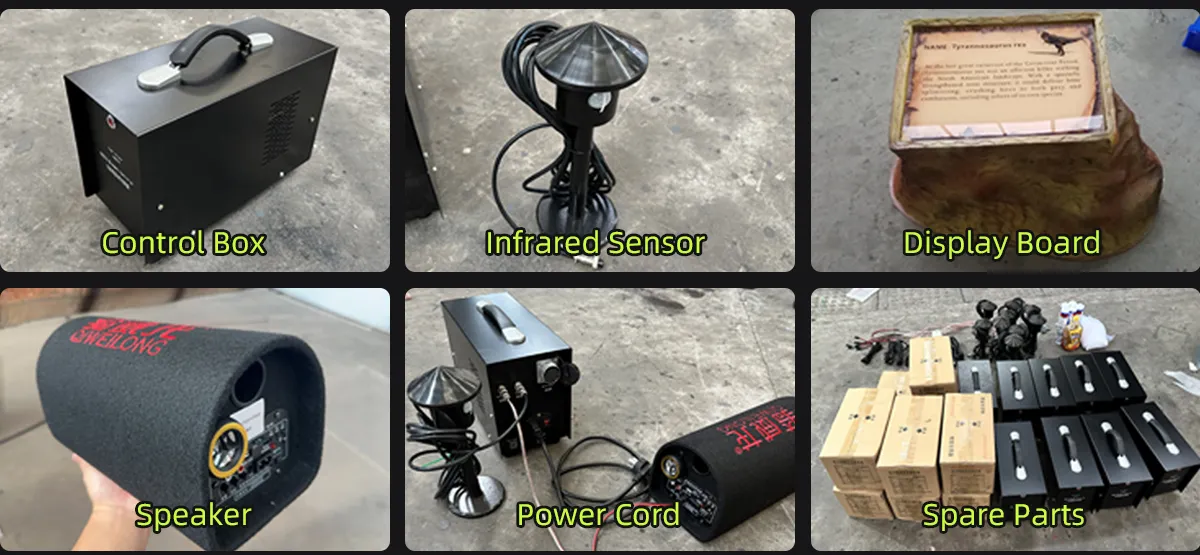
The head section is the awkward lift, topping out at 2.1 m and needing support from below while the bolts go in. Anchors go through the base plate at four points, resin-set on a pad. The cabinet sits inside the body with the door on the service strip rather than the queue side, since a panel standing open in front of visitors breaks the illusion faster than bad paint.
Before you order
Send photos from the visitor approach, the ground, the gate width, the distance to power and where water sits after rain. If it goes at a junction, say which way the path turns.
Two cases where another size is better. A site where the animal is seen from a road thirty metres off: eight metres is too short, and fifteen earns its freight. Indoors under a 2.6 m ceiling, the head has nowhere to turn without fouling a lighting track, and a five-metre animal does the job with less argument.
Enquiry
Send the site photos and the route visitors take, and we come back with a placement sketch and a section layout. Tell us the ground surface and whether it runs on a timer, a proximity sensor or a floor mat. Price excludes freight, duty, certificates and installation, so each arrives as its own line.
Where to go next
Worth reading before you commit: the pneumatic versus hydraulic comparison for how the sizes compare, the installation guide for pads and access for what the ground has to carry, and the wiring concealment notes for where the money actually goes.
For ideas on placing it, see what shipping a large animal involves. The rest of the range is on animatronic dinosaurs, and if this one is the wrong size for the slot, animatronic styracosaurus for jurassic theme parks is the closest alternative.
Product Accessories
Packaging and Container Loading