


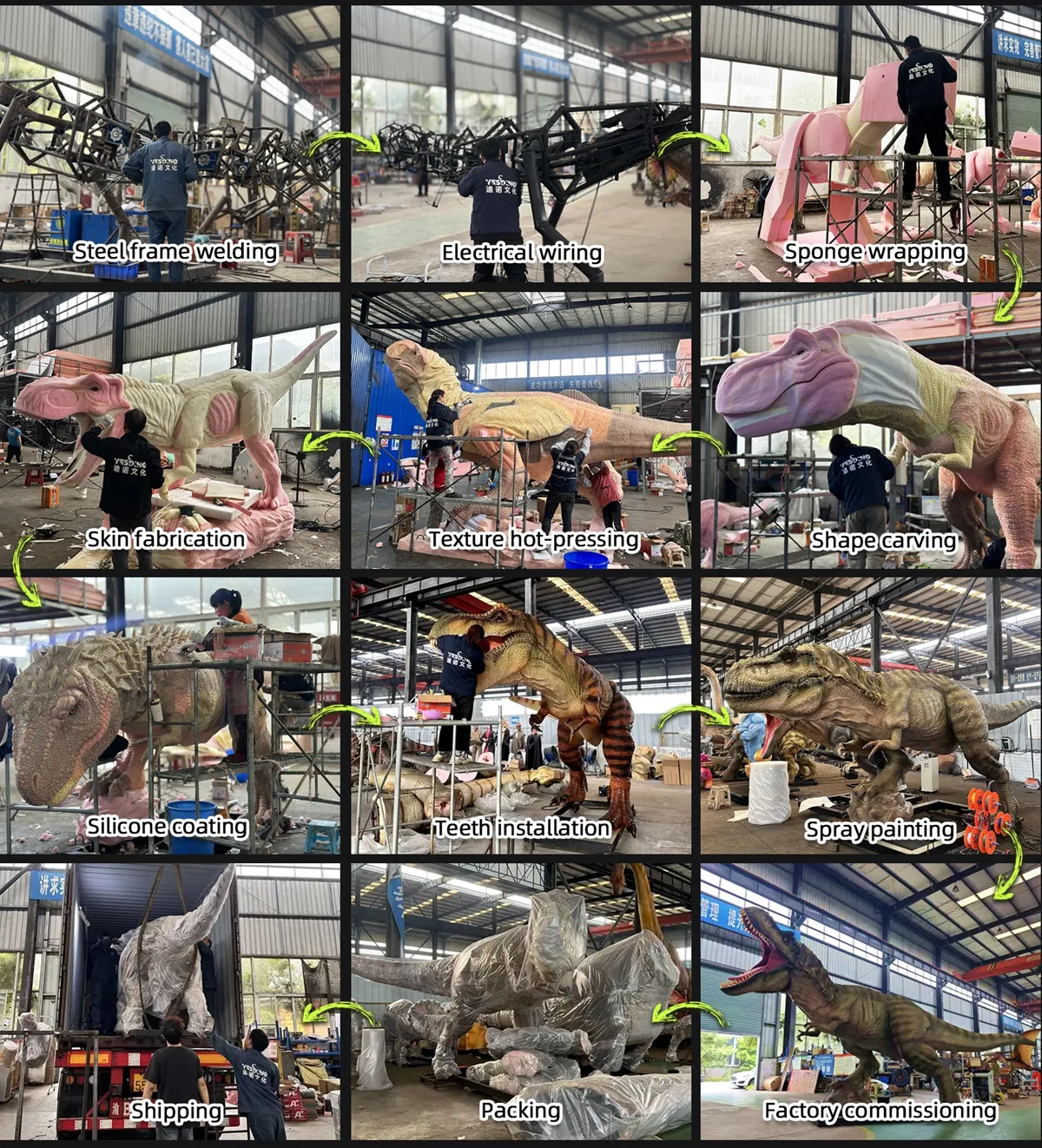
Production Process
The truck pulls in at six and the doors open at ten the next morning. Between those two points a thirteen-metre T-Rex comes off six crates, goes up on a forecourt that was a car park on Friday, and takes a lighting rig along its spine.
That is the job this build exists for. An event animal rather than a park fixture: it travels, it gets dressed, it comes down again.
An animal that lives in a crate
Large animatronic predators usually go in once and stay for years. This one works the other way round, three days to three weeks on site and then back in the truck. The 13 m length is the point of it. At forty metres, in the evening, with the crowd lit and the body half in shadow, it reads as scenery. The 4.5 m head height keeps the skull above the eye line of people standing close, which is where the reaction happens.
The trade is worth saying. You get scale and you give up spontaneity. A 13 m build wants a crew, a forklift and a full day. If the slot is two hours in a pedestrian street with no vehicle access after eight, a shorter animal causes you less friction.
Where 13 m by 1.9 m actually fits
Forecourts, arena aprons, festival fields, the flat roof of a car park with a goods lift. At 1.9 m across the body the animal is narrow for its length, so it sits on a strip of paving that would not take a stage. Set the long axis along the direction people walk. A crowd crossing the body end-on loses the silhouette you paid for.
The 4.5 m height sets the lighting plan too. Truss at six metres clears the skull with room for a fixture aimed down the neck. Under existing four-metre lamp posts the animal looks like it is sheltering, which is not the effect anyone is buying.
What to tune before the doors open
Neck and head carry most of the mass and take the longest to set up. A heavy skull on a long neck needs a slower start than a small animal's; that first second is what sells weight, so the ramp gets adjusted on site rather than copied from a sheet. Tail last: the sway keeps the body from looking bolted down between gestures.
The forelimbs carry two-fingered hands and stay small by design. At this scale the arms read at eight metres and disappear at thirty, so gesture time goes into the head and the jaw. Triggering runs off one approach sensor on the queue side, about 7 m out, with 0.9 s of delay, which is enough for the head to arrive with the people rather than before them.
Skin that survives a season of load-ins
Q235 steel frame, rust-treated, body carved in high-density foam, silicone skin 5–7 mm with colour sprayed in translucent layers so scuffs do not turn into pale patches. Rated −25 °C to 45 °C. Touring wear differs from park wear: the animal is loaded at night, in rain, by a crew in a hurry. Flank panels come off with a hex key, so a damaged section gets swapped instead of patched in the dark.
Six crates and a four-hour strike
It ships in six crates, the heaviest around 380 kg. Assembly runs base frame, then legs and body, then neck and head, then skin, then power and programme check. The cabinet sits on the flank away from the public with 700 mm clear in front of its door, a service position that is easy to lose once the animal is pushed back against a fence.
On a hire site the anchor is ballast, not concrete: M16 bolts into water ballast or precast blocks. On a suspended slab, find where the beams run first. Load-out reverses the order and takes a practised crew about four hours.
What we need from you
The venue plan, the door the crates come through, and the time window. Body width is 1.9 m, so a 2.2 m clear opening keeps things simple; if the only door is lower than 4.5 m, the head goes on outside. Voltage is set at build, 110 V or 220 V, and the forklift and crew usually belong to the venue.
This size suits touring work and it suits very little else. For a permanent park with no storage, for a site where the animal stands through a winter, and for bookings with less than a day of setup, a smaller build does the job with more budget left over.
Enquiry
Send the site plan, the dates and a photo of the ground. If a lighting design already exists, share it, since aim points matter as much as the fixture list. We will reply with a crate list, a build schedule and the lifting requirements for your venue.
Where to go next
Two things come up in almost every enquiry on this build: how the size compares with the alternatives, and what it takes to get it on site. The pneumatic versus hydraulic comparison sets out the length options side by side, and the installation guide for pads and access covers pads, access and assembly. Budget planning sits in the wiring concealment notes.
For ideas on placing it, see layout strategies for themed trails. The rest of the range is on animatronic dinosaurs, and if this one is the wrong size for the slot, animatronic giganotosaurus for shopping malls is the closest alternative.
Product Accessories

Packaging and Container Loading



