


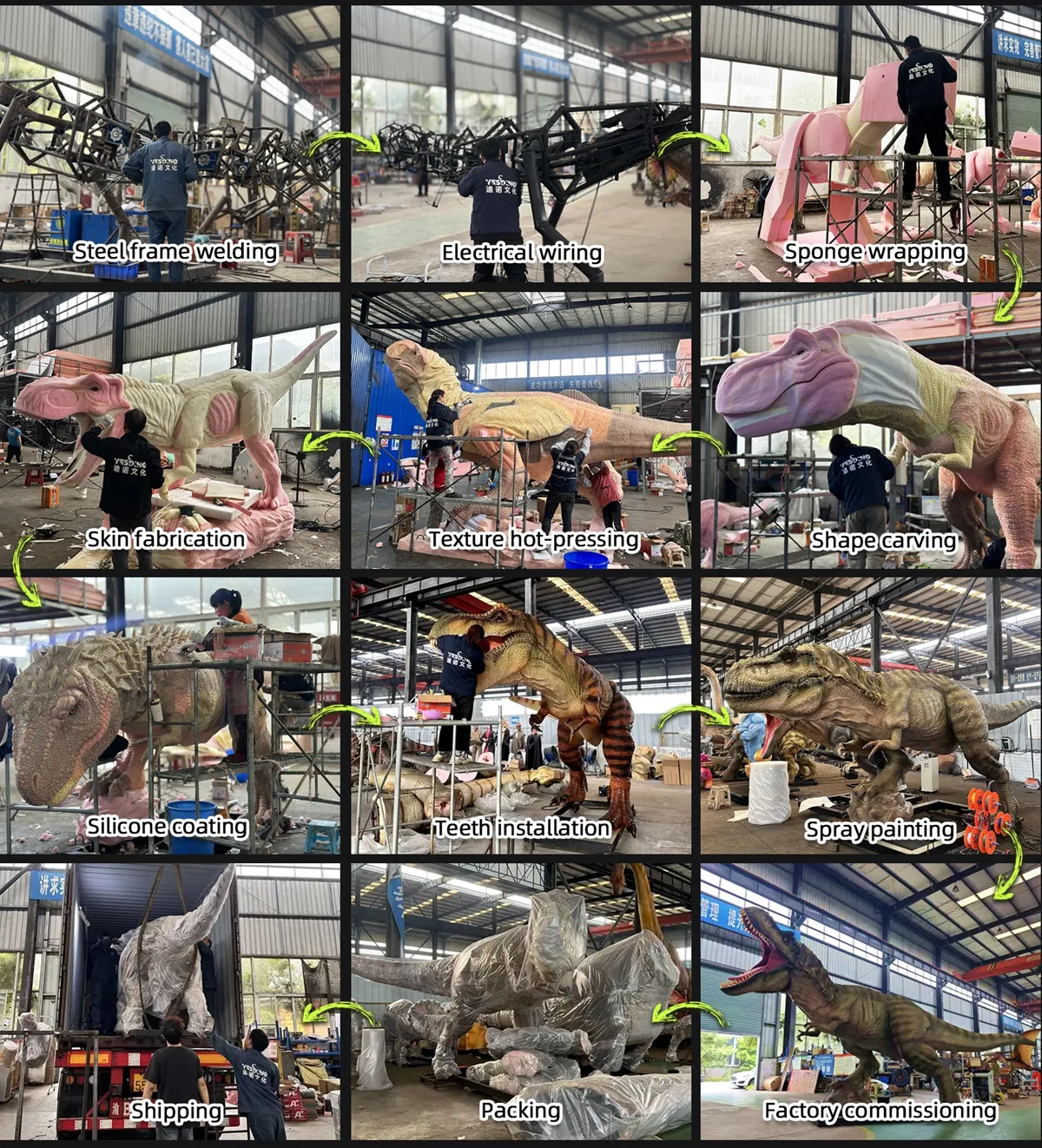
Production Process
Most mall installs run from ten at night to six in the morning, with cleaners working around you and tenants arriving for opening. That window decides how the animal breaks down and what each section weighs.
This build is 8 m long, 0.9 m across the body, 2.1 m to the top of the head. It fills a concourse without a crane, which is why it exists.
Why eight metres and not ten
Ten-metre builds are trail animals. They want a hiab, a fenced compound for two days, and a slab that takes a heavy point load under the base frame. A shopping centre rarely gives you any of the three.
At eight metres the sections come apart into pieces a 2.4 m lift accepts, and four people walk the whole thing in through a fire door in a night. What you give up is the look-up moment. At 2.1 m tall the animal meets visitors at chest height, and for a concourse that is the more useful height: phone cameras work there.
Where it sits in a concourse
The slots that work are 6 to 9 m from the nearest seating, with the flank parallel to the walking line so people pass along the animal's length rather than meeting the snout head-on. Leave 3 m clear in front of the head. The neck swings the nose about 1.1 m past its resting point when it tracks a passer-by.
Tile over screed is fine with a spreader plate under each foot, and so is polished concrete in a converted unit. Two floors that cause trouble are a suspended mezzanine deck and a floor with under-tile heating. Both want a structural sign-off before the animal is specified.
What moves, and which group to tune
Jaw, neck turn, head tilt, tail sway, blink, and a slow breathing cycle through the rib section. On an eight-metre body the tail is what reads across a large room: a lateral sway at the tip, one sweep every six seconds or so, makes the animal look like it is standing in place rather than switched on.
The group worth the tuning time is the neck and head. On this skull — long, shallow, barely deeper than the jaw hinge — a quick turn looks wrong, so we run the head turn at about seventy percent of the speed used on our T-Rex builds. It reads as a large animal scanning. Three-fingered hands sit low at the front of the body and take a small independent movement, which is what people photograph.
Frame, skin, and mall air
Q235 steel frame with rust treatment, foam-carved volume, silicone skin at 5–7 mm. Colour goes on in translucent silicone layers rather than a painted topcoat, so a scuff from a pushchair shows as a lighter tone in the same family instead of a grey patch.
Air handling matters more indoors than out. A centre runs near 22°C with low humidity, and silicone at that temperature picks up a slight tack under a warm downlight. Indoor builds get a matte sealer, which also cuts the shine a 4000 K ceiling grid throws on a wet-looking hide. Under 3000 K retail lighting the same skin reads warmer, so samples are worth approving on site.
Getting it in
The animal ships as head, two body sections, tail in two parts, base frame, cabinet, sound system, wiring diagram and calibration sheet. Load order counts: tail sections go in first and sit deepest, the head comes last and stays near the door until the frame is bolted.
Anchoring on the 8 m frame is four M16 resin anchors into the slab. The cabinet sits on the service side, off the public route, within 3 m of a socket the centre lets you keep, with 700 mm of clear swing for the door. Motion parameters are recorded at commissioning and left with you in writing.
Before you order
Send a photo of the slot from the escalator, the floor plan with the walking line drawn on it, the ceiling height, the widest door on the delivery route, and the voltage at the socket. The busiest hour decides between a proximity sensor and a timed loop.
Two cases where this size is the wrong buy. A double-height atrium with a 10 m void swallows an eight-metre animal and it looks small from the upper level. A slot with under 2 m behind the tail makes service access awkward all year, not just on install night.
Enquiry
Send those five items and we will come back with a section drawing, the load per foot and an install sequence built around your window. If the concourse is tighter than the plan suggests, a five-metre predator does a similar job in less floor. Freight, duties, certificates and installation are quoted separately from the product price.
Where to go next
If you are still comparing options, start with the spare parts and repair kit list — it lines up the builds by length and reach. Site work is covered in the size guide covering 3 m to 12 m builds, and the rental cost breakdown lists the factors that move the price.
For ideas on placing it, see mall exhibition notes. The rest of the range is on animatronic dinosaurs, and if this one is the wrong size for the slot, 6m animatronic t-rex for dinosaur parks is the closest alternative.
Product Accessories

Packaging and Container Loading



