


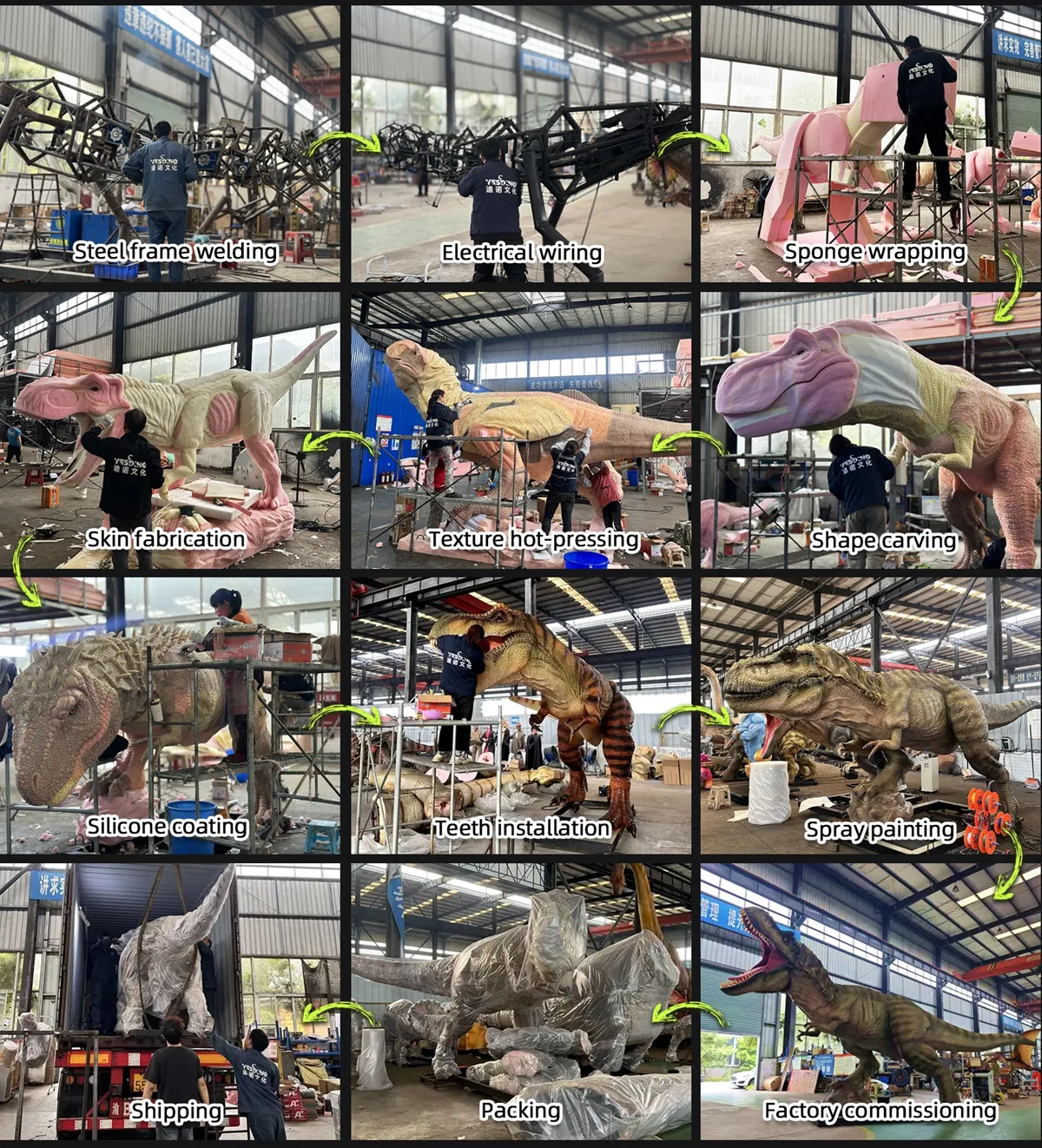
Production Process
On a trail the animal is seen at walking pace from four to six metres away, at about shoulder height. That is close enough to notice teeth and far enough that nothing above eye level gets looked at.
This one is 8 m long, 0.9 m across the body, 2.1 m at the ridge of the sail. Low, long, and built to be read from the side.
A sail at two metres reads as a ridge
A sail animal built at 4 m lifts the sail above the tree line and turns it into a silhouette, which is a different object. At 2.1 m the sail runs along the back at roughly head height, and from the path you see a long serrated ridge with the spine reading through it. That shape holds at four metres.
The cost is drama from a distance: from the trailhead this animal is a low shape among the trees. Parks that want a skyline landmark put something taller at the entrance and keep this one for the middle of the walk.
Trail geometry: walk-past, not look-up
Placement works when the path runs along the flank at 4 to 6 m, with the body angled about fifteen degrees towards the approach. That angle shows the sail in perspective. Too parallel and the walk-past is flat; too square and visitors meet the snout and miss the back.
Ground matters as much. A surface of compacted gravel or bark sits 40 mm below the frame so runoff passes under the belly instead of pooling at the feet. On a slope the base wants a level pad cut into the grade; a frame standing on packers walks out of level within a season.
Movement that starts at the spine
Neck, head turn, jaw, tail sway and a breathing cycle through the ribcage. The group worth the time is the neck and the sail’s leading edge moving together — that coupling is what makes eight metres of body look connected rather than assembled.
The tail sways slow and wide, at the pace of a large animal shifting weight. The trigger sits in a low bollard at 700 mm on the path side, 1.5 m off the flank, with a 1.2 s delay: people on a trail walk slowly and stop at signs, so a short delay fires at arrivals instead of the ones already looking.
The snout is where visitors stop
Long, narrow, crocodilian, with conical teeth set along both jaws. That is why it works close up: the head is a metre of detail people lean over the rail to study, and the teeth are separate pieces fixed into the jaw, so a chipped one comes out on its own.
Jaw travel is set to open about 25 degrees. Wider looks impressive in a workshop and odd on a trail, where the pose reads as a roar. Closing runs slower than opening, which is how a heavy jaw behaves.
Frame and skin through a wet season
Q235 steel frame, rust-treated, foam-carved volume, silicone at 5–7 mm sprayed in translucent colour layers. The sail takes the weather: it is a thin vertical surface with rain running down both sides, so the frame inside is braced at 400 mm intervals to keep the ridge from sagging. Those junctions are built with a slight fall to the flank, and the skin is bonded rather than laid over the foam.
Rated for −25°C to 45°C, 110 V or 220 V configured at build, core electronics under a two-year warranty. Trail lighting at 2700 K pulls the skin olive; under cool white it goes grey-brown, so colour is worth checking under the trail’s actual lamps.
Getting it onto the trail
Ships as head, two body sections, sail panels, tail in two parts, base frame, cabinet, sound system and documentation. Load order where no vehicle reaches the slot: base, tail, body, sail panels, head. Sail panels go on after the body is bolted — at 0.9 m across the body the animal passes a 1.2 m gate easily, and the sail is the piece that decides whether it fits.
Where the path is narrower than the delivery vehicle, sections are carried the last stretch by hand, four people and roughly 200 m an hour on flat ground. The cabinet sits behind a rock or plant cover at the rear, hinged so the door opens away from the path and the technician works off the trail.
Enquiry
Send a photo of the path at the slot, the walking direction, the ground surface and the nearest power point, and tell us whether visitors arrive at the head or the tail. One case where this size is wrong: a park of wide open plazas with long sightlines, where height does the work and a 2.1 m animal gets lost. Freight, duties, certificates and installation are quoted separately.
Where to go next
Two things come up in almost every enquiry on this build: how the size compares with the alternatives, and what it takes to get it on site. The wiring concealment notes sets out the length options side by side, and the park layout and theming strategies covers pads, access and assembly. Budget planning sits in the cost breakdown with the seven price factors.
For ideas on placing it, see photo zones and crowd flow. The rest of the range is on animatronic dinosaurs, and if this one is the wrong size for the slot, 5m t-rex for indoor exhibitions is the closest alternative.
Product Accessories

Packaging and Container Loading



