Production Process
At an expo the barrier is often a rope on two posts, and the gap between rope and snout is under two metres. People stop for a full minute, take four photographs and lean in. At that distance the eyes, the jaw edge and the noise all matter.
This build is 5 m long, 0.8 m across the body, 2 m tall. Compact enough for a stand, tall enough to keep the head above a crowd.
Why five metres is an expo size
A five-metre animal takes about 6 m by 3 m of floor once the head arc is allowed for. On a trade stand that is a usable footprint; an eight-metre build would eat half the hall and pull visitors off neighbouring stands.
What you give up is the wide shot. This animal photographs best from three-quarters at two to four metres, not from across the aisle. For a stand whose job is stopping traffic, that is the frame people share.
The two-metre barrier line
Set the rope 1.8 to 2 m off the flank, not off the nose. The head swings when it tracks people, so a rope measured from the resting nose ends up inside the swing at the far end of the turn.
At 2 m tall the skull sits above adult head height, so the face is seen from below at the rope and from above from a mezzanine. Both views need the jaw line finished, which is why the underside of the lower jaw gets the same skin work as the crown.
Movement and sound at arm's length
Neck turn, head tilt, jaw, tail sway, blink and a breathing cycle. The eyes carry this build: a domed lens over a painted iris, set in a socket with a clear coat so the highlight sits on the surface rather than inside the paint, with a three-axis servo for a small follow. At two metres a flat painted eye shows within a second.
Blink timing matters too — about one blink every seven seconds with an occasional double. Faster looks nervous, slower looks dead. The jaw ramps open over 0.8 s and closes in 1.2 s, which reads as weight rather than a snap.
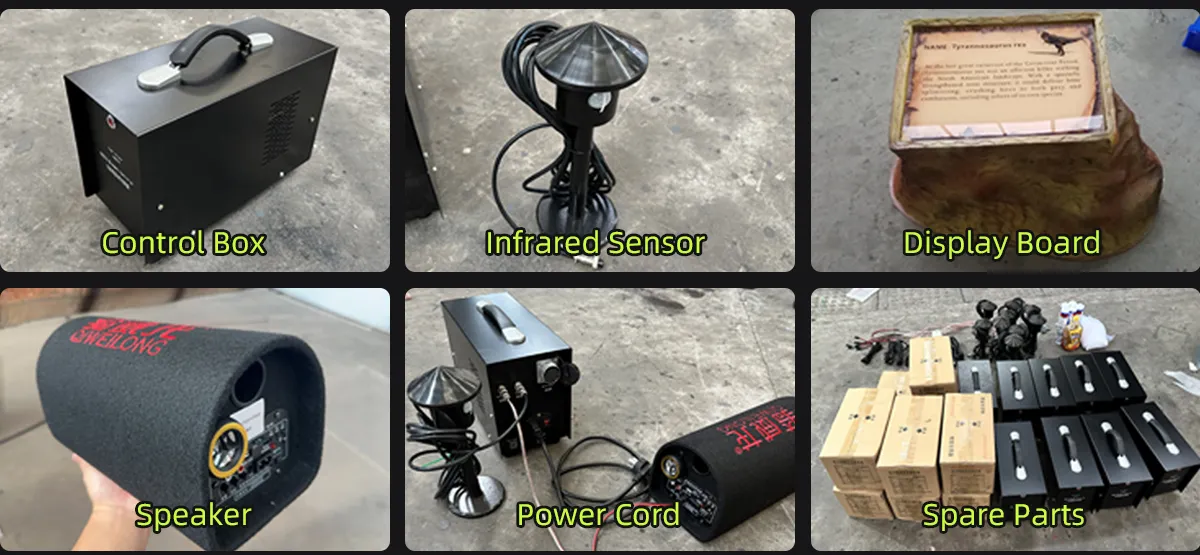
Two speakers sit in the chest and throat, with level trimmed on site rather than at the factory, because halls differ more than a preset can cover. The target is a roar felt in the chest at the rope while the exhibitor beside it can still talk.
The trigger is a sensor on the barrier post at 1.6 m, aimed along the rope rather than across it, with a 0.3 s delay. Aimed across, it fires at everyone in the aisle; aimed along, at people who have stopped at the stand.
Finish that survives handling
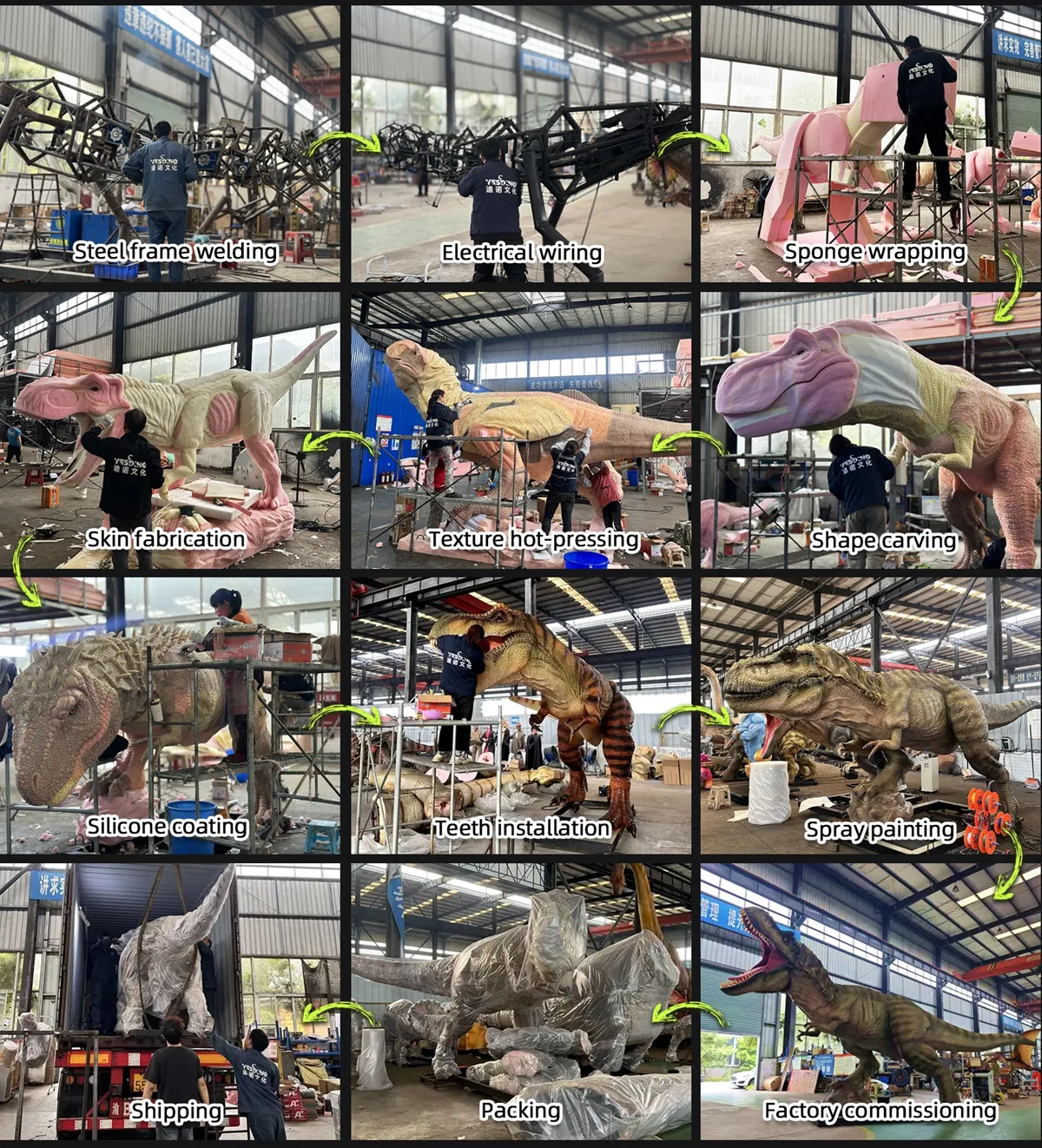
Silicone at 5–7 mm over carved foam on a Q235 frame, colour in translucent layers. On an expo floor the wear points are the snout, the top of the skull and the forelimbs, where hands land when someone reaches over the rope. Those areas get an extra sealing pass and a matte topcoat chosen for wipe-down rather than sheen.
Lighting does more damage to the look than hands do. A 3000 K track head two metres from the skull turns the skin yellow and puts a hot spot on the brow; a diffused 4000 K source at four metres holds the colour approved at the factory. Ask the stand builder where the heads point before the animal is positioned.
Into the hall
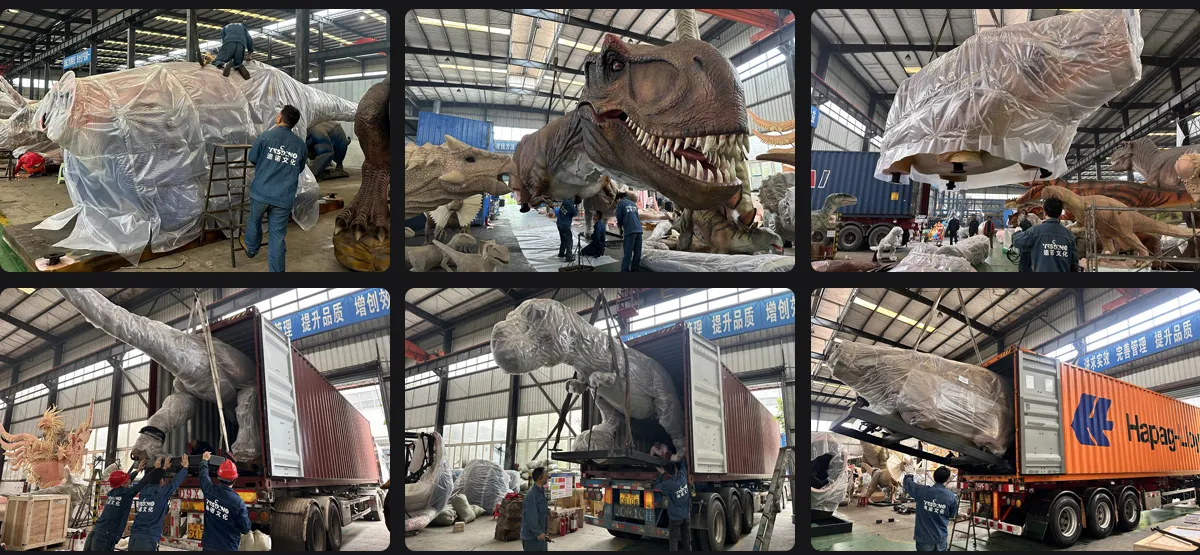
Ships as head, body, two legs, tail, base frame and cabinet. Order of work: base and frame while the carpet is clean, then legs, body, tail, and the head last so the aisle stays open. At 0.8 m wide and 2 m tall it clears a 2.2 m hall door; where the route narrows to 1.9 m, the head travels off its collar.
Power is 110 V or 220 V, configured at build, and the cabinet sits behind the backdrop with 800 mm of access. Rated −25°C to 45°C, which covers a cold loading dock as well as a warm hall. Electronics carry a two-year warranty.
Before the floor plan is fixed
Send the stand drawing, aisle width, barrier type, ceiling height and power drop. The show length matters too: a four-day and a four-week show want different service intervals.
This size is wrong for a stand on an aisle under 3 m, where the head turn brings the snout over the rope into the walkway, and for a hall where organisers cap sound near background level. Shipping, duty, certification and installation are quoted on top of the product price.
Enquiry
Send the drawing with the neighbouring stands marked, the aisle width and the show dates. Two minutes of that tells us more than a spec sheet. If the stand is still being drawn, a footprint is enough to start.
Where to go next
If you are still comparing options, start with the rental cost breakdown — it lines up the builds by length and reach. Site work is covered in the pneumatic versus hydraulic comparison, and the installation guide for pads and access lists the factors that move the price.
For ideas on placing it, see layout strategies for themed trails. The rest of the range is on animatronic dinosaurs, and if this one is the wrong size for the slot, animatronic triceratops for exhibition halls is the closest alternative.
Product Accessories
Packaging and Container Loading