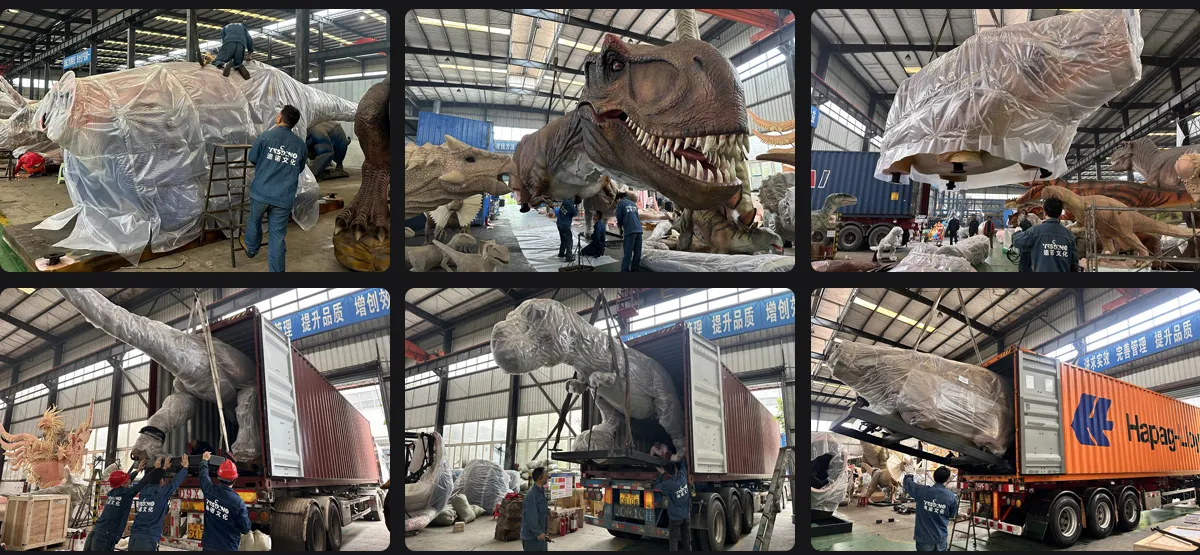


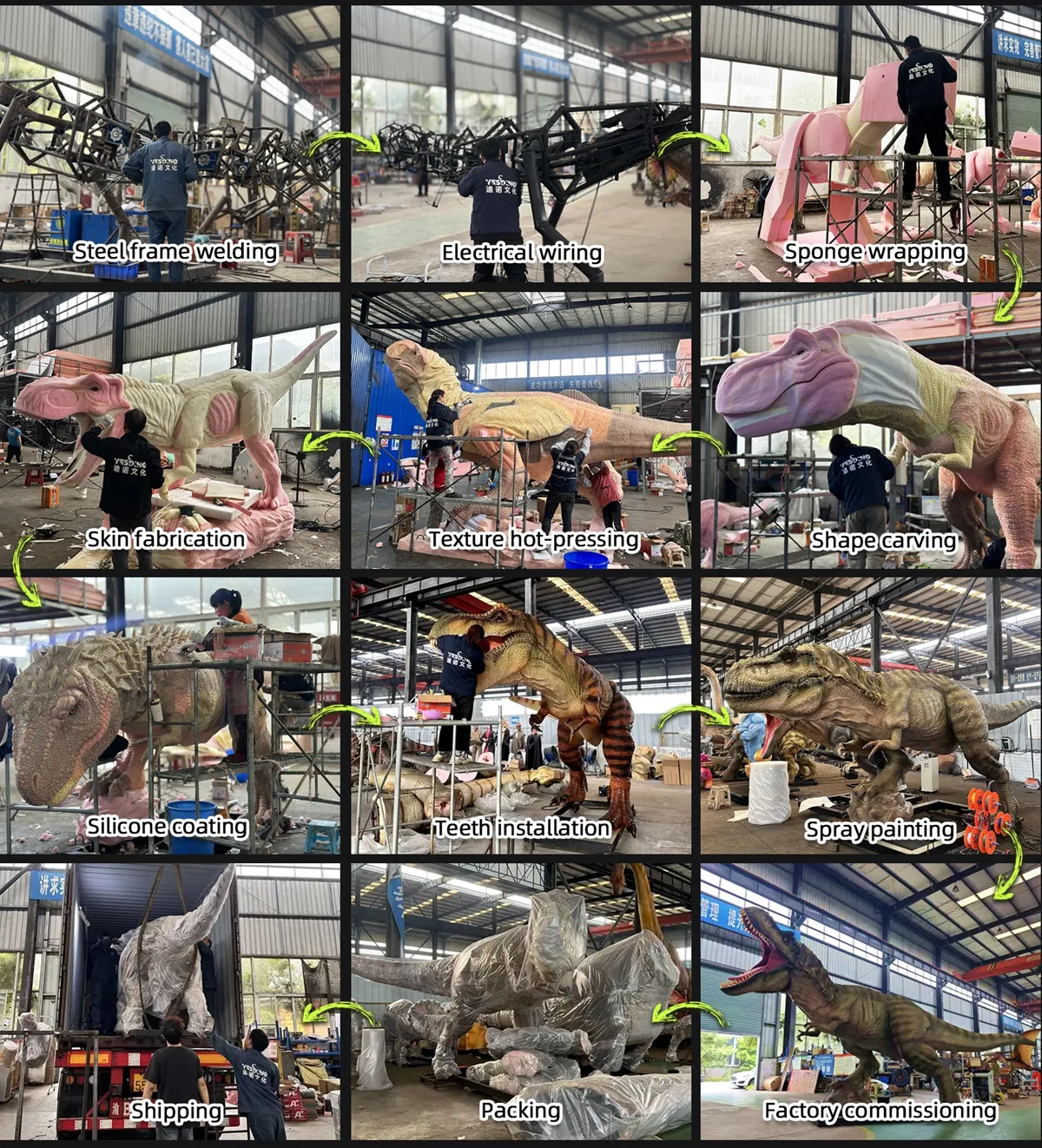
Production Process
Most dinosaurs are recognisable by their head. This one is recognisable by its back. The sail is what people point at from forty metres away, and it is also the part of the build that decides whether the model survives its first windy season.
SKU YKL-109: six metres long, 2.2 m to the top of the sail, 0.8 m across the body. A compact build of an animal that reached fourteen metres in life, sized for trails and indoor halls where the full-length version has nowhere to stand.
The sail is a structural question first
A sail is a flat panel standing in the wind. On the living animal it was supported by neural spines that lengthened towards the middle of the back; on a model those spines become steel ribs inside the foam, and the skin over them has to hold a shape without drumming or flapping.
Three things make the difference. The ribs are tied into the main frame rather than the outer skin, so load goes to the hips instead of the surface. The silicone over the sail is run at the thick end of the five-to-seven-millimetre range. And the base frame is anchored, because a tall flat surface on a six-metre animal generates real side load in gusty conditions.
If the exhibit goes on an exposed site — a rooftop, a coastal park, a hilltop — say so at enquiry. It changes the rib spacing and it may add anchor points.
The head is not a T-Rex head
This is where cheap Spinosaurus models give themselves away. The skull is long, low and narrow, built like a crocodile's, with a notch at the front where the upper jaw meets the lower and a rosette of teeth at the tip. The teeth are conical and interlocking rather than blade-shaped, and they are set to mesh when the jaw closes.
We sculpt that from the skull reference rather than scaling a theropod head sideways, because the proportions are the whole identity of the animal. The jaw travel is shallower than a tyrannosaur's for the same reason — a long snout with a wide gape looks wrong immediately.
Movement groups
Six groups on independent drives with end-of-travel protection: head left and right, neck up and down, jaw open and close synchronised with a roar, blinking eyes, tail sweep, and a forearm scratch. The neck group does more work on this animal than on a theropod with a heavy skull, because the head is light enough to move quickly without looking frantic.
Programs are set at commissioning and documented, so your technician can slow the cycle down later without a service visit. The tail sweep is worth setting conservatively on a compact build: at six metres the tail tip comes round faster than people expect.
If the exhibit sits beside water
Spinosaurus is the one dinosaur that belongs next to a pond, and that is usually where operators want it. It changes the specification in ways worth deciding early.
A splash zone is not the same as immersion. Splash from a fountain or a wave feature hits the lower legs and belly; standing water around the feet keeps the base frame wet continuously. The first is handled with coating and drainage, the second needs the frame raised on a plinth above the waterline and the cable route brought in from above. We don't build floating or swimming units — if the plan involves the animal standing in a pool, the plinth is the answer.
Tell us the distance to the water and whether spray reaches the body. That single answer decides whether the standard outdoor finish is enough or whether the lower third needs the heavier coating.
Scale, and when to go bigger
Six metres suits a trail stop or an indoor gallery. It does not suit a main plaza where the animal has to hold a hundred metres of open space. If your site is the second kind, ask about the larger build before you fall in love with this footprint — the sail gains proportionally more than the body does as the animal grows, and the silhouette gets stronger with size.
Finish is foam over a welded Q235 steel frame, silicone five to seven millimetres, translucent silicone airbrushed in layers. Standard palette is a grey-brown body with darker banding across the sail and a pale underside, which is the scheme that holds up against green planting and against grey concrete.
Enquiry
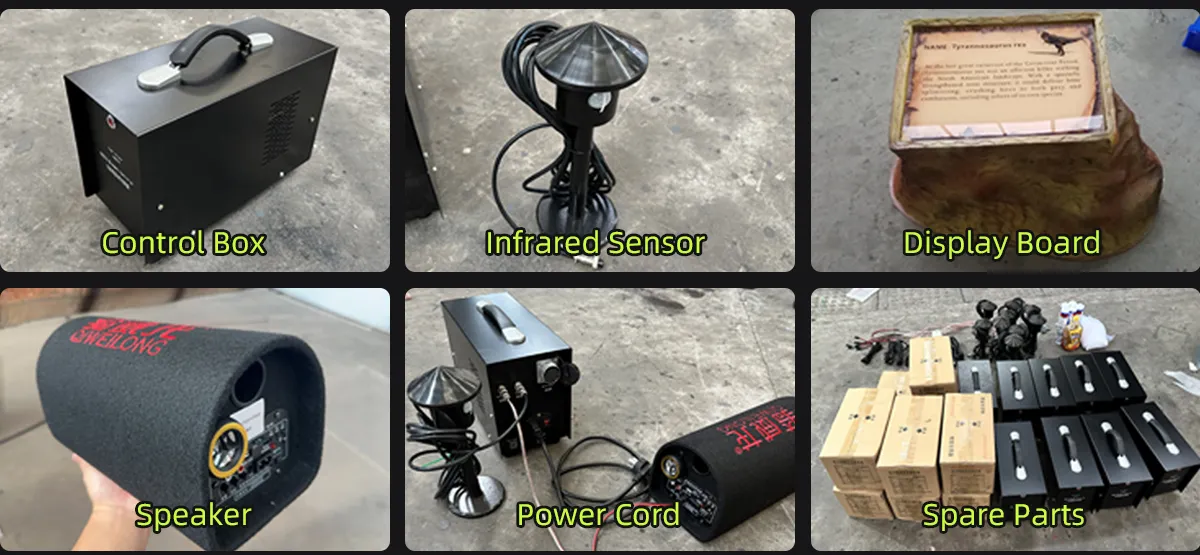
Send the site photo, the viewing distance and whether water is involved. The animal ships in sections with a base frame, control cabinet, sound system, wiring diagram and calibration sheet; freight, duties and installation are quoted separately and sit outside the product price. Rated −25 °C to 45 °C, 110 V or 220 V set at build.
Where to go next
Worth reading before you commit: the installation guide for pads and access for how the sizes compare, the wiring concealment notes for what the ground has to carry, and the park layout and theming strategies for where the money actually goes.
For ideas on placing it, see layout strategies for themed trails. The rest of the range is on animatronic dinosaurs, and if this one is the wrong size for the slot, animatronic giganotosaurus for exhibition halls is the closest alternative.
Product Accessories
Packaging and Container Loading