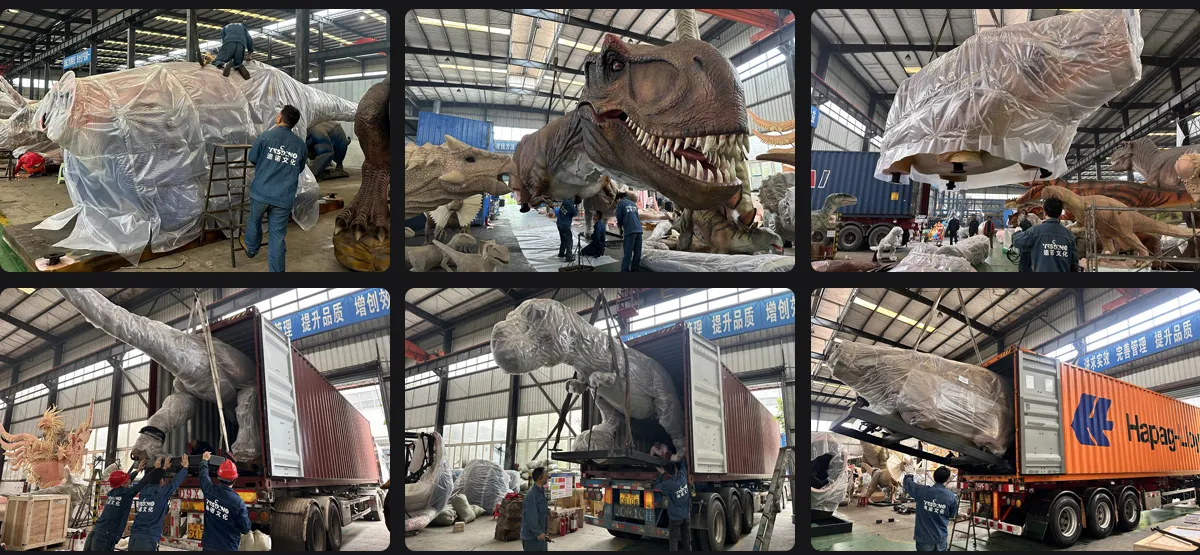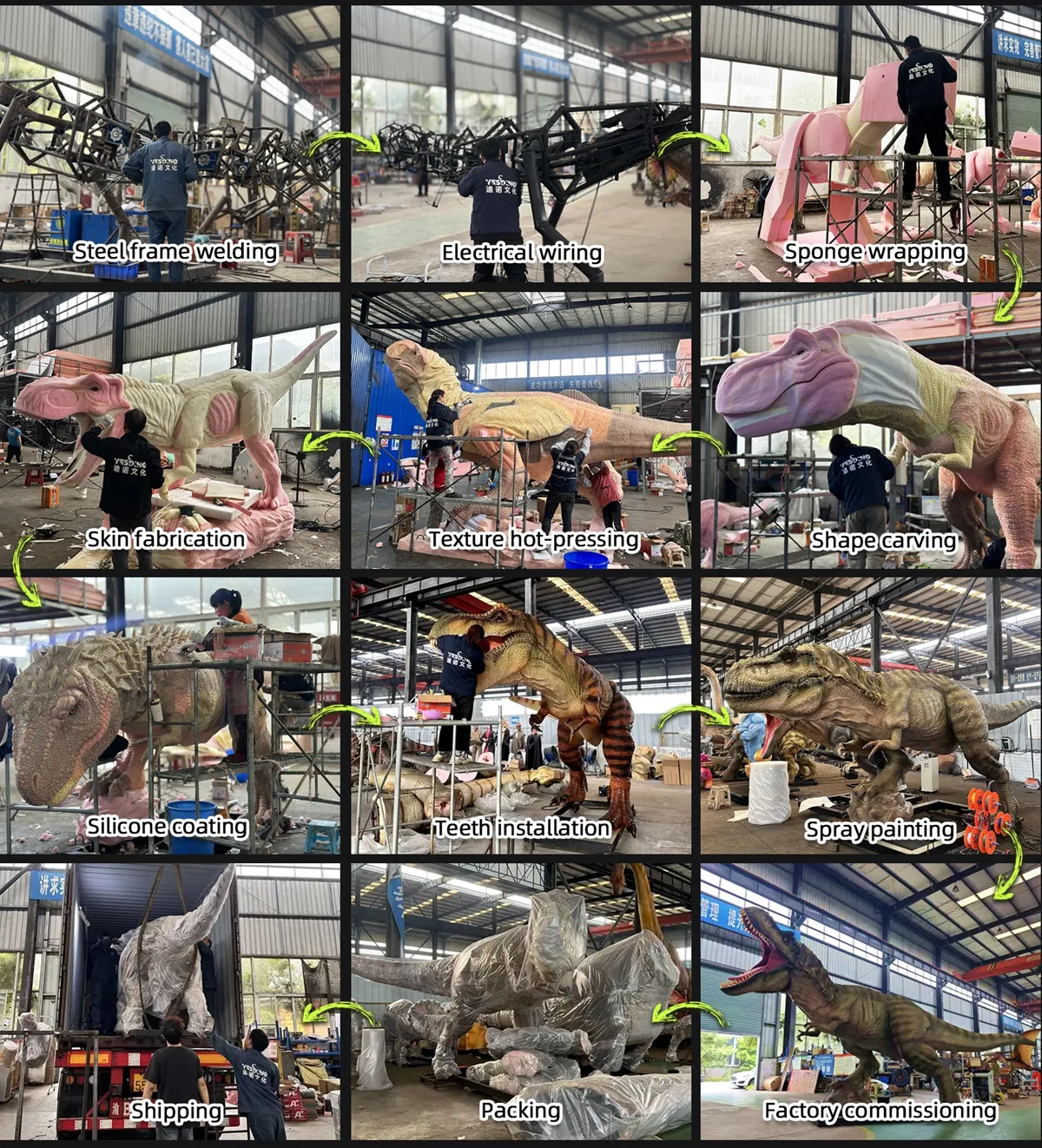
Production Process
Most Spinosaurus builds are bought for the skyline. This one is bought for the path: five metres long, two metres tall, narrow enough to stand beside a walkway and let visitors pass within two metres of the head.
SKU YKL-100: five metres long, 0.7 m across the body, two metres at the head.
Compact, without losing the identity
Scaling a Spinosaurus down is a risk: shrink it evenly and the sail, the snout and the tail all lose the proportions that make the animal recognisable. On this build the sail stays proportionally tall and the snout stays long and narrow, which means the body is slightly shorter than a strict scale would give.
The result reads correctly at three metres — the distance at which a walk-through exhibit is actually viewed. From ten metres it reads as a smaller animal, which is exactly what it is.
The snout at close range
At this size the head is the part people inspect. The snout should be long and shallow with the notch behind the tip, the teeth conical and set to mesh when the jaw closes, and the jaw travel shallow — a long snout with a wide gape looks like a puppet from two metres away.
We keep the jaw movement short and let the neck do the work, which is also how the animal would have moved: a low sweep of the head, then a hold.
Six movement groups
Head left and right, neck up and down, jaw open and close with a roar, blinking eyes, tail sweep, forearm scratch. The forearm group is worth keeping at this size — the claw is close to visitor height and it is the detail that gets photographed.
Independent drives with end-of-travel protection; loop, proximity sensor or floor mat. On a walk-through path the mat trigger works better than a sensor: crowds standing still keep a proximity sensor firing, and the animal ends up moving continuously instead of performing.
Where it works
Walk-through trails. Beside the path, angled so the head comes out over the walkway at chest height.
Indoor exhibitions. Two metres clears a standard ceiling with room for signage, and five metres fits a hall without dominating it.
Water features. If it sits beside a pond, keep the base out of standing water and bring the cable route in from above. Splash is fine; a permanently wet frame is not.
Finish and delivery
Welded Q235 steel frame with anti-rust treatment, foam volume, silicone five to seven millimetres, translucent layered colour. Standard palette is a grey-brown body with darker banding across the sail and a pale underside.
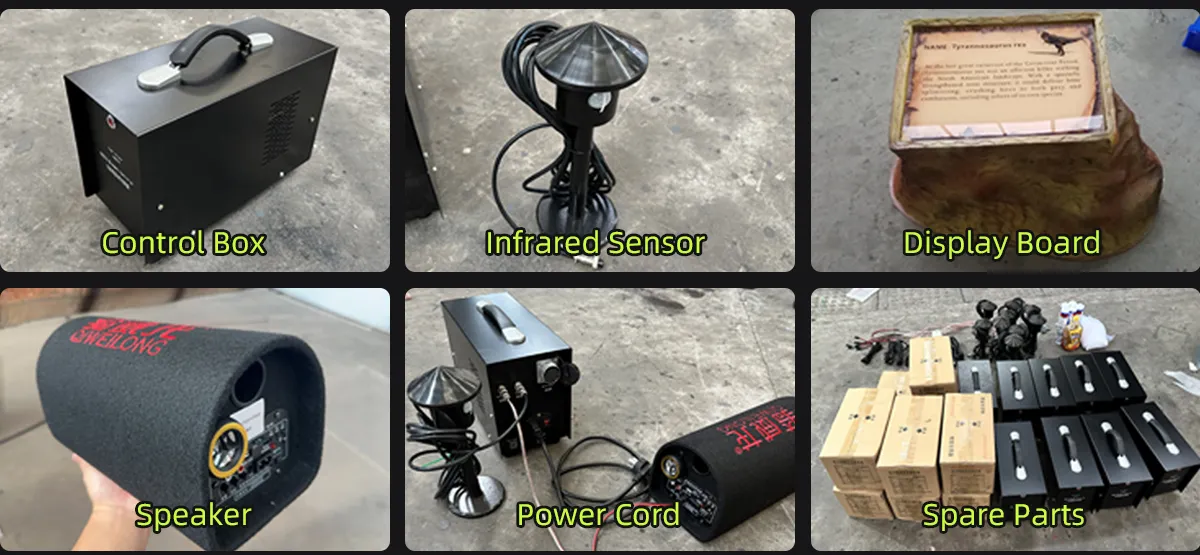
Rated −25 °C to 45 °C, 110 V or 220 V configured at build. Ships in sections with base frame, control cabinet, sound system, wiring diagram and calibration sheet; freight, duties, certificates and installation are quoted separately from the product price.
Holding the sail's proportion
The sail is a proportion, not a size. On a five-metre animal it has to stay tall relative to the body or the identity disappears, which is why this build runs a slightly compressed torso: the sail and the snout get their scale first, and the body is shortened to suit.
That is a design decision worth knowing about if you are comparing this build against a five-metre theropod of another species. It will look shorter in the body and taller over the hips than the tape measure suggests, because the animal's character lives in the parts that aren't the body.
Placement beside a path
Set the animal three-quarters to the walkway rather than parallel to it. Parallel placement puts the sail edge-on as visitors approach and hides the one feature that identifies the species; angled, the sail opens up as people come round the bend.
Keep a metre and a half between the tail arc and the barrier. On a five-metre animal the tail tip travels further than the body length suggests, and visitors who step back from the head are stepping towards the tail.
Enquiry
Send the path width and a photo of the spot. If the trail is narrow, this build sits beside it rather than in it — which is usually the difference between a walk-through exhibit that flows and one that creates a queue.
Where to go next
Two things come up in almost every enquiry on this build: how the size compares with the alternatives, and what it takes to get it on site. The rental cost breakdown sets out the length options side by side, and the pneumatic versus hydraulic comparison covers pads, access and assembly. Budget planning sits in the installation guide for pads and access.
For ideas on placing it, see exhibit planning walkthrough. The rest of the range is on animatronic dinosaurs, and if this one is the wrong size for the slot, 5m t-rex for small parks is the closest alternative.
Product Accessories
Packaging and Container Loading