


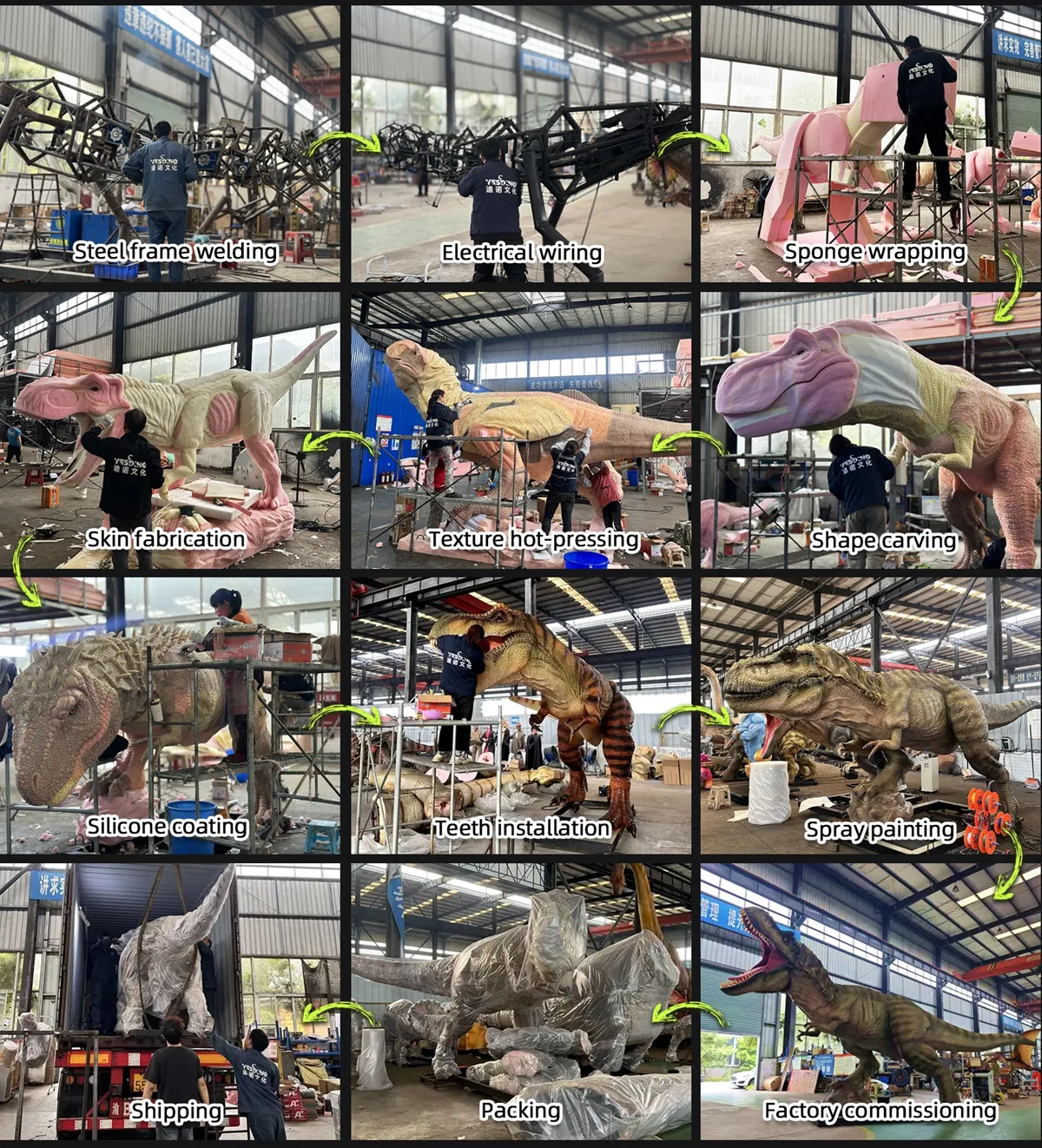
Production Process
A farm park with a spare paddock. A resort with a lawn nobody uses. A garden centre that wants something at the end of the plant area. Most first animatronic purchases look like this, and most of them land on a 6 m animal, because it is the size that can be delivered on a trailer and unloaded by two people doing it for the first time.
What six metres buys you first time round
6 m long, 2 m tall, 0.8 m across. From twelve to fifteen metres, where most visitors stand, the whole animal fills the view: sail, long snout, conical teeth, tail. That complete read at a short distance is what a first purchase is for. The animal has to look finished and alive in a photo taken on a phone from the path edge.
It also needs less around it: no crane, no engineered pad, no dedicated crew. A trailer, a telehandler or a tractor, and a day.
What the larger builds add. Height is the first thing. At 2 m to the top of the sail, the animal sits at the eye level of an adult. Stand twenty metres back and it compresses into a low shape, which is fine on a path and weak as a roadside landmark. The 8 m build carries more body behind the shoulder; the 13 m one is an event animal with presence across a plaza and a freight bill to match.
The second is skin area. A larger animal shows more surface at close range; on six metres the detail zones are the head, the sail edge and the shoulder.
Movement groups are the third. This build covers head, neck, jaw, eyes and tail; larger builds add gestures that need length, and on a compact body those look like shrugging.
Where a first sail animal works
Along a fence line at a farm park, with the snout over the path and the tail in the grass. On a resort lawn, set back three metres from a walkway so the 0.8 m body does not block the route.
Tuning a small animal to look unhurried
Small builds get over-programmed. A six-metre animal doing five gestures in eight seconds looks like a toy; one doing two looks like an animal. We set head turn, a jaw open with a pause at the top of the travel, and a slow tail sway, then leave gaps. The sail itself does not move, so the head carries everything and the gap between moves is what makes the next one read.
Sensor at 4 m on the approach side, 0.7 s delay, mounted at 1.1 m so it sees adults and children on the same line. Point it away from a sunny wall; a warm surface in the beam holds the trigger on all afternoon.
Build, skin and the first winter outside
Q235 steel frame, rust-treated, foam-carved body, silicone skin 5–7 mm with colour in translucent layers, rated −25 °C to 45 °C. The base frame sits on feet rather than flat on the ground, which keeps the steel out of standing water; on a lawn, set each foot on a 300 mm paving slab so the animal does not sink on the wet side.
Under trees, expect leaf tannin and bird lime on the sail; both clean off with water and a soft brush, and the batch colour on the build sheet covers small repairs. A two-year warranty on the core electronics is standard, and commissioning parameters are written down so a replacement board does not mean starting over.
Three crates, a trailer, one Saturday
Three crates and about 600 kg total. Assembly is base frame, legs, body, neck and head, skin, power. Two people with a tractor and a morning will get it standing; the afternoon goes on alignment and on walking the trigger line with someone playing the visitor. Anchoring is four M12 ground screws or bolts into slabs, and the cabinet sits on the far side from the path with the door opening toward your maintenance route.
Power is 110 V or 220 V, chosen at build. If the nearest supply is a shed forty metres away, decide now whether you want an armoured run or a small consumer unit at the animal; both are cheaper to plan than to add later.
Before you pay a deposit
Send a photo of the intended spot from the path, the surface, the distance to the nearest power, and how visitors will approach.
Skip this size if the animal has to be visible from a road, if the site floods in winter, or if people will circle it at arm's length. Those briefs want a taller build, a raised pad, or a barrier.
Enquiry
Tell us the site, the viewing distance and the season you plan to run it. We will say whether six metres fills that view or leaves it empty.
Where to go next
If you are still comparing options, start with the pneumatic versus hydraulic comparison — it lines up the builds by length and reach. Site work is covered in the installation guide for pads and access, and the wiring concealment notes lists the factors that move the price.
For ideas on placing it, see what shipping a large animal involves. The rest of the range is on animatronic dinosaurs, and if this one is the wrong size for the slot, animatronic cryolophosaurus for exhibition halls is the closest alternative.
Product Accessories

Packaging and Container Loading



