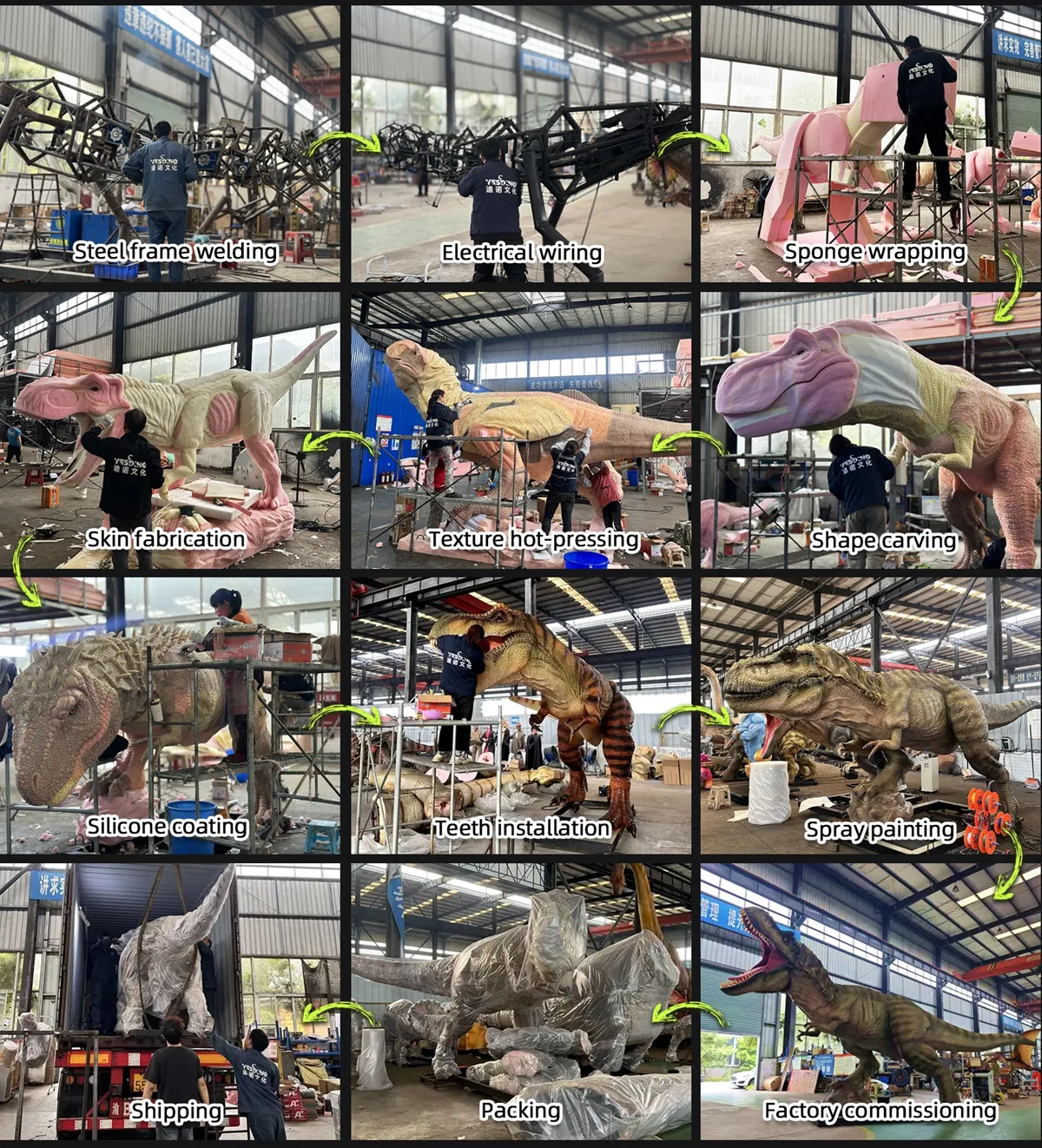
Production Process
The name means "shark-toothed lizard", and it is accurate: the teeth were thin, curved and serrated along both edges, built for slicing rather than for crushing bone. It lived in what is now the Sahara, and its skull is one of the largest of any theropod.
SKU YKL-070: six metres long, 0.65 m across the body, two metres at the head. A compact build of an animal that reached twelve or thirteen metres, sized for a trail or an indoor hall.
Build the head first
In life the skull was around a metre and a half long, and proportionally deep — a shape that reads as heavy even at a distance. On a six-metre model that head is the thing that identifies the animal, and it is where the build time goes.
Three details matter. The snout is long and slightly convex rather than tapering to a point. The jaw line is deep at the back, where the jaw muscles sat. And the teeth are visible along the closed mouth, thin and closely spaced; on a cheaper build they get modelled as a row of fat triangles, which turns the animal into a generic monster.
Six metres against thirteen
Shrinking a large theropod to six metres changes the proportions: the legs look shorter relative to the body and the head looks larger. On this animal that actually helps — the head is the selling point, and a slightly oversized head on a compact body reads as a young adult rather than a mistake.
It also makes the animal practical. Six metres fits a narrow trail, travels in crates that don't need a crane, and stands under a three-metre ceiling with clearance for the head travel.
Six movement groups
Head left and right, neck up and down, jaw open and close with a roar, blinking eyes, tail sweep, forearm scratch. The jaw travel is deliberately shallower than a tyrannosaur's: this animal's skull was long and relatively light, and a wide gape looks like a puppet on it.
Independent drives with end-of-travel protection, run from a loop, a proximity sensor or a mat, with speeds set at commissioning. On a six-metre build the tail sweep covers less ground than on a bigger animal, so it can be set more freely without reaching the barrier.
Where it earns its place
Trails that already have a T-Rex. This is a different silhouette from the same distance — longer head, lower carriage — and visitors read it as a separate animal rather than a repeat.
Museum and science displays. The Saharan origin and the shark-tooth dentition give a curator two facts that aren't about size, which is what separates an exhibit from a photo opportunity.
Film and event work. A deep, narrow skull photographs well in profile, and the compact size makes it easier to move between sets.
Finish and delivery
Welded Q235 steel frame with anti-rust treatment, foam volume, silicone five to seven millimetres, translucent layered colour. Standard finish is a warm sand-brown with darker dorsal striping and a pale underside, with the teeth kept off-white rather than bright white.
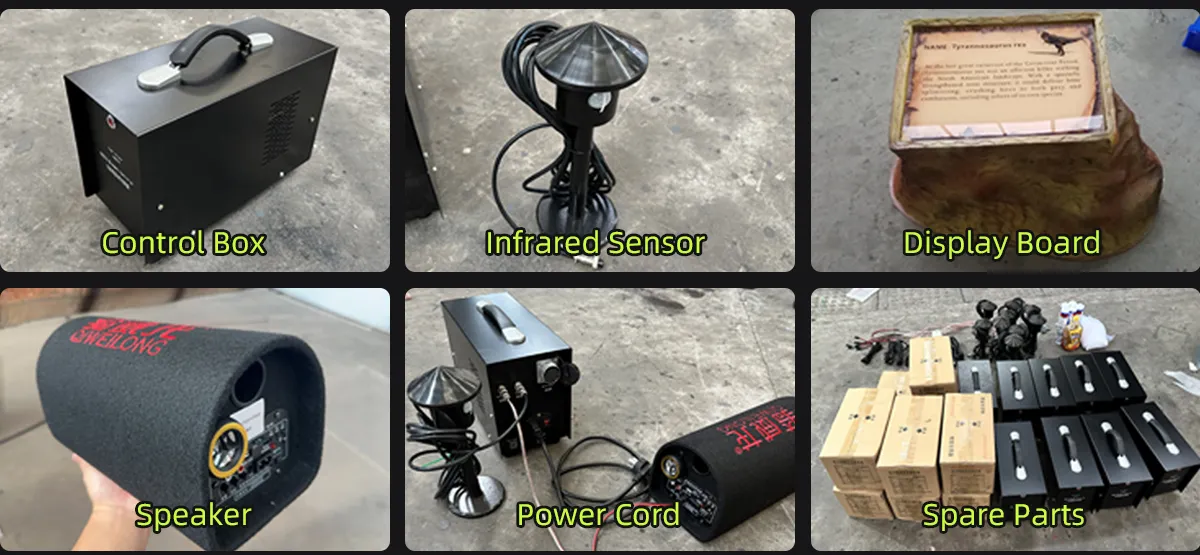
Rated −25 °C to 45 °C, 110 V or 220 V configured at build. Ships in sections with base frame, control cabinet, sound system, wiring diagram and calibration sheet. Freight, duties, certificates and installation are quoted separately from the product price.
Teeth, and what they were for
The teeth are thin, curved and serrated along both edges — a shape built for slicing flesh rather than for crushing bone. That single detail separates this animal from a tyrannosaur in the eyes of anyone who looks in the mouth, and it should be visible on the model even with the jaw closed.
The skull matches: long, deep and relatively light for its size, with a jaw joint set to open wide and close fast. We keep the teeth slightly irregular in size, because a perfectly even row of identical triangles reads as a moulding rather than as an animal.
Enquiry
Send the site photo and the viewing distance. If the trail already has a large theropod, tell us which one — placement advice depends on what the visitor has just seen.
Where to go next
Two things come up in almost every enquiry on this build: how the size compares with the alternatives, and what it takes to get it on site. The wiring concealment notes sets out the length options side by side, and the park layout and theming strategies covers pads, access and assembly. Budget planning sits in the cost breakdown with the seven price factors.
For ideas on placing it, see what shipping a large animal involves. The rest of the range is on animatronic dinosaurs, and if this one is the wrong size for the slot, animatronic pachycephalosaurus for sale is the closest alternative.
Product Accessories
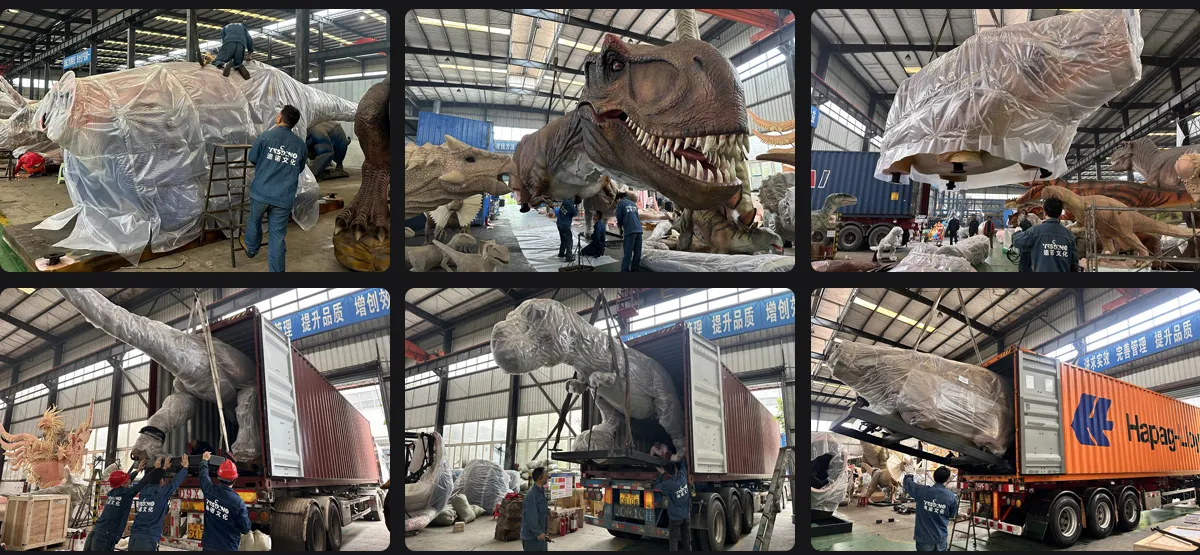
Packaging and Container Loading