


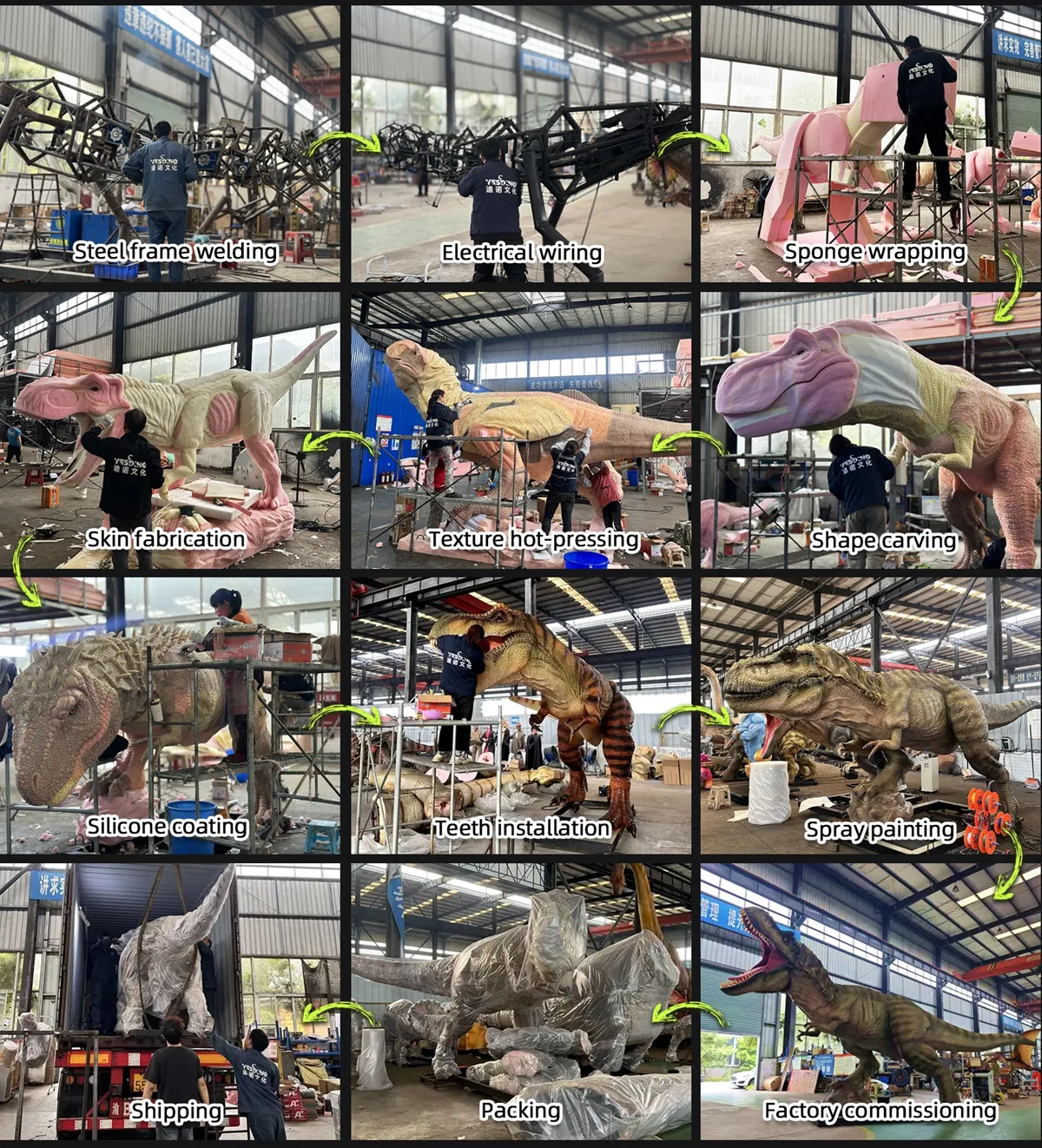
Production Process
The sail sells this animal and the sail also gets it misidentified. Visitors see a hump-backed dinosaur and say Spinosaurus; what they are looking at is a plant-eater from Cretaceous Africa with a much lower ridge, a broad snout for cropping vegetation, and no teeth worth fearing.
SKU YKL-102: four metres long, 0.7 m across the body, 1.9 m at the head.
A ridge, not a sail
The spines along the back of Ouranosaurus are shorter and thicker than a Spinosaurus sail, and the outline is a low hump that rises over the hips rather than a tall sheet. Building it as a thin fin is the fastest way to make the model wrong, and thin fins also fail in service: they flex, they drum in wind, and the paint cracks along the leading edge.
We build the ridge as a solid volume on spine-mounted ribs, with the skin carried over it in the thick end of the five-to-seven-millimetre range. It holds its shape, it doesn't flutter, and a knock damages a patch rather than the whole ridge.
The details that make it a herbivore
Three features tell visitors what they're looking at, and all three are cheap to model. The snout is broad and flattened, like a duck's bill, rather than the narrow snout of a predator. The teeth are leaf-shaped and set in batteries for cropping, not conical. And the hands carry a spike on the thumb — a defensive tool, and the one detail children remember.
Get those right and the animal reads as harmless even before the label. Get them wrong and it reads as a small predator with a hump.
Why four metres
Adults reached seven to eight metres. This build is four, which suits a walk-through trail where the path is two metres wide and the animal has to sit beside it rather than across it. It also keeps the head low, at 1.9 m — right at adult eye level, which means visitors meet it face to face.
For an indoor gallery, four metres is often the largest herbivore that can be moved in through a service door without dismantling a wall. If your plan needs the full seven-metre animal, ask at enquiry; it changes the crate sizes and the access requirements more than the price.
Five movement groups
Head left and right, neck up and down, jaw open and close with a call, blinking eyes, tail sweep. No forearm group: the hands are held close to the body and there is nothing worth animating there. The jaw on a herbivore is a cropping motion rather than a roar — we set the sound to a low bray, which suits the animal and keeps a family trail from sounding like a monster movie.
Independent drives with end-of-travel protection, triggered from a loop, a sensor or a mat. The neck group is the one to tune: a slow lift with a pause at the top reads as browsing, and it is the movement that makes people stop.
Placing it near a Spinosaurus
If both animals are on the same site, separate them and vary the palette. A dark grey-green Spinosaurus beside a warm ochre Ouranosaurus reads as two different animals; two similar greys read as the same model at two sizes, and visitors will say so.
Keep at least thirty metres of path between them and let the herbivore come first — a calm animal sets up the tension for the predator that follows.
Specification and delivery
Welded Q235 steel frame with anti-rust treatment, foam volume, silicone five to seven millimetres, translucent layered colour. Rated −25 °C to 45 °C, 110 V or 220 V set at build, two-year warranty on core electronics. Ships in sections with base frame, control cabinet, sound system, wiring diagram and calibration sheet; freight, duties, certificates and installation are quoted separately from the product price.
Enquiry
Send the path width, the viewing distance and a photo of the spot. If the trail is narrow, this is one of the few herbivores that will sit beside it without blocking the flow.
Where to go next
If you are still comparing options, start with the installation guide for pads and access — it lines up the builds by length and reach. Site work is covered in the wiring concealment notes, and the park layout and theming strategies lists the factors that move the price.
For ideas on placing it, see exhibit planning walkthrough. The rest of the range is on animatronic dinosaurs, and if this one is the wrong size for the slot, animatronic indominus rex for jurassic theme parks is the closest alternative.
Product Accessories

Packaging and Container Loading



