


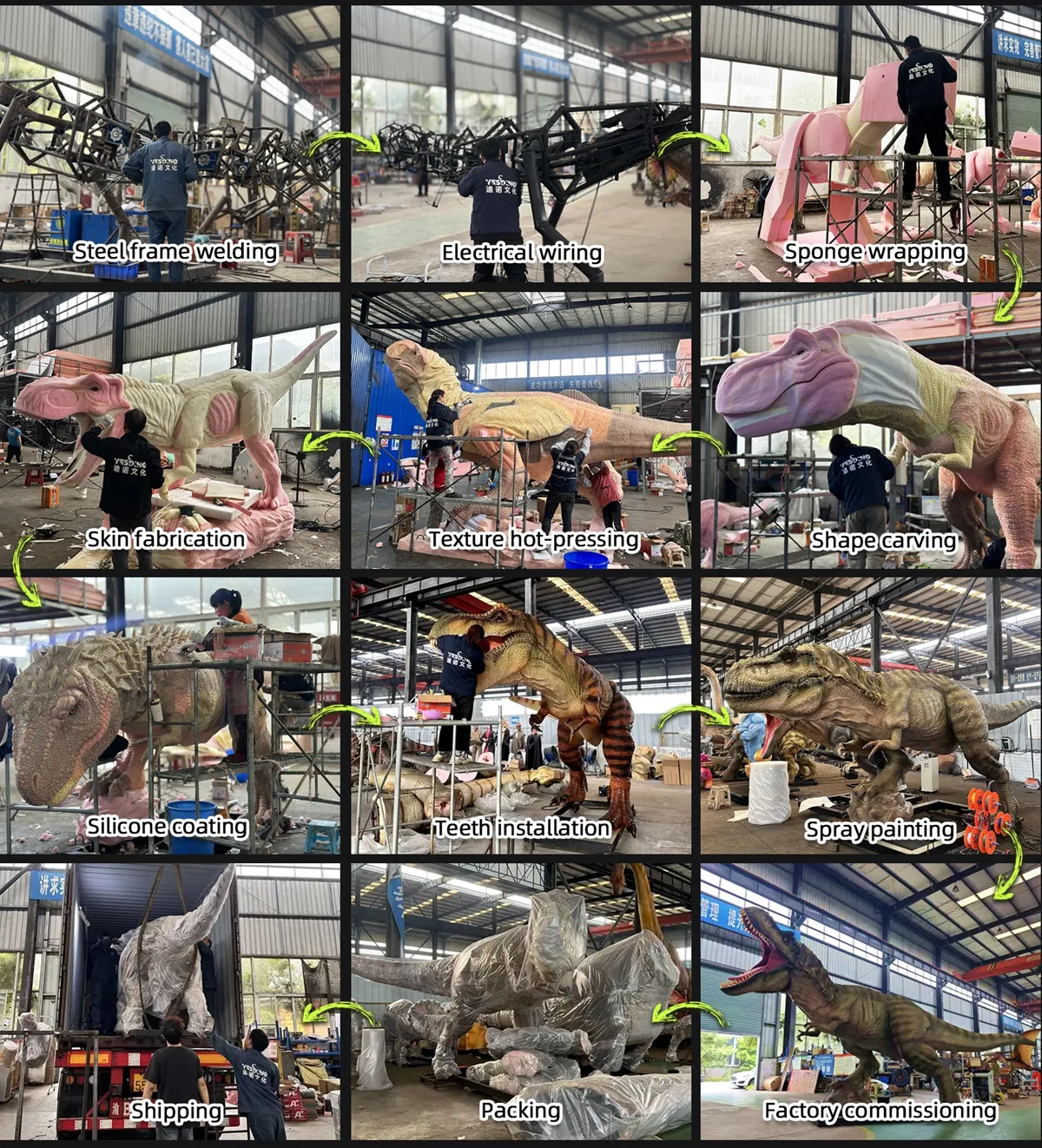
Production Process
Every other animal on this site has a reference: a skeleton, a mounted cast, a published reconstruction. This one doesn't. It was invented for a film, which means there is no correct answer to check a model against — and that changes the job from matching a reference to agreeing a design.
SKU for this build: fifteen metres long, 1.7 m across, 2.7 m to the top of the back. Long and low, rather than the tall forward-leaning stance of a tyrannosaur of the same length.
Why a fictional animal is harder than a real one
With a real species the argument ends at the fossil. With this one, every decision is a choice: how long the arms, how deep the skull, whether the skin carries osteoderms or smooth scales, whether the dorsal line runs straight or rises over the hips. Two visitors will each remember the film differently, and each will think the model is wrong in a different place.
The practical answer is to fix the design before fabrication. We work from a set of reference stills you supply, agree a posture and a colour scheme, and produce CAD drawings for approval. That document is what the workshop builds to, and it is also what protects you from a "that's not what I pictured" conversation three months later.
Fifteen metres at 2.7 m tall
That combination is unusual and worth understanding before you place it. The animal is long, low and horizontal, so it photographs best from the side and at a distance. Put it beside a tall theropod and the height difference is obvious; put it on its own at a bend in a path and it reads as something heavy moving through the undergrowth.
Because the body sits low, the head arrives at chest height rather than above the crowd. That is what makes it effective at close quarters and less effective as a landmark from the car park — if you need the skyline shot, this is the wrong animal and a taller build will do that job better.
Six movement groups
Head left and right, neck up and down, jaw open and close with a roar, blinking eyes, tail sweep, and a forearm scratch. The forearm group is worth specifying here: with arms this length, a hand that lifts and closes draws attention in a way a tyrannosaur's stubby arm never can, and it is the detail most visitors mention afterwards.
Programs are set at commissioning and documented. On a low animal, the tail sweep covers a lot of ground quickly — set the end stops so the tip stays clear of the barrier line, because visitors reach over it.
Skin: film look or plausible animal
There are two defensible directions. The film finish is darker, glossier, with pronounced ridges along the spine and a heavier build-up around the jaw. The other is a more naturalistic treatment — a dull, mottled hide with countershading, the way a large predator would actually be coloured.
The first photographs better at night and under coloured lighting; the second survives daylight and holds up in a museum context. Both are built the same way underneath: foam volume over a welded Q235 steel frame, silicone five to seven millimetres thick, pigment carried in translucent silicone layers rather than painted on the surface.
One thing to decide before you print signage
The creature's name comes from a film franchise, and names like that are usually protected. We build the animal and can build it to look like the one you have in mind; what you call it in advertising, on tickets or on a web page is a decision for you and your legal adviser. Plenty of parks market this shape under a generic name — hybrid tyrannosaur, super-predator, genetic hybrid — and visitors recognise the silhouette without needing the trademark.
Delivery
Fifteen metres travels in sections: legs, body, neck, head and tail, with a steel base frame, control cabinet, sound system, wiring diagram and calibration sheet. The base needs a pad and anchoring — a long low body still presents a large side profile to wind. Freight, duties, certificates and installation are quoted separately and sit outside the product price.
Before you order
Send the reference stills you want it to match, the site photo and the viewing distance. We'll turn that into a posture proposal and a budget range, and tell you honestly where a fifteen-metre low build will not suit the space you have.
Where to go next
Worth reading before you commit: the size guide covering 3 m to 12 m builds for how the sizes compare, the rental cost breakdown for what the ground has to carry, and the pneumatic versus hydraulic comparison for where the money actually goes.
For ideas on placing it, see layout strategies for themed trails. The rest of the range is on animatronic dinosaurs, and if this one is the wrong size for the slot, animatronic spinosaurus for museum displays is the closest alternative.
Product Accessories

Packaging and Container Loading



