


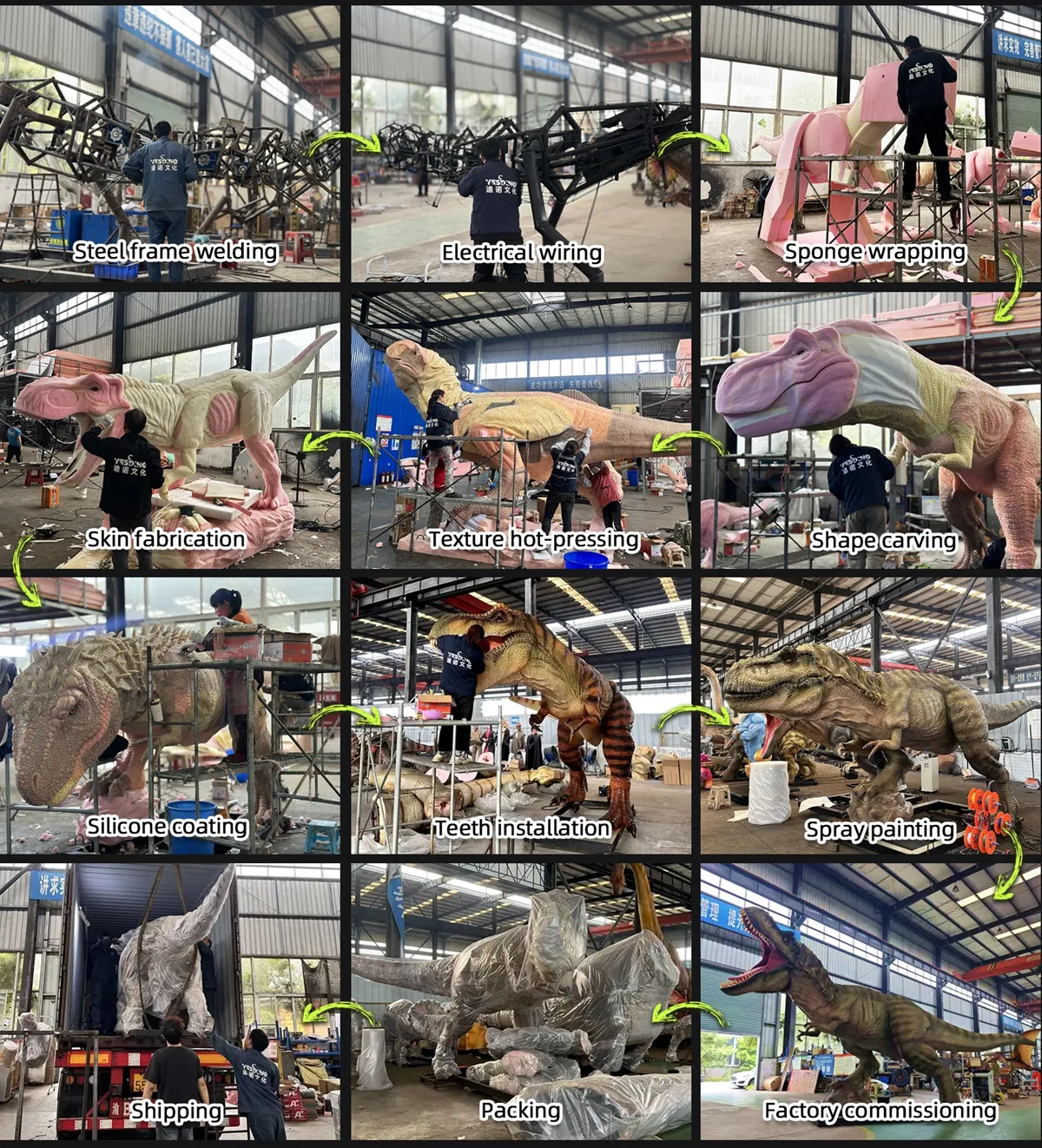
Production Process
Most visitors will call this a raptor, and they will be closer to right than they expect. The animal in the films wore the name Velociraptor, but its size, its build and its behaviour were drawn from Deinonychus — a three-metre predator from Cretaceous North America.
SKU YKL-058: three metres long, 0.8 m across the body, 1.8 m to the top of the head. That is close to the fossil animal, not scaled up.
True scale, and what it buys you
A three-metre Deinonychus stands at chest height on an adult. That is a different experience from a six-metre raptor looming overhead: visitors look down at it, it looks up, and the encounter is intimate rather than theatrical.
For a walk-through trail that is a strength. For a roadside landmark it is useless — nobody sees it from a moving car. Decide which job the animal has before choosing the size, because those two briefs lead to different builds.
The claw is the point
The second toe on each foot carried an enlarged, curved claw held clear of the ground when the animal walked. It is the single most diagnostic feature of the group, and it is also the detail most models get lazy about — either painting it on or sculpting it flat against the toe.
We build it as a separate curved element on the raised toe, with the toe joint set in the walking position. At 1.8 m the feet are at eye level for a child, which means the claw is one of the most-photographed parts of the animal. It is worth the extra moulding work.
Six movement groups
Head left and right, neck up and down, jaw open and close with a roar, blinking eyes, tail sweep, forearm scratch. The tail on this animal is long, stiff and held straight out — it should move as a unit rather than whip, and the sweep should be smaller than on a larger theropod.
Because the animal is small, movement speed matters more than travel. A quick head turn and a fast blink read as a bird; slow heavy motion reads as a machine pretending to be a big animal. We set the cycle faster on this build than on anything else in the range, and leave the parameters documented so it can be tuned on site.
Feathers: the honest option
The evidence for plumage in this group is strong, and a feathered Deinonychus is a different tooling job from a scaled one. We can build a feather-textured variant across the arms, neck and tail — sculpted rather than applied, so it survives weather and handling.
Specify it at enquiry rather than later, because it changes the moulds and the build time. If your exhibit carries interpretive panels or school groups, it is worth the conversation: a feathered raptor is more accurate and, at this size, more striking than another olive-green scaly one.
Where it works
Walk-through trails. Best use. Place it at a bend so visitors meet it side-on at two to three metres, with the head turned towards the path.
Museum galleries. A true-scale animal beside a mounted skeleton is a strong pairing, and the size difference between the two tells the story without a label.
Children's areas. Chest height, a visible claw and a fast blink make it the animal children engage with most. Keep the barrier at a metre and the sound level low.
Behaviour, and what to animate
A small predator on a trail has one advantage over a big one: visitors can get close, which means small behaviours carry. A head that tracks a passer-by, a blink timed a beat late, a hand that opens and closes — at two metres these read as an animal deciding something. At fifteen metres they would be invisible.
What doesn't work is the aggressive set piece. A lunge at the barrier, a snap at a child's hand: it looks cheap next to the real thing, it frightens the audience you most want to keep, and it hammers the mechanism. The animals that get remembered are the quiet ones doing something small and unexpected.
Sound is worth thinking about for the same reason. A continuous roar loop is exhausting; a low vocalisation triggered on approach, followed by silence, gives the animal a presence without a soundtrack. We can set the trigger radius at commissioning and change it later without a service visit.
Specification and delivery
Welded Q235 steel frame with anti-rust treatment, foam volume, silicone five to seven millimetres, translucent layered colour. Rated −25 °C to 45 °C, 110 V or 220 V set at build, two-year warranty on core electronics. Ships in sections with base frame, control cabinet, sound system, wiring diagram and calibration sheet. Freight, duties and installation are quoted separately from the product price.
Enquiry
Tell us the viewing distance, whether it is indoors or out, and whether you want the feathered variant. Those three answers settle the build.
Where to go next
If you are still comparing options, start with the installation guide for pads and access — it lines up the builds by length and reach. Site work is covered in the wiring concealment notes, and the park layout and theming strategies lists the factors that move the price.
For ideas on placing it, see layout strategies for themed trails. The rest of the range is on animatronic dinosaurs, and if this one is the wrong size for the slot, 12m animatronic t-rex for amusement parks is the closest alternative.
Product Accessories

Packaging and Container Loading



