


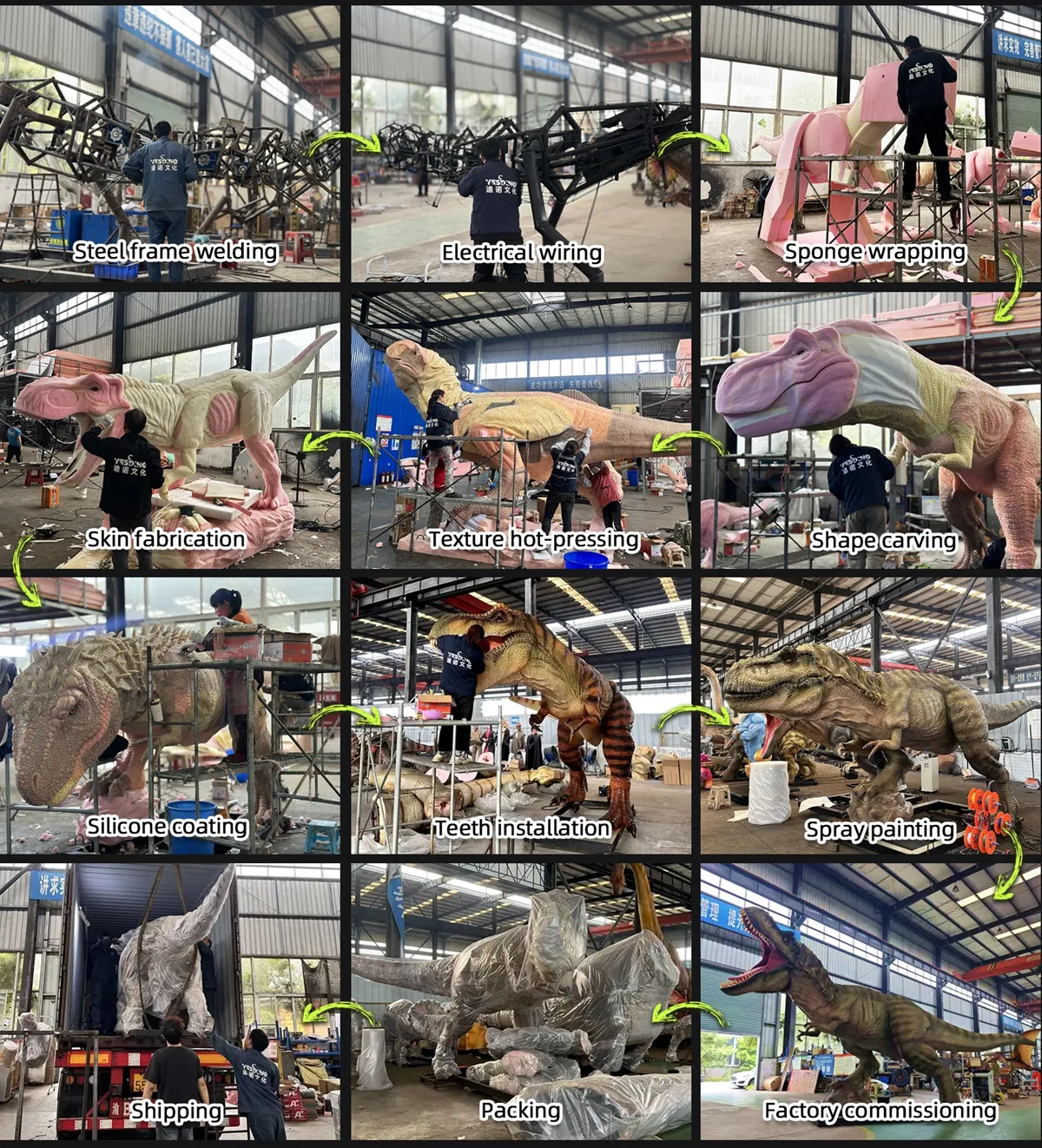
Production Process
There is a conversation worth having before you order this animal. Eotyrannus was a small early tyrannosauroid — roughly four and a half metres, known from the Isle of Wight — and the model on this page is fifteen metres. That is a choice somebody made for the catalogue, and it should be your choice too, not a surprise when the crates arrive.
As built: fifteen metres long, 1.6 m across, 2.7 m tall, carrying the head forward and low.
Saying it plainly
At fifteen metres this is a display animal, not a reconstruction. It reads as a mid-size theropod with a tyrannosaur's head, which is exactly what most park trails want: something that looks dangerous, fills a space, and doesn't cost what a full-size T-Rex costs.
What it is not is accurate. If your audience includes a museum, a university or a committed dinosaur community, someone will eventually point out that the real animal was the size of a pony. A label calling it a juvenile or a "scaled display model" solves that; silence doesn't.
What the extra length buys you
Presence, mainly. At fifteen metres the animal spans a path junction, and the head can be positioned to come out over a walkway at 2.7 m — above adult height, below the treeline. That is the height band that photographs well without needing a crane to install.
It also gives you a predator that isn't a T-Rex on a trail that already has one. A visitor who has just walked past a five-and-a-half-metre tyrannosaur will still stop for this, because the silhouette is different: longer, lower, head thrust forward rather than carried high.
If you need true scale
We build a four-and-a-half-metre version to the fossil animal, with the proportions corrected — shorter body, lighter frame, and the head at roughly 1.6 m. It suits museum galleries, education rooms and any trail that has already committed to accurate sizing elsewhere. Say which version you want at enquiry; the two are different frames, not a resize.
Six movement groups
Head left and right, neck up and down, jaw open and close with a roar, blinking eyes, tail sweep, forearm scratch. The forearm group is worth keeping here: early tyrannosauroids had proportionally longer arms than the later giants, so a hand that lifts and closes is anatomically defensible on this animal in a way it isn't on a T-Rex.
Independent drives with end-of-travel protection, run from a loop, a sensor or a button, set and documented at commissioning.
What the real animal looked like
Eotyrannus is known from a partial skeleton found on the Isle of Wight, and it sits near the base of the tyrannosaur family tree — early Cretaceous, roughly 125 million years ago. It already had the family's signature: a long, narrow skull with teeth that were flattened rather than round in section, and a build that was clearly made for running.
Its arms were long, with three working fingers. That is the detail most people don't expect from anything called a tyrannosaur, and it is why the hands on this model are worth getting right. The later giants of the family reduced their arms almost to nothing; this animal still used them.
If the exhibit carries interpretive text, that contrast is the story: the same lineage, at the start of its run, still small and still armed. A fifteen-metre build tells a different story, which is fine as long as you know which one you're telling.
Finish and delivery
Welded Q235 steel frame with anti-rust treatment, foam volume, silicone five to seven millimetres, translucent layered colour. Standard finish is a mid-brown body with darker banding and a pale throat; posture, pattern, colour and sound are made to order.
Rated −25 °C to 45 °C, 110 V or 220 V set at build, two-year warranty on core electronics. Ships in sections — legs, body, neck, head, tail — with base frame, control cabinet, sound system, wiring diagram and calibration sheet. Freight, duties, certificates and installation are quoted separately from the product price, and the base needs a pad and anchoring on an exposed site.
Enquiry
Tell us which version you want — display size or fossil size — plus the viewing distance and whether the trail already has a large tyrannosaur. We'll confirm the build and quote both if you're undecided.
Where to go next
If you are still comparing options, start with the pneumatic versus hydraulic comparison — it lines up the builds by length and reach. Site work is covered in the installation guide for pads and access, and the wiring concealment notes lists the factors that move the price.
For ideas on placing it, see layout strategies for themed trails. The rest of the range is on animatronic dinosaurs, and if this one is the wrong size for the slot, animatronic allosaurus for exhibition halls is the closest alternative.
Product Accessories

Packaging and Container Loading



