


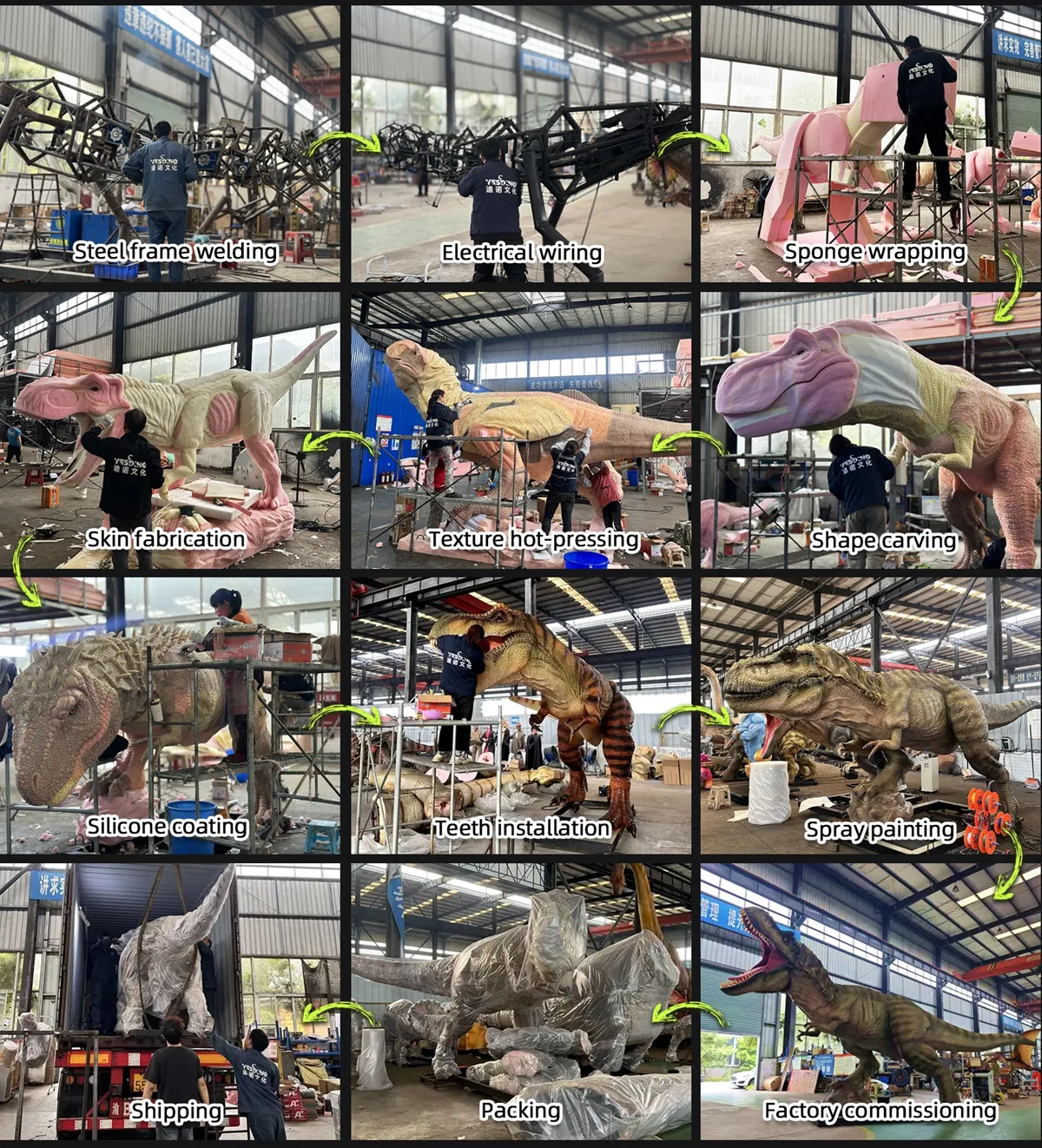
Production Process
A hall with a stone floor, a case of bones along one wall, and a five-metre animal standing in the open. Nobody looks at it from forty metres. They stand three metres away, at eye level with its hands, for two or three minutes.
The animal is 5 m long, 0.8 m wide across the body, 2 m to the top of the head. Low enough to sit under a lighting track, narrow enough to walk around, long enough to hold a room on its own.
The crests and the three fingers
Two features separate this animal from a generic theropod at close range, and both are small: the pair of bony crests above the eyes, and hands with three fingers, each ending in a large claw held forward rather than hanging.
We build the crests up in the foam under the skin as raised ridges instead of painting a shape onto a smooth head. A painted crest reads as a stripe from two metres and disappears under gallery light; a built one casts its own small shadow, which is what makes the head look like a skull with skin on it.
Floor plan and viewing distance
Allow a footprint of about 7 m by 3 m: the 5 m body plus a metre at each end, 0.8 m of body plus a metre either side. A rail at 1.2 m from the flank puts visitors where the hands and the crests read without anyone leaning over.
Ceiling decides the room. At 2 m the head clears a 2.6 m slab, but a lighting track 400 mm below it leaves nowhere to turn. We ask for a photo of the ceiling, not just the floor, because the head turn is the movement people remember.
Movement in a quiet room
Neck, head turn, jaw, blink, tail sway, breathing, and a wrist flex that opens and closes the three-fingered hands. The wrist group earns the tuning time indoors: the hands sit near adult chest height, so a slow closing of the fingers happens at the level of a visitor's face.
Hard floors and plaster ceilings push the roar back at you, so a recording that sits right outdoors sounds harsh indoors. We run it lower and shorten the call. A proximity sensor about 2.5 m out on the approach side starts the head turn a beat before the visitor stops walking.
Skin under gallery light
Q235 steel frame, rust-proofed, foam body, silicone skin 5-7 mm, colour in translucent layers. Under 4000 K track lighting a warm brown can turn olive, which is why we ask what lamps the room uses before pigment is mixed.
A 3000 K spot from about 45 degrees in front keeps the crests shadowed and the eyes visible; light straight overhead puts the sockets in shadow and the animal looks blank. Hall air is dry, dust settles on the shoulders, and a dry cloth twice a month is the whole routine.
Getting it through the building
This one goes through a door, not over a wall. Four sections under 0.8 m wide, so a 1.5 m double door and a goods lift with a 2.1 m opening both take it. No crane: a pallet truck, floor protection and four people.
Bolt the base plate down where the floor is concrete and anchors are allowed; on tile or a listed floor we ballast the plate and hide the edge under a low plinth. The cabinet door faces the service side, with 0.8 m clear so a technician can stand with the panel open without roping off the exhibit.
What to settle first
Send the ceiling height, a photo of the lighting, the door and lift openings, the floor material, and whether anchors are permitted. Mark the visitor route on the plan: the head faces the arrival, the tail points at the wall.
Where this size stops working: a narrow circuit at arm's length, where a 5 m animal in a 4 m aisle becomes an obstacle rather than an exhibit. A 2.2 m ceiling with surface conduit does the same. A smaller animal, or this one on a plinth with motion cut back to head and jaw, is the calmer answer.
Enquiry
Send the room photos, the ceiling height and the floor plan with the route marked. If the show tours, say so, because a build that moves between venues wants the ballasted base and quick-release sections. Price excludes freight, duty, certificates and installation.
Where to go next
Worth reading before you commit: the spare parts and repair kit list for how the sizes compare, the size guide covering 3 m to 12 m builds for what the ground has to carry, and the rental cost breakdown for where the money actually goes.
For ideas on placing it, see exhibit planning walkthrough. The rest of the range is on animatronic dinosaurs, and if this one is the wrong size for the slot, animatronic spinosaurus for dinosaur parks is the closest alternative.
Product Accessories

Packaging and Container Loading



